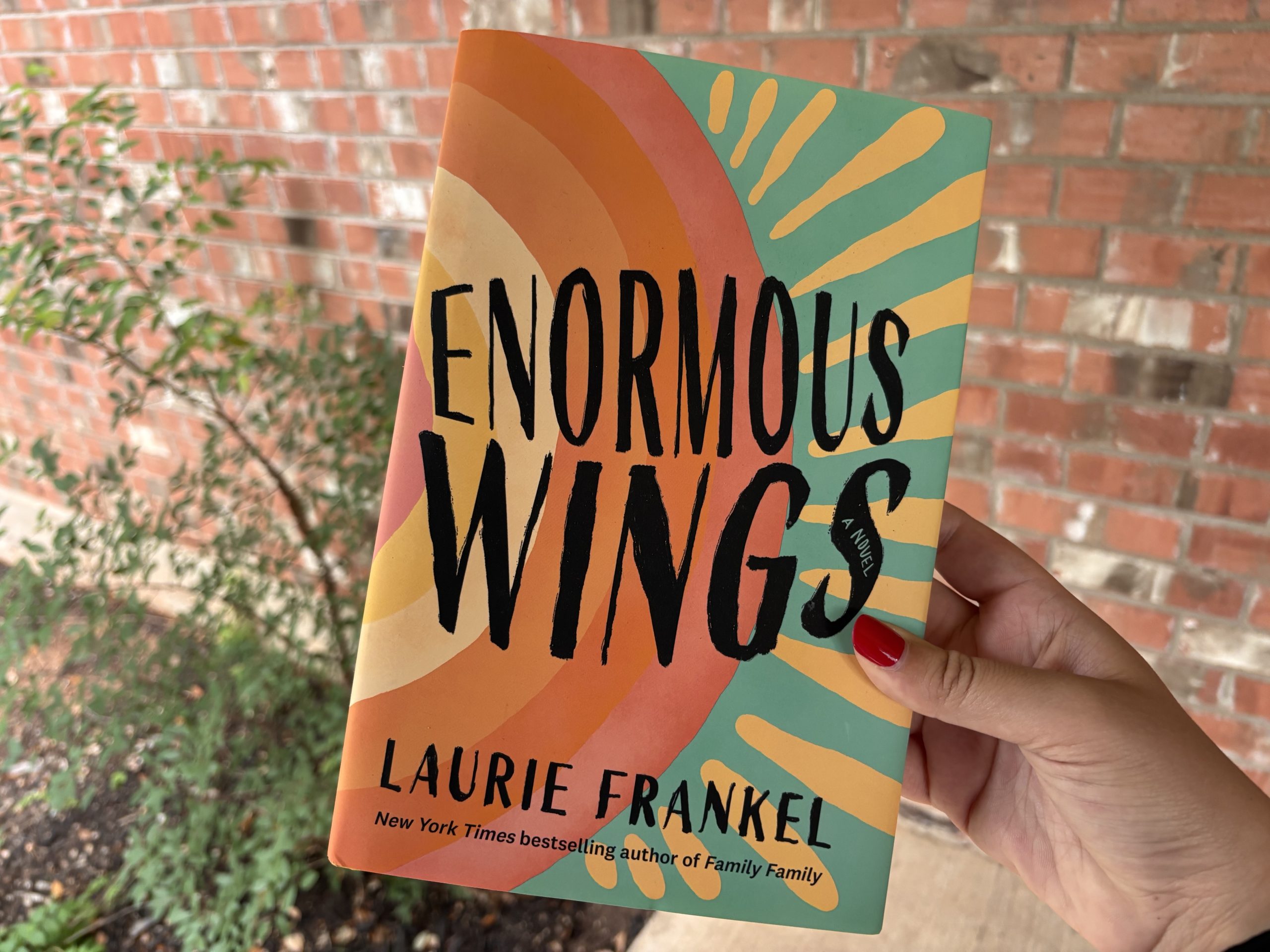
Pepper Mills did not choose to move to a retirement home in Austin at the age of 77. Her adult children made that call for her.
But once she moved in, things went well. She even fell in love.
Then the exhaustion, vomiting, and a slew of other symptoms began. She feared it was cancer or a stroke. But the truth was more shocking: She was pregnant.
This is the plot of Laurie Frankel’s new novel, “Enormous Wings.”
Frankel joined the Standard to talk about the book. Listen to the interview in the player above or read the transcript below.
This transcript has been edited lightly for clarity:
Texas Standard: This book certainly has an attention-grabbing premise. How did you come up with that idea?
Laurie Frankel: It really is something of a bananas idea.
When my grandmother got sick 25 years ago with what we later learned was lung cancer, at the beginning, it presented as sort of nausea and confusion and general muddledness and this feeling of everything being a little off. I was in my mid-20s at the time and she and I were joking together that maybe she was pregnant, which would have been much, much better news, frankly, than lung cancer.
At the time, I was not writing books and I think that seed planted and then took two and a half decades to come to fruition.
Without giving too much away, I’m curious if this is meant to be a realistic scenario or if this book steps into something like magical realism?
That’s exactly the central question, and it’s one that I myself struggled with for years while I was writing this book.
I went into it thinking something like magic realism. It’s one of the places that the title comes from — “Enormous Wings” comes from a short story called “A Very Old Man with Enormous Wings” by Gabrielle García Márquez. And I definitely went into it thinking, “I don’t have to explain this, there’s so much that we don’t understand (about pregnancy).”
But the more I wrote the book and the more I looked into it, the more possible it seemed. And the more found out that there are women even older than 77 who have successfully carried healthy pregnancies to term.
So I did a lot of research surrounding that, which was fascinating and therefore got included in the book. Not because I was seeking to explain — I think these kind of life-and-death questions are always a little bit beyond our comprehension — but because the science here really is interesting.
What made you decide to set the book in Texas? Was there a particular reason Austin felt like the right place for this story?
The first time I wrote this book, it was 2017, I wrote the whole thing. And then I put it in a drawer because I could not quite convince you that this character would do anything other than have an abortion in this situation.
And when I took it back out of the drawer in 2023, I reset it from Seattle, where I live, to Texas, where abortion had become illegal in the intervening six years.
It could have been any of the other 13 states where abortion has become illegal, but what I love about Texas is that it’s so diverse. It’s so big, it’s jubilant. There’s so much Texas, and I love that. It makes for really interesting conversations.
This diversity, not just demographic diversity, but a diversity of ideas and opinions and the way those things express themselves… Austin bought me all of that, so it was really the perfect place.
We don’t get a lot of fiction about older women. What was it like to inhabit the world of a retirement home and bring that to the reader?
So many of these ideas of what happens to us as we get older, as our bodies change yet again, as our agency and what kinds of decisions we get to make ourselves change yet again, all of that stuff was really interesting.
Retirement communities by themselves were super interesting to write about and, I imagine, live in because it’s this very closed-off community. On the page, it’s very much like a desert island mystery — like you put everybody in a room where they can’t get out and you lock the door and you walk away and then you see what happens.
That makes for really, really interesting dynamics, especially because the age range at a retirement community is so wide. We kind of like to think,”oh, they’re just old people.” But in fact, so many of these places are 55 and up, and that up is like 105. So that’s a 50-year age range.
And it is, I think, the only time in our lives that we are really living with and spending lots of really close time with people with such a wide range of ages.
There are a lot of relevant themes in this book — bodily autonomy and pregnancy, for one. Why did you feel like that story was worth telling right now?
It was the central metaphor, I guess, that really drew me to this.
I think that we certainly talk about pregnancy and motherhood and reproductive freedoms. These are conversations that we are having, but within pretty narrow parameters.
And what I liked about this idea was the opportunity to talk about some of those issues from a different lens than usual — not least because so many people’s minds are already made up about so many of these ideas, and that means that we can’t really have a conversation. But if we change the lens, if we change the approach, if we change the givens and the parameters that we go in with, then we get to have a conversation.
There’s the whole point of novels. Give me 250 pages and seven, eight hours of your time, and then we can look at all the stuff that we do agree on surrounding the stuff we don’t agree on, or all of the other issues that come alongside that we don’t get to talk about enough.