Students seeking higher education have some difficult choices to make. Often, these are financial: how to get the degree they’ll need without getting into unsustainable debt.
But the choices about if and where to go to college go far beyond that to issues of academic, extracurricular and cultural opportunity.
For more than 180 years, HBCUs have been one option in the U.S. The new PBS documentary “Opportunity, Access and Uplift: The Evolving Legacy of HBCUs” aims to bring Historically Black Colleges and Universities to the forefront of the conversation.
Brandis Griffith Friedman is an anchor at PBS Chicago and host of the project. Listen to her conversation with the Texas Standard via the audio player above or read the transcript below.
This transcript has been edited lightly for clarity:
Texas Standard: Why tell the story of HBCUs right now?
Brandis Griffith Friedman: You know, why not now, obviously. But also, we have these nationwide conversations about higher education, the cost of higher education, at the same time, the value of them, right? And I think for a lot of time, HBCUs have kind of been a well-kept secret.
A lot us know about them, but there are some students that we interview in the film who weren’t aware of the HBCU opportunities in their community until it was time to start looking at colleges.
It was different for me growing up in Mississippi. I come from a family of HBCU grads. As this film was coming out, I heard from my aunt that I’m fifth generation HBCU. I did not realize that going that far back in my family that many people had gone to an HBCU.
So I am fortunate, I’ve always been aware. But I think not everybody else has recognized the value and the importance of HBCUs in the higher ed conversation.
You may come from a community that is largely Black and attending an HBCU is like home for you – like that’s something that you are very familiar with. Or you come from a community where you are the like the literal numerical minority and it feels different to be in a community that’s largely Black. It can be both supportive but also a little bit, you know, kind of surprising and startling, educating.
You compare HBCUs to another acronym that you constantly kind of have to remind folks what this means – what’s a PWI?
Yes, a lot of people don’t know what that is because they don’t otherwise, right?
PWI is a predominantly white institution and you would not know that if you did not know that there are also predominantly not-white institutions that are HBCUs and minority-serving institutions, which we also call MSIs, which we don’t really get to in the film, but HBCU’s are also MSIs as are a number of Hispanic-serving institutions and tribal universities, colleges and universities as well.
» RELATED: Beyond demographics, UTEP aims to redefine what it means to be a Hispanic-Serving Institution
HBCUs serve, historically, Black students. And they are still a place where Black students thrive and a lot of them graduate and get their degrees. But they’re not exclusively for Black students and really haven’t been for a very, very long time.
Absolutely, yeah. And they’ve never been exclusively, although they’ve always been predominantly Black, right?
Like the whole reason for their foundation was because these universities were founded at a time when Blacks sought education in large numbers. But the schools that existed, which were white schools, of course, those schools were not accepting Black students.
And, even in the film, we introduce a white woman, a freedom rider during the ’60s, and because of her civil rights activism, she was kicked out of her PWI at the time. And Tougaloo College, which is my aunt’s alma mater in Mississippi and where she taught for many years later on, accepted her. And so she was the first white woman to enroll in an HBCU at that time.
Today, the enrollment of HBCUs nationwide is 25% non-Black. So a quarter of HBCU enrollment is not Black.
2020 was a turning point in history. This was the beginning of COVID but also the racial reckoning really sparked by the police killing of George Floyd. Can you talk about what we saw and what we have continued to see at HBCUs since that point?
Yeah, in the film, you hear UNCF president Dr. Michael Lomax, who was also the Dillard University president when I was a student there… But he uses the analogy, you now, “when America gets a cold, Black America gets the flu.” You know, whatever is happening, it’s just happening that much worse or cutting that much deeper for the Black community.
I think his point was, we’re wrestling with all of this and Blacks are dying in larger rates or being infected at larger rates of COVID at the time. And then on top of that, this racial reckoning rises up and really bubbling over a problem that Blacks had been familiar with and experiencing for years and years, and decades in fact.
A lot of students looked around at that and they thought, I want to go to some place that sees me and that supports me because it has become apparent that that is not going to be the case at just any university.
I think several years ago, maybe 10 or 15 years ago, enrollment for lots of universities started to slide across the country. But for Black universities, their enrollment has still seen a bit of growth.
And even, in fact, since the Supreme Court’s decision on affirmative action and basically saying that race cannot be a factor in enrollment decisions, I think we’ve even seen some numbers since then of Black enrollment at some of the elite and traditionally white universities has slipped and applications have certainly increased at HBCUs across the country.
Is there a crisis coming? You talk about the need that HBCUs fill and really the demand for them, but how their endowments really don’t match a lot of the big universities, the predominantly white institutions that we’ve talked about.
They don’t. And I hope it is not a crisis because, I mean, there have been PWIs to close in the last few years as well. I can’t count any HBCUs that have closed in the last five, six years.
I will say this. I think a lot of people have started to notice the importance and the impact of HBCUs and the money has started to flow their way.
Certainly, MacKenzie Scott, Dr. Lomax has called her “St. MacKenzie Scott,” for the massive transformational multimillion dollar donation that she has made to UNCF. UNCF’s goal is to stake a large endowment for all of the 101 [HBCUs] nationwide, but only I forget what number it is, maybe 50 or so that are UNCF-endowed schools.
And so there is work to grow those endowments collectively and individually. And MacKenzie Scott has given individually to many HBCUs as well.
And so I hope that that is to sort of meet the moment. These schools have always needed the investment, they’ve always been underfunded and underinvested in compared to PWIs, but also to meet the challenge that might be down the road as applications at HBCUs are increasing, that this money is there to support them.
» RELATED: Odessa College receives largest one-time donation ever, from MacKenzie Scott
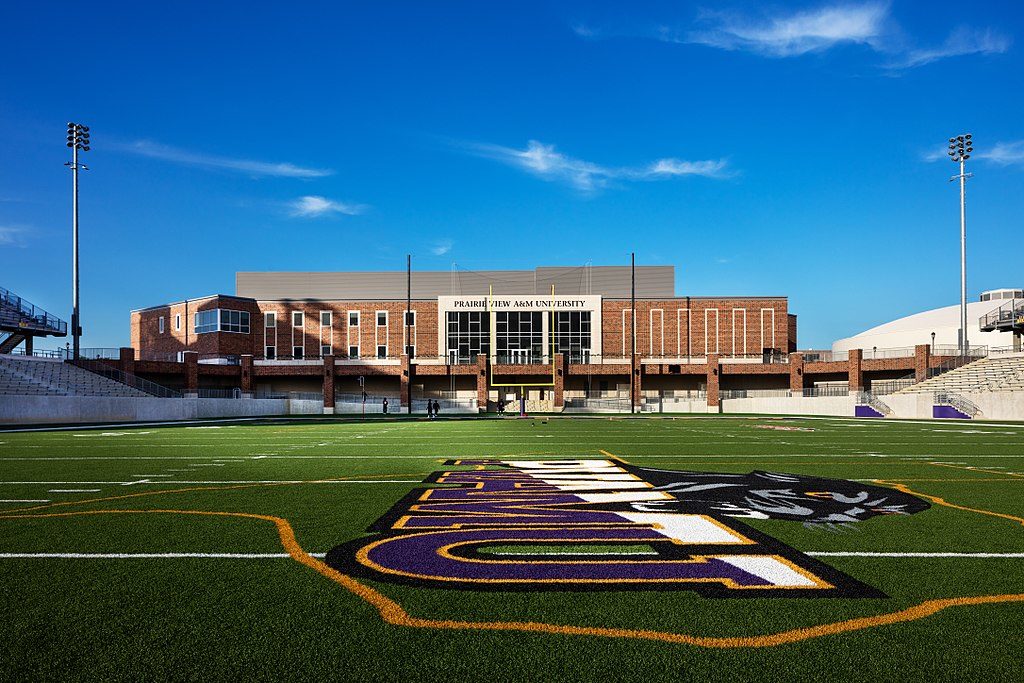
Prairie View A&M University. Maureen.allen/Wikimedia Commons (CC BY-SA 4.0)
We should mention 101 HBCUs, including nine here in Texas. It’s not that one is the same as all, right? I mean there are a lot of variety and opportunity out there among HBCUs as well. Is that important to highlight?
Absolutely, right, because you’ve got, you know, there are some HBCUs that are the big ones that they’re in the SWAC conference and they’ve got the football team and the marching band, and that comes with a very different culture. I think the students at Prairie View probably know what I’m talking about.
But then there are the schools like the one that I went to, smaller private HBCUs where you feel a little bit closer. A smaller school where you can get to know folks and the staff and your professors there a little better.
If you found the reporting above valuable, please consider making a donation to support it here. Your gift helps pay for everything you find on texasstandard.org and KUT.org. Thanks for donating today.