How Houston cultivated its grass for the FIFA World Cup — and how it’s being installed in NRG Stadium

Some of the most elite athletes in the world will run, slide, kick, flop, and stomp on the grass, which has been growing for more than a year in Colorado. Its growth, shipment, and installation, are a gardening endeavor of Herculean levels.

By Michael Adkison, Houston Public MediaMay 13, 2026 9:30 am,

From Houston Public Media:

On a farm near Denver, Colorado, thousands of square feet of grass have been cultivated for more than a year. It is no ordinary grass, though; countless hours of discussions have been devoted to ensuring it’s grown properly.

“It’s been a comprehensive effort, with all the cities involved working together over many meetings over multiple years at different universities to try to do all we can to deliver consistent surfaces across this tournament,” Dan Bergstrom, a certified sports field manager, said.

In the coming days, the grass, shipped in by refrigerated trucks from Colorado to Houston, will be installed as the pitch for the 2026 FIFA World Cup. Some of the world’s most elite athletes will run, slide, kick, flop, and stomp on the grass.

In order to host each of the 104 games throughout the entirety of the World Cup, each host city in North America is responsible for cultivating and installing the grass, called a pitch, for their stadiums. FIFA has “the highest expectations possible for these pitches,” according to Bergstrom.

“That’s because the athletes that will play on the surface are literally world-class, the best of the best,” he said in an interview with Houston Public Media. “And when you play any sport at that level — in this case, soccer — those elite world-class athletes expect the surface to play and behave in a certain way.”

The cultivation

As the official pitch consultant for the Houston host committee, Bergstrom, who is the director of turf and grounds for the Houston Dynamo and Dash Football Club, has been involved in Houston’s work in the World Cup since Houston made its initial bid to FIFA. His colleagues said he was a major part of the bid’s success.

“It was his system and his plan, with input from others, that convinced FIFA we could do this and ultimately be a host city,” John Coppins, vice president of operations for Houston’s World Cup host committee, said. “Dan gets a lot of credit for being good at his job, which is thinking about grass and growing grass and elite-level playing surfaces.”
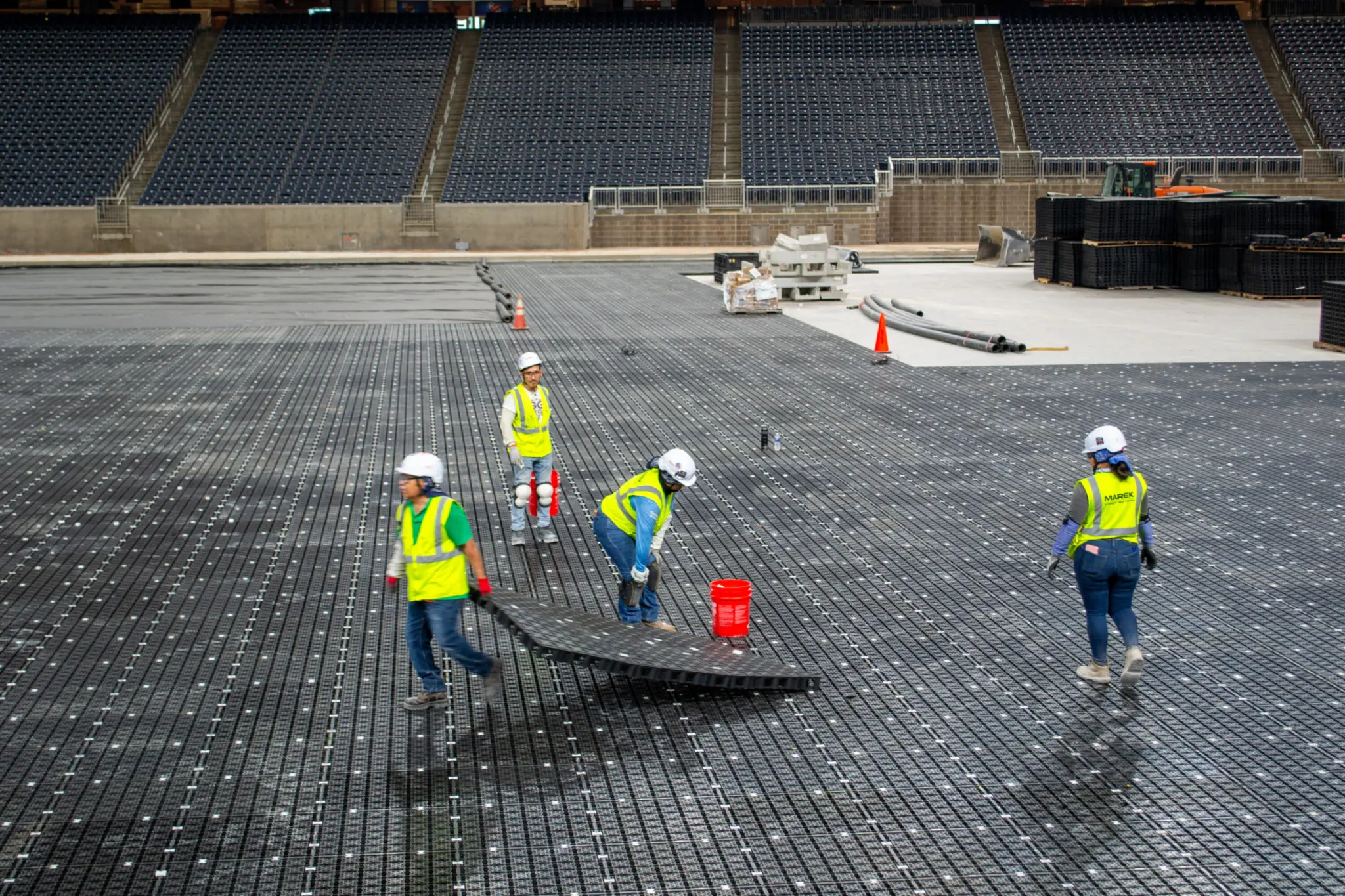
Kyle McClenagan / Houston Public Media

Workers at NRG Stadium install the first layers of the pitch ahead of the 2026 FIFA World Cup on May 8, 2026.

Under FIFA’s stadium design guidelines, much of intricacies of how the grass is grown and installed are handled on a case-by-case basis. But generally, every natural grass pitch must have a drainage system; areas for roots to extend and grow; and, of course, grass.

The grass began growing at the Colorado farm around 14 months ago. Though outdoors, the grass was grown in a controlled environment, with farmers managing the root zone and moisture for an engineered sod.

In landscaping terms, the grass is “sod on plastic,” where the root zone is laid over plastic sheets, where the grass is seeded in. The plastic sheets can then be rolled up and transported across the country. Dallas and Atlanta, as well as Houston, are also getting their grass from this same farm for the World Cup.

“That’s one of FIFA’s requirements, is to try to get as much consistency between the playing services as possible,” Bergstrom said.

The installation

When it’s time for the move from Denver, the grass will be rolled up in rolls that are more than three feet wide and up to 50 feet long, Bergstrom said.

“We’ll get 20 to 24 rolls on a truck,” Bergstrom said. “A refrigerated truck will bring it from Denver to Houston, and as soon as we can we’ll get those rolls unrolled onto the surface.”

It’s no simple landscaping project. Each roll of grass weighs between 1,800 and 2,000 pounds, according to Bergstrom, and a specialized sod-unrolling machine will unfurl each roll.

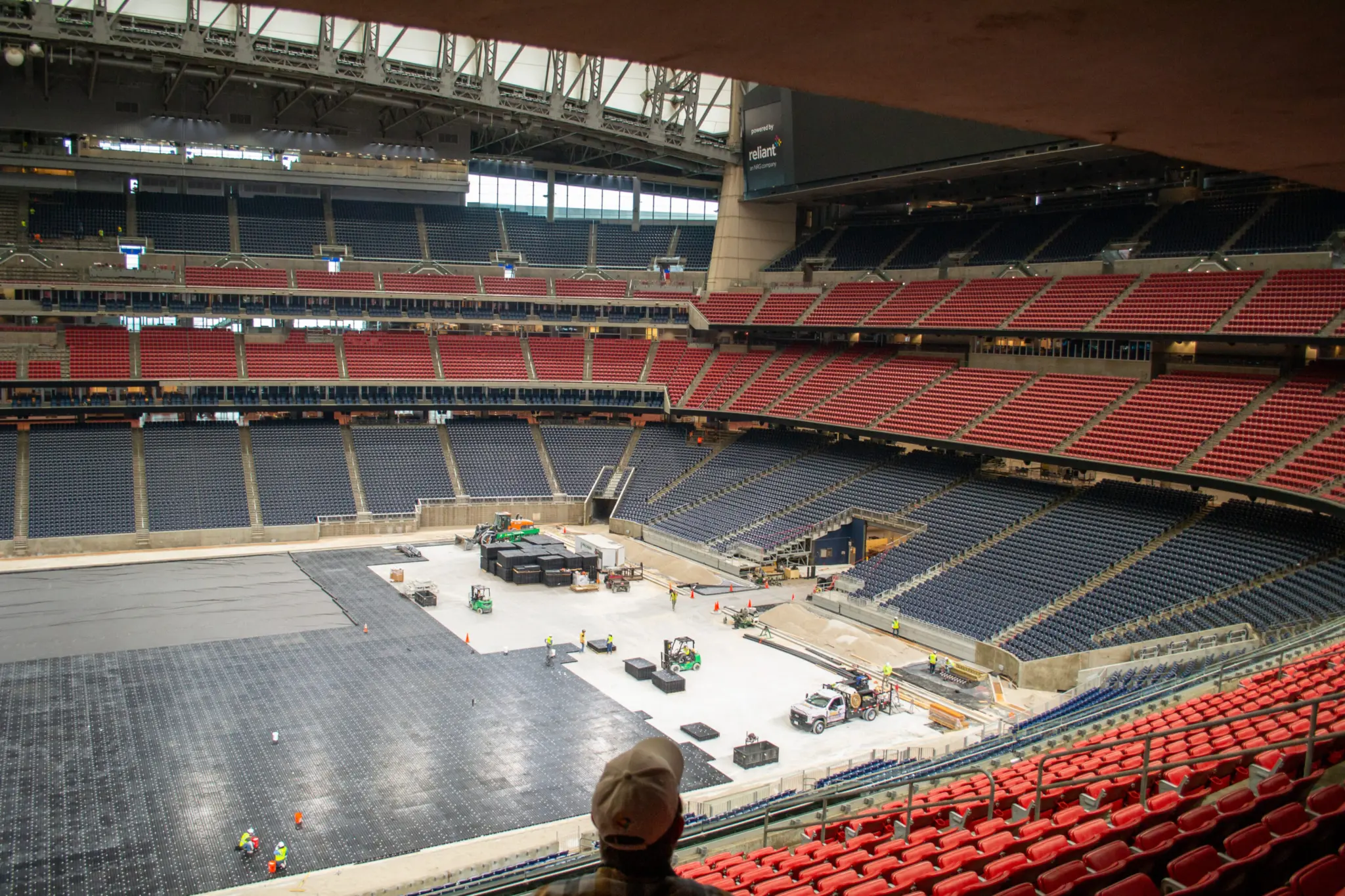
For the last decade, NRG Stadium, which will be called “Houston Stadium” for the duration of the tournament, has used artificial turf. Prior to that, the stadium, which launched in 2002, had used natural grass that was grown outside the building on trays, which were brought in and pieced together on the field.

Because NRG Stadium was built, originally, to use natural grass, Bergstrom said the process of installing a pitch will be somewhat easier in some respects. Still, he said, it’s also something of an Achilles’ heel.

“We’re going to keep the grass in there the whole time,” he said. “We’re never going to take it outside to get some sunlight and grow. We’re going to have to manage this indoors the full time, where the original intent of the stadium was to move the grass in and out as it needed for growth.”

The solution: grow lights, shipped to Houston from the Netherlands. Twelve large units, four smaller ones, and some fans will create artificial sunlight within NRG Stadium. Even that merited its own issue, Bergstrom said, in ensuring that the system could stay powered throughout the tournament.

Once the grass is installed, the host committee will bring in a stitching machine to stitch in polypropylene fibers, which give strength and durability to the pitch. There are different ways to measure the strength of the pitch, Bergstrom said: traditional ones, like measuring in Newton-meters of force, and non-traditional ones, like twisting a cleat onto the pitch.

“There’s a whole science behind it,” Bergstrom said. “But after the grass gets installed, we’ve got a crew of eight full-time people who are going to work on this field nonstop, from the day it’s installed until July 5, maybe a couple days beyond.”

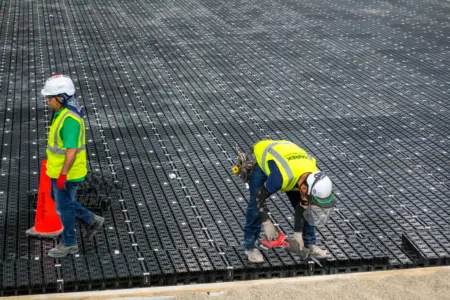
Kyle McClenagan / Houston Public Media

Workers at NRG Stadium install the first layers of the pitch ahead of the 2026 FIFA World Cup on May 8, 2026.

Greener pastures

Come July, the pitch will reach the end of its time in Texas.

Houston’s final match of the World Cup tournament will be a round-of-16 match on July 4. At that point, Bergstrom said, the grass will die.

“It’s a grass that likes cold overnights,” he said, “and that does not happen in Houston in July.”

“Its tour of duty is seven World Cup matches,” Coppins added with a smirk, “and like a good triple-crown racehorse, it’ll be sent out to pasture after the event.”

Though there likely isn’t a pasture for the pasture itself, the grass will be removed from NRG Stadium and die soon after. Years of hard work, both indoors in meetings and in the field cultivating the grass, will come to an end after seven matches in three weeks.

“We’re kind of running this event through NRG Stadium similar to any other event — a major concert, or a Disney on Ice-type production — where they come in, set the event up, and them move it right out,” Bergstrom said. “We’re trying to follow that same business model with this event with a natural grass surface that actually needs time to set up and be maintained properly. So, that’s the exciting part of this project, is doing it on this timeline.”

“‘Exciting’ is the right word,” Coppins added. “There’s probably a few other words — the challenging, stressful, anxiety-riddled part of the project. But I think it’s going to be, hopefully, a celebration on July 4.”

If you found the reporting above valuable, please consider making a donation to support it here. Your gift helps pay for everything you find on texasstandard.org and houstonpublicmedia.org. Thanks for donating today.