It was a sunny October day in 2022.
Off the coast of Louisiana, three friends head into the gulf for a day of fishing, hoping to catch some red snapper.
But some 15 miles offshore, the three men suddenly find themselves clinging to a cooler, surrounded by rough seas, giant jellyfish and circling sharks.
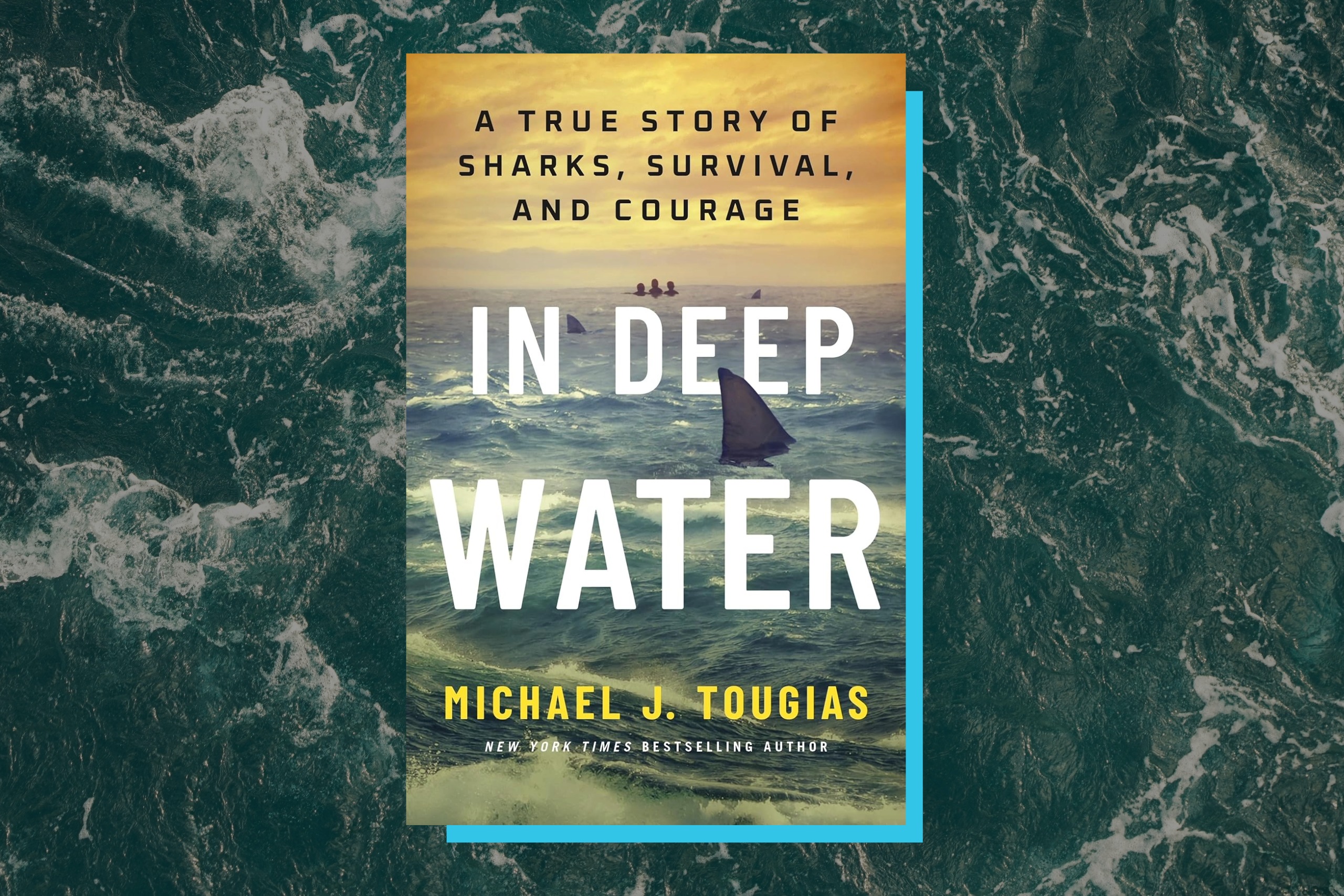
It’s a remarkable rescue story, and it’s the subject of “In Deep Water: A True Story of Sharks, Survival, and Courage,” the latest book by New York Times bestselling author Michael J. Tougias.
Tougias sat down with the Standard to discuss the book and the rescue of the fishermen. Listen to the interview in the player above or read the transcript below.
This transcript has been edited lightly for clarity:
Texas Standard: What’s got you so interested in this story and how did it come to your attention in the first place?
Michael J. Tougias: Well, I get pitched survival stories all the time, because this is my ninth book of survival at sea and rescues.
What I look for is a lot of surprises, a long-duration survival — this lasted 28 hours in the ocean — and tough decisions that need to be made. So, that’s what pulled me to “In Deep Water.”
What draws you to these sorts of stories? Is it just sort of the indomitable spirit, or something else?
It’s that, and also I asked myself: “Could I have made it?” When the answer is no, then I’m so curious: “Okay, how did they persevere and what kind of decisions did they have to make to get 100% correct.”
Those are the ones I tend to gravitate towards.
This happened remarkably fast, and I know a lot of people will be asking themselves that question: Could I have, would I have had the presence of mind? Their boats sank before they could even send a mayday.
You know, as you reconstructed what happened, how much did that surprise you about the circumstances of how they just found themselves floating there?
They had made a couple mistakes that I outlined in the book, but I’ve made the same mistakes myself because I’m always out on the ocean fishing.
When the boat went down, they only had time to grab life jackets and the cooler. From there, it was: “Okay, how do we get through this? Nobody knows where we are, nobody knows the boat went down, and nobody’s expecting us home at a certain time, other than this evening.”
So there’s no search going on when the boat sinks at about noon.
One of the promises that the three men made almost immediately was that they would stay together no matter what. That decision sort of ended up being critical.
It did, it really helped them get through the night when the sharks are moving closer and they’re being stung by jellyfish. But, surprisingly, there’s a break from that vow — and that affects the outcome in a surprising way.
We don’t want to give away too much, because this is one of those kinds of terrific reads for the summer, and it’s not just a survival story. It’s also, in a sense, a coast guard story — a lot to learn about how these rescue crews make decisions when they have so little to go on.
Absolutely. You had crews out of Corpus Christi, you had a boat skipper from Baytown, Texas. In the beginning, their odds of finding anybody alive were just one percent because the search area was as big as Rhode Island.
You mentioned that you’d written nine books on survival stories. As you look across these accounts, what seems to separate the people who make it home from those who don’t?
If I had to pick one trait, it’s take it hour by hour. Don’t think how long you’ve got to make it, because you’ll get overwhelmed.
So, they’re looking hour by hour. “What can I do to improve my situation?” Don’t worry about the things I cannot control, focus on the few that I can and then fight on for another hour.
Pretty soon they’ve strung together, in this case, 28 hours of treading water and fighting off sharks.
I found something rather fascinating about how, in a way, you sort of reconstruct a kind of internal narrative, the thoughts of these three. I’m wondering, how did you get to that? Had you talked with these men, or were you imagining this, or how did you arrive at that narrative?
The three men who were recreational fishermen were just fantastic to work with, so I did many interviews with them and they would actually give input on some of the sample chapters as well. So I was right inside their heads, because they were telling me their thoughts.
You mentioned that you like to spend time on the open water yourself. Did you think you learned something, and perhaps something that readers will be picking up if they themselves out on the water somewhere? Maybe something they should take to heart?
Absolutely. You know, one of the big mistakes they made, is they didn’t tell anybody where they were leaving from, where they were going, and when they were coming back.
And I do that all the time. I just forget. And boy, I am trying to follow that rule closely now.
Ultimately, when you think about these stories and the readers who are reading them, do you tend to think in terms of what can be learned as a kind of lesson? I’m just curious if you think of this more as the kind of reading for a summer day, or if you’re thinking more about the kind of person who is really intrigued by the sea and the stories of those first responders, that sort of thing.
I would say first and foremost, my mantra is making it fast-paced. I just don’t like books that are slow. I give up on them. So, I always make it as fast as I can.
And it’s not until the first draft is completed that I begin to see some of the techniques they used mentally to get through the ordeal and I go, boy, I could use some of those techniques when my luck turns bad.
I was thinking that probably there’s someone on Melrose or somewhere in L.A., thinking about how much of a wonderful movie this would be. Have you already heard from Hollywood?
Yes. I’m working with an Academy Award-winning producer, Lili Zanuck, and we did the screenplay and now she’s going to be talking to different studios. So, I’m in good hands and we’ll see where it goes.
I’ve had one movie called “The Finest Hours.” I got lucky once, maybe it’ll happen again.
I don’t suppose you want to consider the perilous waters of casting here. You see anybody in the lead role or anything?
No, I haven’t thought that far ahead. I did joke with the survivors, you know, “give me a role when it comes, let me play one of your fathers.”
You never know with Hollywood. You know, “The Finest Hours” was a little bit of luck, and we’ll probably get a little bit of luck on “In Deep Water” as well.