Wizzie Brown, a program specialist with the Texas A&M AgriLife Extension Service and our go-to insect expert, is helping answer questions from kids about bugs.
Is a spider an insect?
Spiders are not insects.
They are closely related to insects. Both are arthropods, and that means that they have certain characteristics. A main one is that they have an exoskeleton or their bones on the outside of their body.
Spiders are going be in the subphylum Chalicerata, whereas insects are going be in the subphylum Hexapoda. And there are different characteristics for each of those. When we’re looking at chelicerates, those have two body regions. So they have what’s called a prosoma and a opisthosoma. They also have chelicerae, which are types of mouth parts, and they do not have any antenna.
If we look at Chelicerata as a whole, that includes arachnids, horseshoe crabs, sea spiders. I don’t deal with horseshoe crabs, fortunately, because I would know nothing about them. What I deal with are going to be the arachnids, and those are going be a class. And then furthermore, spiders are in the order Araneae.
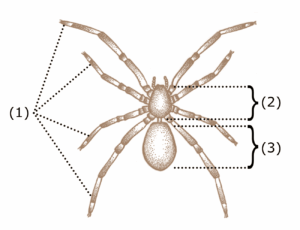
CDC Public Health Image Library (public domain).
For something to be a spider, they have a cephalothorax and an abdomen. They don’t have antennae. They have four pair of legs. And then they have chelicerae, which are again, they’re chelicery mouth parts. And those have fangs that they can use to inject venom.
If you’re looking at insects, they have three body regions. They have a head, thorax, and abdomen. They have pair of antennae, and they’re going to have three pair of legs, and usually two pair of wings.
So spiders are not insects, and they are going to have different body structures and makeup.
» RELATED: Is a bug the same thing as an insect?
Is a worm an insect?
Some insects have worm in their name, but they are not true worms.
So some examples of that are silkworms, inchworms, grub worms, glowworms. These are typically immature stages of moths or beetles or things like that.
The three categories or types of worms that are true worms are segmented worms, flatworms, and roundworms. And while they, along with insects, are all invertebrates, they are different.
Flatworms have soft, unsegmented bodies. They actually breathe through their skin. Examples of that are tapeworms or planarians.
Roundworms are tubular in shape and they have openings at each end of their body. So you have one end where food goes in and the other where the food goes out as waste.
And then the segmented worms, which is probably the most common kind, those are earthworms. Those have body segments and they may also have what are called parapodia that are going to help them move. So kind of false feet almost.
How about a centipede?
Centipedes are not insects either.
But centipedes are more closely related to insects than worms are. And that is because both insects and centipedes are arthropods. They both have exoskeletons, that hard outer skeleton. But centipedes fall into a group called Myriapoda.
Essentially, when you look at the body design of a centipede, they have a head with a trunk, so a long kind of worm-like body with lots of legs, whereas insects have three body regions.
Do you have a bug question for Wizzie Brown? Drop us a line, and we’ll pass it along.
If you found the reporting above valuable, please consider making a donation to support it here. Your gift helps pay for everything you find on texasstandard.org and KUT.org. Thanks for donating today.