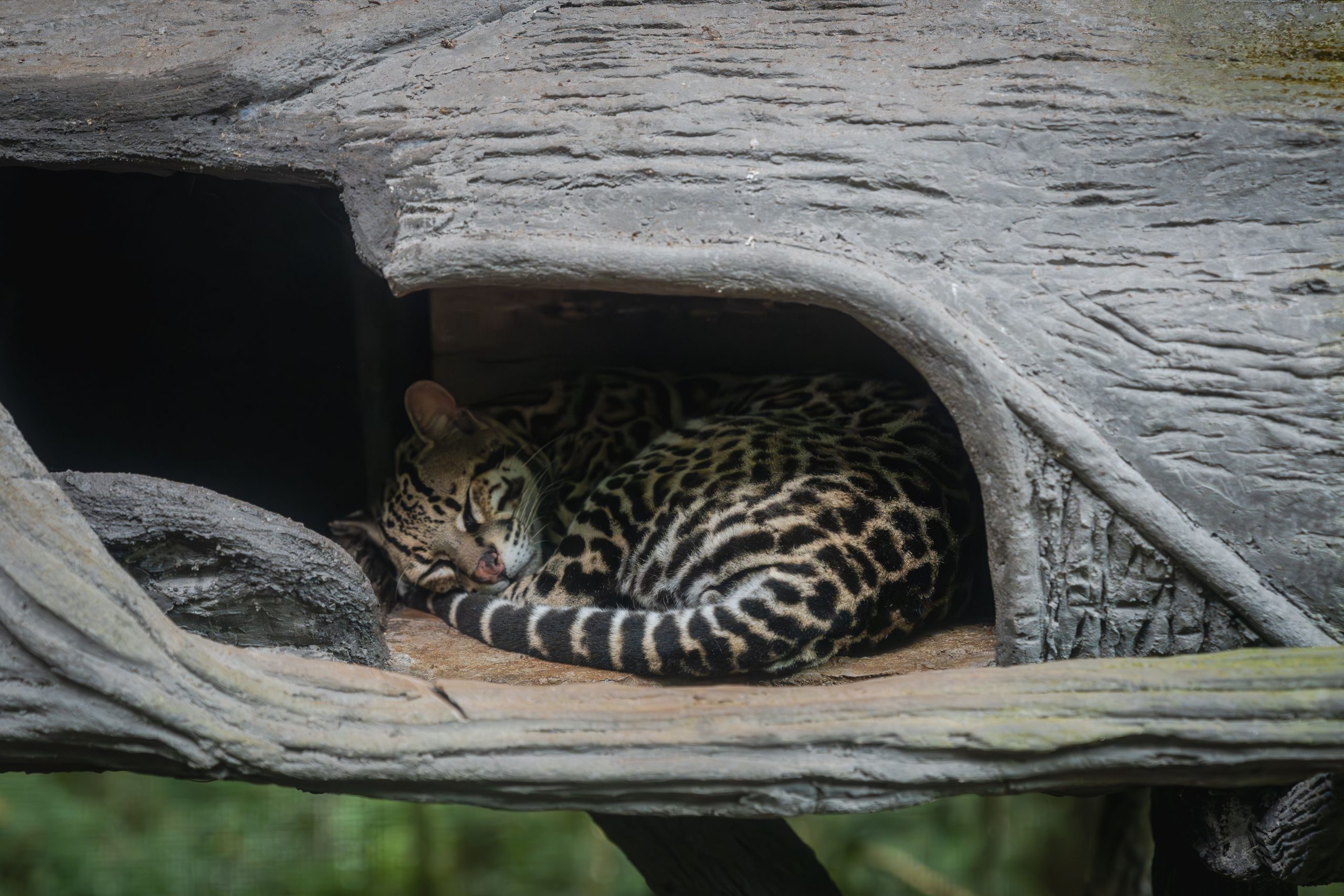
For a species famous for stage fright, these two ocelots crawled right into the spotlight.
In June, Tyler’s Caldwell Zoo announced the birth of two ocelots, yet-to-be-named kittens of Maya and Batata.
“This birth of our ocelot kittens is a huge milestone for conservation efforts in the wild,” Hayley Bragg told the Texas Standard.
Bragg is the Mammals Curator at the zoo. She said that with ocelots populations where they are, every kitten is an achievement.
Ocelots once had ranges from Louisiana, Arkansas and throughout Texas. As a native predator, they are essential to a healthy, stable ecosystem in these areas.
“They’re what you call an umbrella species,” said Bragg. “If you protect ocelots in their native habitat and native ranges, then you’re protecting the species that inhabit that land in doing so. Plants, other vegetation, other animals, insects — it all correlates together.”
They’re considered mesopredators — mid-level predators that play both the hunter and the prey. Ocelots are critical to managing the number of armadillos, raccoons, rats, and mice; their predation has cascading effects on the food web.
Ocelots have been recognized as federally endangered in the United States since 1982. Hunting, poisoning, habitat loss, vehicle collisions, and inbreeding led to an implosion in their population. Now, fewer than 100 cats can be found in the remote areas of southern Texas.
Bragg says a primary challenge in recovering species is how difficult they are to breed.
“It’s a challenge because they’re a very elusive, solitary species,” she said. “Environmental factors have to be perfect. It has to be quiet, no predators around, no unfamiliar scents around. Anything that can disturb them will hinder the breeding process and then also the delivery process.”
Because of how shy they can be around breeding, the team at Caldwell Zoo still don’t know the sexes of the kittens. They’ve left the new family alone: Watching Maya through monitors as she bonds with her litter. Bragg said they’ll wait until absolutely necessary to intervene, when they’ll give the kittens a post-natal check-up.
According to Recover Texas Ocelots, studies have found wild ocelot populations in the state have low genetic diversity and high rates of inbreeding compared to their U.S. zoo-based counterparts.
Bragg said that genetic diversity is a key element of recovery their breeding program seeks to address.
“We want to build the genetic diversity up to get the best species possible, and so these two cats are potentially going to go to other facilities,” said Bragg.
Those could include other [Association of Zoos and Aquariums] AZA-accredited zoos throughout the region that participate in the program.
The offspring of these kittens will likely end up in the East Foundation of South Texas. The foundation is a series of six ranches and land committed to ocelot conservation, with over 200,000 acres of sanctuary.
“They focus on bringing females in and having wild male genetics, as well as for breeding or even AI,” Bragg said.
That’s “artificial insemination” — not the other kind.
Bragg says at the foundation, ocelots will have the option to venture beyond the sanctuary land. If you encounter one, she cautions, just turn the other way.
The team at Caldwell Zoo are optimistic about the future of ocelots in Texas. Bragg said that these kittens represent hope for the species.
“We’re absolutely looking at re-establishing a wild, healthy population,” she said.