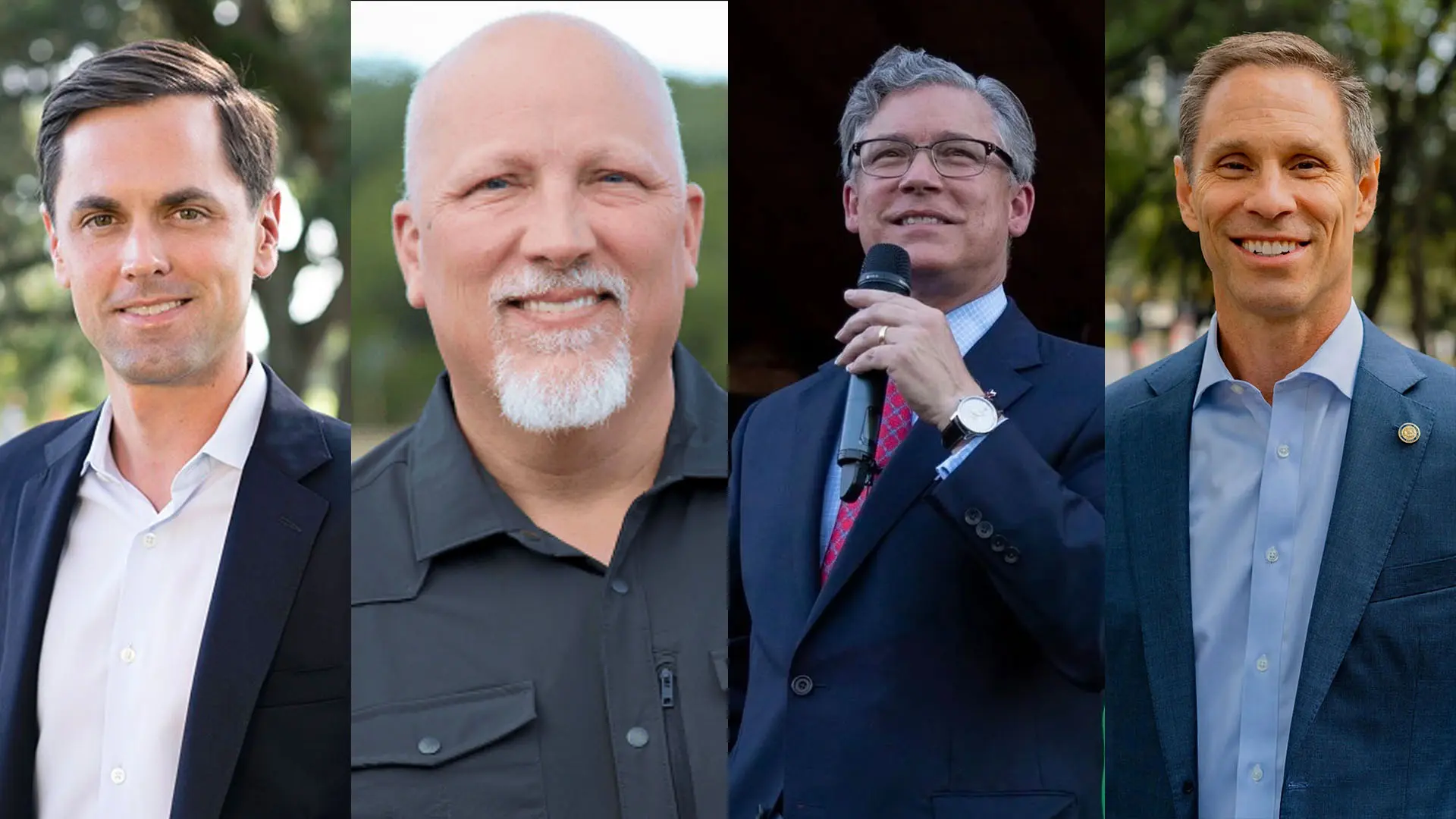
Early voting for the Texas primary runoff elections begins in less than two weeks, on May 18, and one of the most important decisions Republican and Democratic voters will make is their nominees for Texas attorney general.
The position is significant not only in its own right, as a force on both the state and national stages, but also as a potential springboard to higher office.
“I think for many years Texas, not unlike other states, was probably viewed as having an attorney general that was there to protect the state,” said Antonio Dias, practice leader of the State Attorney General Enforcement Investigation and Litigation Practice at the law firm Jones Day. “I mean that in a really classic sense, which was if there were threats to state from the federal government, or if there were regulatory issues with companies operating within the state, the attorney general was really there to make sure that he exercises powers of enforcement of the state laws, and if need be, protect against — particularly in Texas — against any aggressions by the federal government.”
However, Dias said the role of the state attorney general has changed over the past decade and a half, a period that overlapped the latter years of Abbott’s term as attorney general and the whole of Paxton’s tenure. In particular, the office has become a more aggressive advocate for the state’s interests at the federal level.
“I think Texas has … been known recently also for its efforts that relate to more partisan involvement and joining with other states,” Dias said.
In particular, Dias said Republican attorneys general have frequently banded together to sue Democratic presidential administrations, while Democratic attorneys general have done likewise to Republican administrations.
“I think that office in Texas, during the Democratic administrations in Washington, has probably one of the more active states in suing the president,” Dias said.
The Republican field
Republicans have won every election for Texas attorney general since 1998, and the last three to serve as attorney general all still hold some level of political office.
John Cornyn — who served as Texas Attorney General from 1999 to 2001 —is finishing up his fourth term as U.S. senator and is now being challenged in the Republican primary runoff for a fifth term by current Attorney General Ken Paxton. The man who served in between them, Greg Abbott, is running for a fourth term as Texas governor.
The two GOP candidates now in a showdown to succeed Paxton are Galveston state Sen. Mayes Middleton and Central Texas Congressman Chip Roy.
In late March, Republican candidates and voters converged on the city of Grapevine for the annual Conservative Political Action Conference (CPAC). Middleton was one of the featured speakers. He highlighted his legislative achievements — passing laws mandating the display of the Ten Commandments in public school classrooms, banning transgender individuals from women’s restrooms, and barring Chinese and other foreign nationals from buying land in Texas.
“For seven years, I’ve been writing these laws, drafting these laws, defending them on the House floor against attacks by Democrat attorneys, defending them on the Senate floor against attacks by Democrat attorneys,” Middleton said. “Who better to enforce these as attorney general than someone that was on the ground floor writing these and already defeating the left to get them over the finish line?”
Middleton was the first-place finisher in the March 3 Republican primary for attorney general. But he only garnered 39% of the vote, well short of what he needed to avoid a runoff. That came despite his spending more than $13 million, much of it from his personal fortune as an oil and gas magnate.
Roy came in second with just over 31% of the vote. Speaking recently with CBS Texas, Roy pointed to his greater experience as a prosecutor, including as first assistant attorney general under Ken Paxton.
“I think my opponent is trying to buy the brand MAGA,” Roy said. “Some of us have been out there earning that brand and earning the stripes as someone who’s been in court. And I think if you want someone you can count on, then you need to look at what they’ve done. You know, I’ve been in the trenches. I’m currently the lead author of the SAVE America Act, the number one priority for the president.”
Roy hit back at Middleton’s accusations, in his CPAC speech and elsewhere, claiming that Roy had called for President Trump’s impeachment. The congressman noted that he had voted no in both of Trump’s impeachments.
Each of the Republican candidates tried to stake out the lane of being the true conservative and brand their opponent as a RINO – “Republican in Name Only.” It’s a well-worn path to an office that has been in Republican hands for decades.
The latest wrinkle has been an emphasis on cracking down on the practice of Islamic religious law, known as Sharia, anywhere in the state, a mode of attack embraced by Abbott, Paxton, Cornyn, and numerous other Republican candidates.
“This is incompatible with our republic because they don’t think we deserve the right to exist as Americans or as Christians,” Middleton said in his CPAC speech. “This is not a First Amendment issue. This is about putting America first and putting Texas first, and I will be blunt. Sharia law is organized crime, period, and I will treat it as such.”
Roy made similar comments in his CBS interview when asked about whether Muslims had the same rights as other Texans to have public funding for their religious schools through the state’s recently enacted school voucher program.
“At its core, Islam is a political ideology,” Roy said. “And so, when you’ve got things being taught in schools that are counter to our rule of law, that undermine Western civilization, and that frankly are against our interest as Texas and America, again not like a freedom of speech issue that you have the right to say something, but you’re now taking taxpayer dollars to advance something to say that you’re going to advance Sharia law for example that is inconsistent with Texas law, the 14th Amendment to the Constitution, then the governor is right to say that Texas taxpayer dollars shouldn’t be going to fund that.”
Abbott and Texas Comptroller Kelly Hancock initially attempted to exclude several Islamic schools from receiving funding under the voucher program, alleging links to the Council on American-Islamic Relations (CAIR), which Abbott had designated a terrorist organization. Muslim families and schools sued, alleging religious discrimination, and a federal judge subsequently forced the state to extend the deadline for voucher applications.
Houston Public Media reached out to both Middleton’s and Roy’s campaigns repeatedly, but neither candidate agreed to an interview.
The Democratic contenders
The two Democrats vying to become attorney general both argue that successive Republicans have politicized the office, to the detriment of ordinary Texans. Former Galveston Mayor Joe Jaworski is making his second bid for attorney general, after losing the nomination four years ago. Jaworski said, if he’s elected, he’ll use the office to make life more affordable and expand voter access.
“Let me just contrast it with how it’s been used for the last decade plus, under Greg Abbott and Ken Paxton especially. It is an office of persecution. It is used as the Spanish Inquisition used the Church, to punish and stoke fear,” Jaworski said. “That will end if I’m elected and installed in the office.”
Since losing his bid for a second term as Galveston’s mayor in 2012, Jaworski has worked as an attorney and mediator.
“I am not like so many of these other people, under-purposed and hoping that the voters will elect them so they can have something to do,” Jaworski said. “I’ll put my skill set directly to use, as I do for paying clients now. I will continue being a full-time attorney and problem solver, which is really, I think, the question of what the attorney general should do, solve problems, because you are a constitutional executive with over 4,200 employees under your gaze that can help make life better in Texas.”
Jaworski, the grandson of Watergate special prosecutor Leon Jaworski, is sharply critical of his Democratic rival, Nathan Johnson, claiming the Dallas state senator has made too many compromises with Republicans as a lawmaker. Jaworski placed a distant second in the March Democratic primary, at about 26% to Johnson’s 48%.
For his part, Johnson pointed to a superior record of winning elections, including flipping a district that had been in Republican hands for 30 years and holding it for two terms.
“During my time in office,” Johnson said, “I’ve been able to both be a loud, proud, strong, persuasive voice for Democratic values, and also, from the position of a Democratic minority, pass important legislation by working, when necessary, against Republicans, also working, forming coalitions with Republicans and Democrats.”
Johnson said, if elected, his priorities would be enforcing anti-monopoly and consumer protection laws and fighting corruption. He also indicated he would not shy away from challenging President Trump in the same way Abbott and Paxton went after Presidents Obama and Biden.
“While we need a cooperative relationship with the federal government to be able to get things done, we also need a courageous relationship with the federal government to assert independence where state independence is important,” Johnson said. “For example, when the federal government decides to cancel $700 million in public education funding, our attorney general should have sued the Trump administration.”
Election Day for the 2026 Texas primary runoffs is May 26.