The Texas Standard is excited to share the Beachchombing Report from Jace Tunnell, Director of Community Engagement for the Harte Research Institute at Texas A&M University-Corpus Christi. The series can also be found on YouTube, Facebook and Instagram.
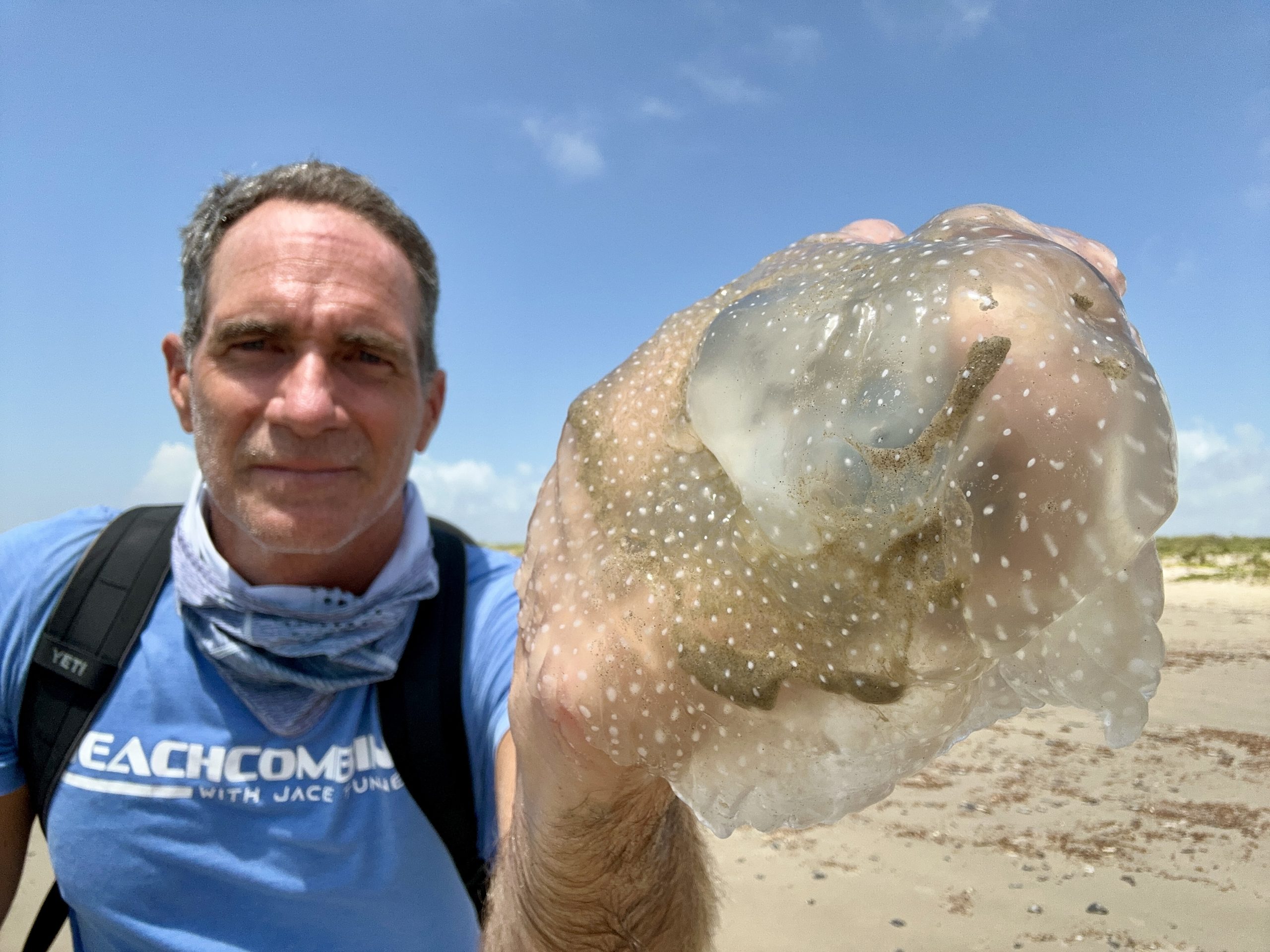
One of the highlights from this week’s beachcombing survey was finding about a dozen Australian white-spotted jellyfish scattered along the shoreline. They were impossible to miss, with some appearing crystal clear, others a rich brown, and a few glowing brilliant blue in the sunlight. Each one looked a little different, making every discovery feel unique.
The most striking feature is the top of the bell, which is covered with countless tiny white spots that resemble a star-filled night sky. Turn one over, however, and you’ll find something completely different.
Instead of long trailing tentacles, the underside is filled with thick, frilly oral arms that resemble a bouquet of cauliflower. These oral arms are used to capture tiny plankton and other microscopic food drifting through the water.
Australian white-spotted jellyfish are native to the western Pacific and were first documented in the Gulf in the early 2000s, likely arriving in ballast water released from cargo ships. Since then, they have become a seasonal visitor to Texas waters during the warmer months.
Unlike many jellyfish that beachgoers avoid, Australian white-spotted jellyfish are harmless to people and don’t deliver the painful stings associated with Portuguese man o’ war or sea nettles.
They’re one of the few jellyfish I don’t mind carefully handling. If I find one that’s still alive and stranded near the water’s edge, I gently return it to the surf, giving it another chance to drift with the currents.
This isn’t the first time we’ve seen an influx of these beautiful visitors. Last summer, large numbers washed ashore along the Texas coast, creating one of the more memorable jellyfish strandings I’ve encountered. Their return this year was a welcome surprise.
If you’d like to learn more, I created a Beachcombing video on YouTube during last summer’s stranding that explores their biology, where they came from, and why they occasionally appear in such impressive numbers along the Texas coast: