Maternal healthcare ‘deserts’ leave thousands of Texas women to their own devices

Cash-strapped rural hospitals in East Texas and beyond are closing their labor-and-delivery units.

By Sandy West, Public Health WatchJune 24, 2026 10:31 am,

From Public Health Watch:

HEMPHILL, Texas — Sarah Gipson knew something was wrong when the normally chatty sonogram technician fell silent and called for the doctor.

Gipson was in the 32nd week of her high-risk pregnancy, and she felt horrible. She was seeing stars, had constant ringing in her ears, and had been on bed rest for several weeks.

Still, she wasn’t alarmed.

“It wasn’t anything abnormal for me to feel terrible,” she said.

That Halloween Day in 2024, however, was different. The doctor told her she’d lost all amniotic fluid — that the baby was “dry” and had to be delivered immediately, both for the baby’s sake and for her own.

But Gipson, who was expecting her first child, was all alone at the doctor’s office in Nacogdoches that day; she’d made the hour-long drive by herself from her home in Hemphill in Sabine County. Her mother arrived just in time for the surgery.

“My child could have died,” Gipson said. ”I could have died. Other people could have lost their children in childbirth. Something could happen on the way, because they’re flying 90-to-nothing trying to get there. … Human life, the loss of a human life, is one of those things that you should care about.”

Gipson is one of thousands of women across Texas living in a maternal healthcare “desert,” with limited access to care during pregnancy, according to an analysis by Public Health Watch of data published in a May 2024 report by the Texas Organization of Rural and Community Hospitals (TORCH).
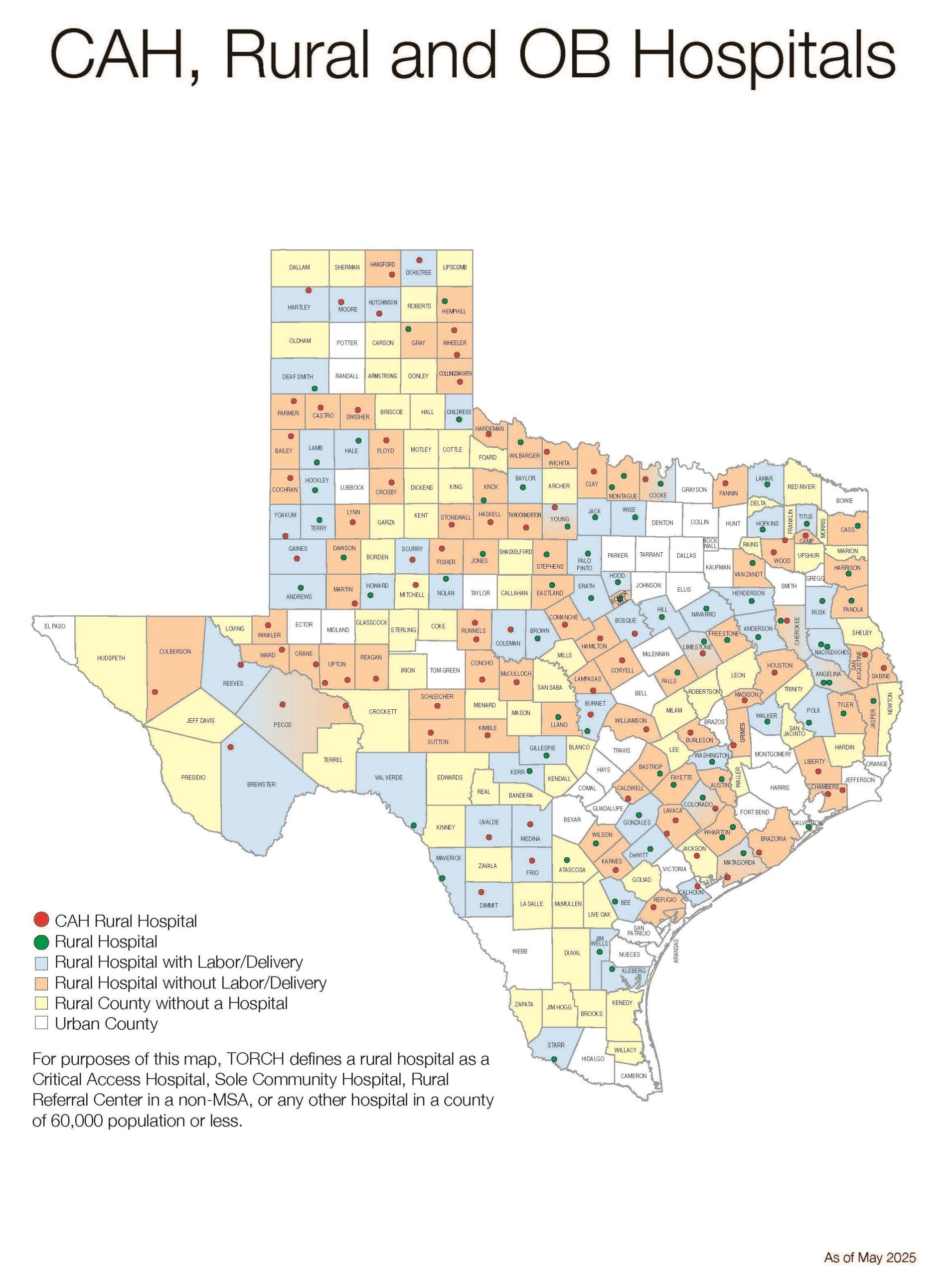
The Texas Organization of Rural and Community Hospitals (TORCH) gathered county-by-county data from across Texas on the availability of hospitals and labor-and-delivery units in rural counties. The analysis was released in a May 2024 report. Credit: Courtesy of Texas Organization of Rural and Community Hospitals

Of the more than 200 rural counties in Texas, about 70 percent have no hospital at all or have hospitals that don’t have facilities for delivering babies.

Maternal access is even worse in East Texas, where more than 80 percent of the nearly 60 counties stretching from Oklahoma to the Gulf Coast are considered rural. More than 72 percent of those counties lack hospitals or labor-and-delivery units.

The cash-strapped rural hospitals can’t make enough money from private insurance or Medicaid to cover the costs of providing maternal care, according to John Henderson, TORCH chief executive officer.

“The pure economics of it are just problematic,” he said.

In the last five years, more than 100 rural hospitals nationwide have stopped delivering babies, leaving fewer than half of rural hospitals across the country with labor-and-delivery services, according to a report from the Center for Healthcare Quality and Payment Reform released in January.

Others are at risk of closing their doors altogether. About one-third of the 2,256 rural hospitals across the United States are at risk of closure, with nearly half of those at immediate risk, according to the report.

In Texas, more than half of rural hospitals are at risk of closure, with about 15 percent at immediate risk. About 20 percent of the state’s labor-and-delivery units are also facing possible closure.

The result is that rural Texas women often face financial and emotional stress — and sometimes dangerous complications during pregnancy — that they might have avoided if they’d had better access to maternal healthcare, according to more than a dozen women, healthcare workers, advocates and industry officials who spoke to Public Health Watch about their experiences.

Sabine County is among the counties without a labor-and-delivery unit, though discussions are underway to expand services at Sabine County Hospital in Hemphill, which closed its delivery unit in 2000.

A new physician is stepping in as a family medicine doctor with special training and will work  with hospital administrator Kaylee McDaniel to find ways to better serve women in the community, perhaps initially by offering access to check-ups and monitoring.

“Rural Texans matter, too,” McDaniel said.

Road warriors

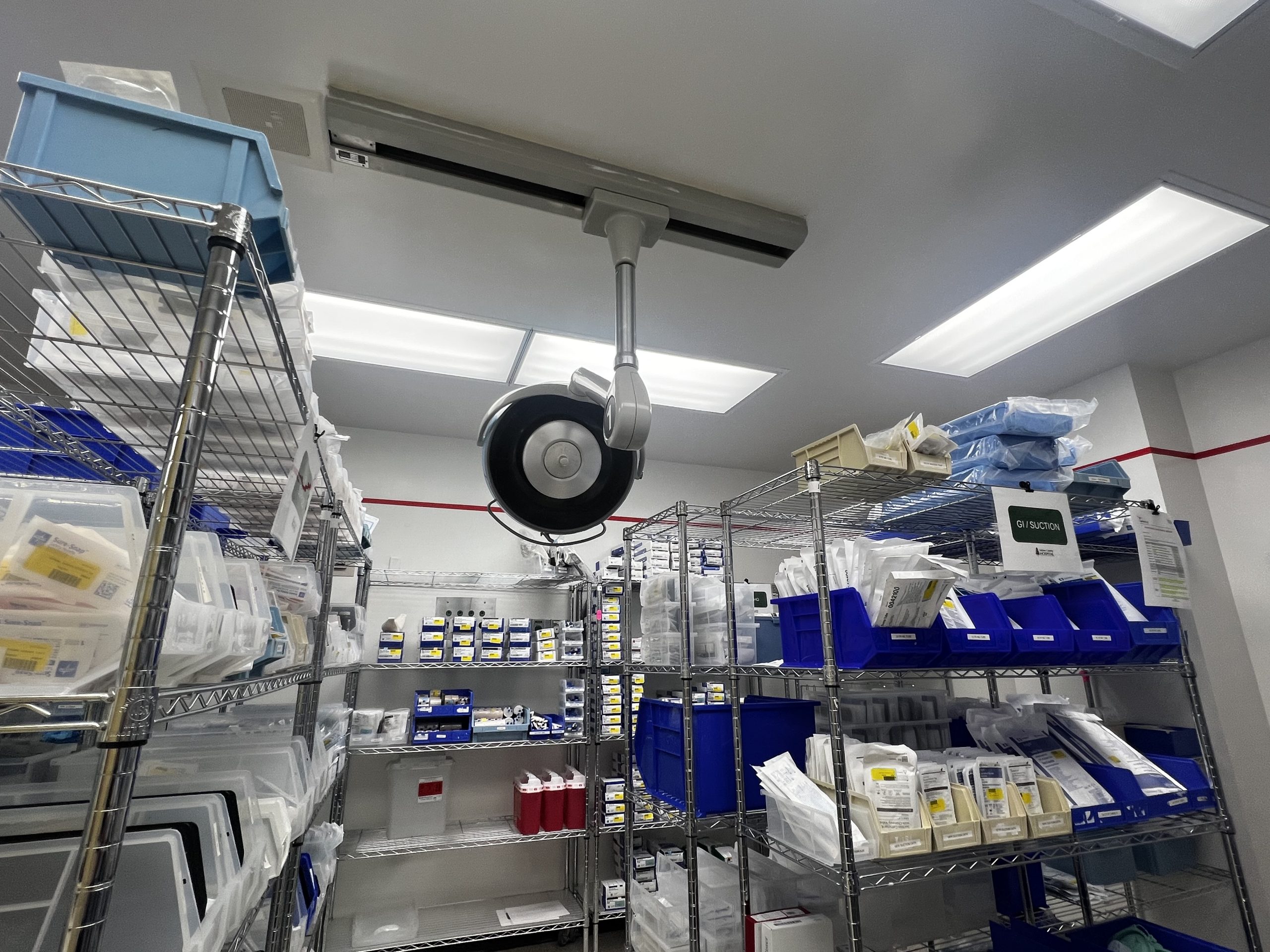
An enormous surgical light still hangs from the ceiling of what used to be the labor-and-delivery room at Sabine County Hospital, an enduring reminder of state-of-the-art services that women in the county once received.

The room is now used for storage, with just one rack of obstetrics supplies pushed against a wall amid a collection of other shelves and boxes. The medical equipment is too old to be used for deliveries.
Sandy West for Public Health Watch

The surgical light from the long-shuttered labor and delivery suite at Sabine County Hospital in Hemphill, Texas still hangs in a room now used for storage. The labor and delivery services were shut down in 2000, after the hospital lost its anesthesia coverage and one of its two doctors left.

When the hospital opened in 1980, there were two doctors offering women’s health care and delivering babies. By 2000, one had retired, and the hospital had lost its anesthesia coverage, forcing closure of the labor-and-delivery suite, according to McDaniel.

For years afterward, the nearest facility offering labor and delivery was about 30 minutes away in Jasper County. But that unit closed in 2019.

Now, women in Sabine County must drive an hour or more to Nacogdoches, Lufkin or Beaumont for maternal care, labor and delivery, post-partum and pediatric care.

“We are 70-ish miles from definitive care,” said Deb Harkins, administrator of Emergency Medical Services for Sabine County, noting that reliable transportation is a huge issue for a number of the county’s residents.

For Gipson, the lack of services near her home meant making twice-a-week trips to Nacogdoches — 120-miles round trip — for sonograms and stress tests at her obstetrician’s office. She was considered high-risk because of persistent high blood pressure that causes a condition known as preeclampsia, which can be life-threatening for the mother and baby.

Photo courtesy of Sarah Gipson

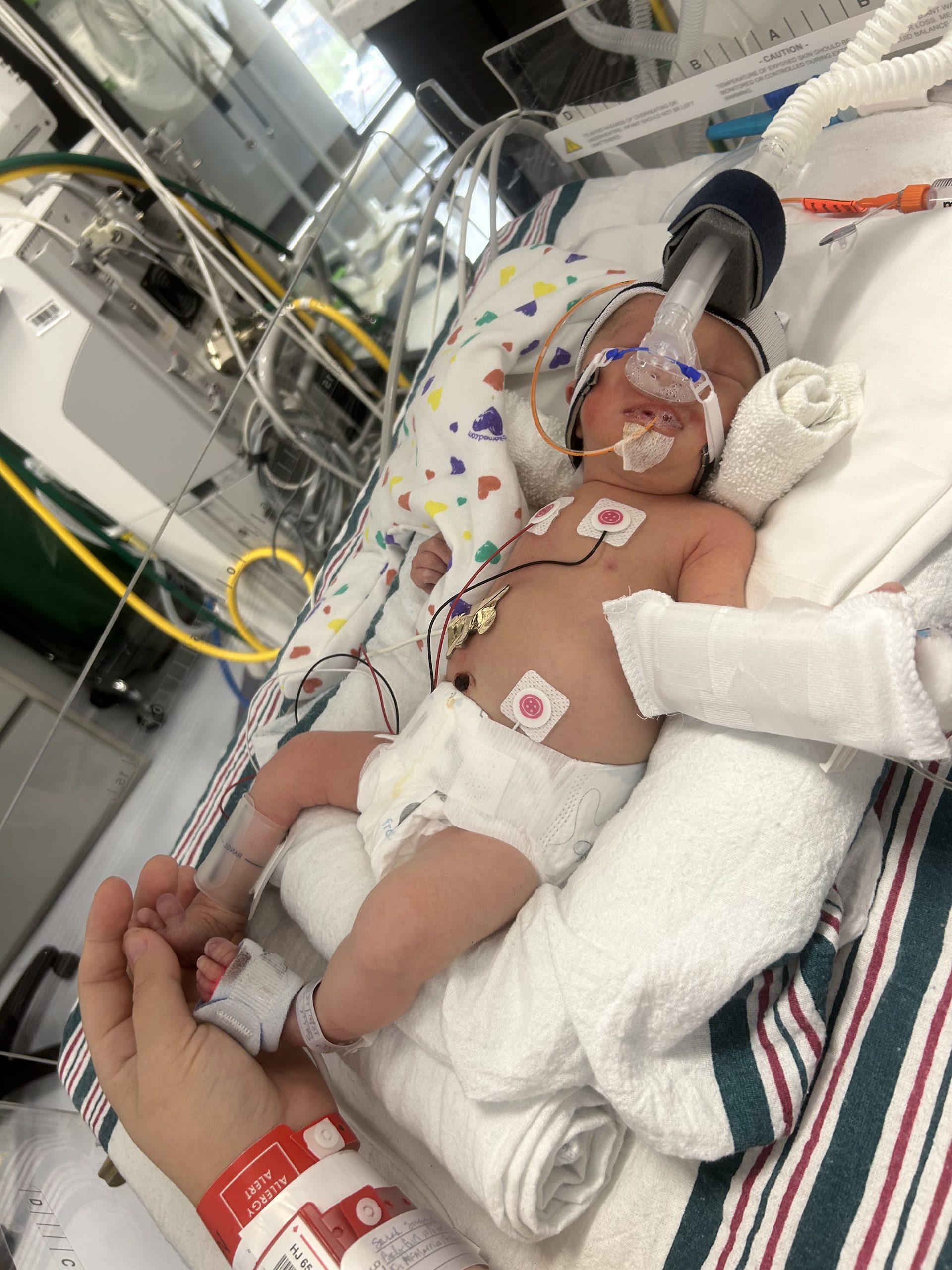
Sarah Gipson’s daughter Whitlee spent 27 days in the neonatal intensive care unit at a Nacogdoches hospital in East Texas after her mother suffered complications during pregnancy.

Gipson had expected her office visit that day in October 2024 to be routine. She was scheduled to get the second dose of a two-dose steroid shot to help her baby’s lungs develop before an expected premature birth.

The sonogram, however, changed everything. After an emergency C-section, Gipson could hear, but not see, the nurses doing chest compressions on her baby girl. Gipson’s blood pressure remained high and she was hospitalized for about a week.

Her mother assured her everything would be all right, and it mostly was. After a 27-day stay in the neonatal intensive care unit in Nacogdoches, Whitlee has grown into a nearly two-year-old  “spitfire,” Gipson said.

She wonders, however, if something could have been caught earlier — or her overall stress level would have been lower — if medical resources had been available closer to home.

Other women shared similar stories with Public Health Watch. They believe rural Texans have as much right as anyone else to robust maternal healthcare.

“Just because it’s a small town, and doesn’t have a lot of people like Austin, doesn’t mean that these people in this community don’t matter,” said Haley Rhodes, a Hemphill resident who delivered both her children — one by emergency C-section — about 60 miles away in Lufkin, in Angelina County.

“We still deserve good health care, and for it to be accessible to us and not hours away.”

Deep in the Pineywoods

About 10,000 people live in Sabine County, a heavily forested area of Deep East Texas criss-crossed by narrow country roads and two-lane state highways.

The Sabine River runs along the eastern edge of the county, separating it from Louisiana, with the Toledo Bend Reservoir at the southeastern corner. The Sabine National Forest consumes about a third of the county.

Photo by Sandy West for Public Health Watch

Kaylee McDaniel, a native of Sabine County and chief administrator at the Sabine County Hospital in Hemphill, Texas, wants to expand maternal services for women in the rural East Texas county.

People are scattered throughout the county’s 491 square miles. Longtime County Judge Daryl Melton points out that there are no traffic signals in the entire county – only a few flashing red lights.

The community takes enormous pride in its response to the 2003 explosion of the Space Shuttle Columbia. Residents leapt into action, joining and hosting thousands of searchers who came to Sabine County to recover the bodies of shuttle crewmembers as well as debris scattered over more than 2,000 square miles. The Patricia Huffman Smith NASA Museum “Remembering Columbia” records their efforts and the lives lost.

Most of Sabine County Hospital’s patients have Medicare and Medicare Advantage, or Medicaid, according to McDaniel.

Photo by Sandy West for Public Health Watch

Sabine County Hospital opened in 1980 to serve the rural East Texas county that sits on the border with Louisiana. In 2000, the hospital closed its labor and delivery unit.

Sabine County Hospital is a federally designated Critical Access Hospital, which means it is eligible for programs designed to address financial challenges and improve access to healthcare in rural communities. Both the hospital and the county’s Emergency Medical Services are owned by the Sabine County Hospital District.

As a Level IV Trauma Center, the hospital provides lab services, wound and trauma care, cardiac care, CT scans and radiology, outpatient nursing services, physical therapy and geriatric mental health, and has 25 in-patient/swing beds. The hospital operates two clinics, and is part of a network of telehealth providers that allows board-certified emergency and critical care providers to interact with patient and hospital staff when needed. Plans are underway to offer endoscopy care next year.

But expanding services to pregnant women in the community has proven more difficult, said McDaniel, the hospital’s administrator, who is also a nurse.

Photo by Sandy West for Public Health Watch

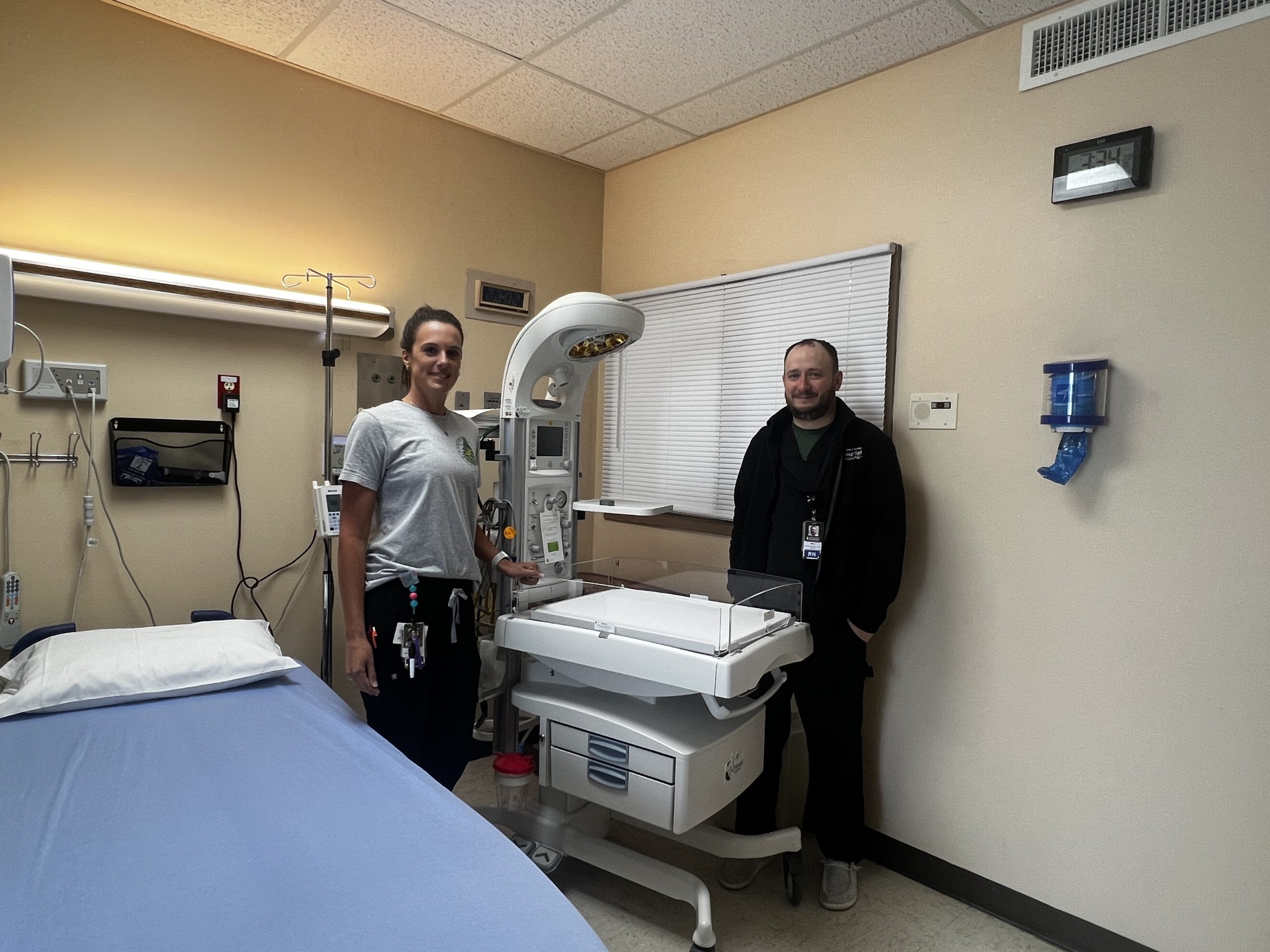
Brian Corley, chief nursing officer at Sabine County Hospital in Hemphill, Texas, stands with registered nurse Susan Gass with a new baby warmer purchased with a grant for the rural hospital.

State records show about 100 births annually attributed to women from Sabine County. Grant funds recently enabled the county’s hospital to purchase a baby warmer and an obstetrics stretcher.

The hospital has also applied for a Texas Rural Health Innovation Grant through the state’s Health and Human Services Commission in hopes of bringing back the county’s prenatal and post-partum care to the hospital and its clinics.

If the grant comes through, McDaniel said, women in and around Sabine County would no longer be forced to drive for basic maternal health care, which would especially help women of limited means.

“If they can’t afford it, they just don’t get maternal health care,” she said.

Still, McDaniel said it is unrealistic to believe the hospital could reconstitute full-spectrum maternal healthcare, with a fully functional labor-and-delivery unit, until funding models for rural health care change.

Costs go far beyond having a doctor on staff. They also include structural upgrades to facilities, and additional staffing with an anesthesiologist and support personnel. Just the medications needed would be costly, McDaniel said.

But she is determined to find ways to provide a level of care that encourages healthier pregnancies for women in the community.

“I want the hospital in Sabine County to be the resource that they need and the resource that they deserve,” McDaniel said. “They deserve care they could get anywhere else.”

To do that, she’ll be working with Dr. Spencer Ince, a family physician and Sabine County native who will join the hospital’s staff in September on a full-time basis. Ince will complete his residency in June with Texas A&M Medical School in a specialized rural health program.

Pregnant women do sometimes still seek care at the hospital. If they arrive in active labor but are not fully dilated, or if they arrive in pre-term labor, they are transferred in coordination with their obstetricians to larger hospitals with labor-and-delivery units. A woman who arrives too late to be transferred creates extra pressure for the hospital staff members, who don’t handle those cases regularly, McDaniel said.

Women in the region, however, are not being well-served, said Brian Corley, the hospital’s chief nursing officer, who noted that there are no obstetricians or labor-and-delivery services in nearby San Augustine, Newton, Jasper or Shelby counties. Some providers are available over the border in Louisiana.

“It’s hard for people in rural East Texas, and our surrounding area, to get OB care,” Corley said.

The county’s EMS operates two fully staffed ambulances that handle about 150 calls per month, including transporting patients. While it is not ideal to deliver a baby in a moving ambulance, and it is not a common occurrence for paramedics in Sabine County, they have done it before and will almost certainly be called on to do it again, said Harkins, the county’s EMS administrator.

Footing the bill

Some help may be on the way to rural hospitals, though cuts to Medicaid and the reduction in Affordable Care Act subsidies has left many Texans without health insurance.

Henderson, with TORCH, said Texas has made some improvements in recent years, including passage by the Legislature of some components of the 2025 Rural Texas Maternal Health Rescue Plan, a collaborative report drafted by a coalition of organizations, including the Texas A&M Rural and Community Health Institute, TORCH, the Texas Academy of Family Physicians and the Texas Health Institute.

The plan was designed to educate state legislators about the crisis in rural maternal health care and recommend ways to improve reimbursement rates for providers, modernize and expand technology in rural hospitals, encourage and retain appropriate medical staff, and expand and simplify Medicaid coverage.

In recent  sessions, Texas lawmakers approved enhanced Medicaid funding and created the Office of Rural Hospital Finance to help shore up hospitals at risk of closure, Henderson said.

In an emailed statement to Public Health Watch, state Rep. Joanne Shofner, R-Nacogdoches, said it will take time to see the full impacts of rural health care measures passed by the legislature in recent sessions. A law that went into effect in September will make it easier for physicians who are veterans and for foreign-trained physicians to obtain licenses to practice medicine in Texas.

Shofner, whose legislative district includes Sabine County, said locally based programs “are often the best providers of support for expectant mothers.”

She said she intends to refile legislation in the 2027 session designed to support doulas who provide help and guidance for Medicaid recipients before, during and after childbirth. She also plans to ask for re-establishment of the public health subcommittee to address maternal healthcare in rural Texas.

At the federal level, Congress in 2025 passed the Rural Transformation Fund, part of a five-year plan to address financial challenges in rural hospitals under the Trump administration’s so-called “Big Beautiful Bill.”

It is expected to help stabilize rural hospitals in the short term, but may not be enough to offset Medicaid cuts that were also included in the bill, Henderson said.

Jacquelyn Alvarado, program manager for the Maternal Fetal Focus Program at the Texas A&M Rural and Community Health Institute, started a program to help train rural emergency room staff how to handle obstetrical emergencies. Women often seek help at the closest medical facility because they worry about making a long drive.

“We know these women are dropping in because they can’t make it,” Alvarado said.

Alvarado is also launching an initiative targeting maternal healthcare deserts to help family practitioners and staff at critical access hospitals provide basic pregnancy care such as checking vital signs and fetal heart tones.

“It’s not a perfect model, but we’re doing what we can to fill that gap,” she said. “Because if there’s not a person in that community, that county, that will see them, this is better than no prenatal care and them dropping in unexpectedly.”

Despite recent efforts, however, the situation remains perilous for pregnant women living in rural communities, advocates and medical providers say.

“The reality in the United States is that we have not decided, as a culture, as a society, that healthcare is a priority,” said Dr. Adrian Billings, a professor and chair of rural health at Texas Tech University Health Sciences Center Permian Basin and longtime family physician in West Texas. 

The emphasis on making a profit across all industries — including healthcare — has resulted in under-investment in health, education and safety net programs, Billings said, “especially in our rural communities, which are disproportionately impacted.” 

‘We were terrified’

For now, pregnant women in rural Texas are largely left to their own devices.

Haley Rhodes, who lives in Sabine County, knew she’d find no obstetrics care in Hemphill when she moved back four years ago, but wasn’t overly concerned.

Then in her mid-20s, she didn’t think much about potential complications when she and her husband began planning a family. She worried more that she might have to give birth on the hour-long drive to the hospital in Lufkin, where she planned to deliver.

Sandy West for Public Health Watch

The back roads that wind through East Texas can slow down women trying to reach maternal healthcare services or the closest hospital. Here, Whittlesey Drive in Hemphill, Texas, is less than a football field from Sabine County Hospital.

But after two harrowing deliveries — the first in 2023 and the most recent just a few months ago  — she serves as a cautionary tale.

During her first pregnancy, everything seemed fine after her 32-week check-up in Lufkin. But within about 30 minutes of returning home from her doctor’s visit, she began “gushing” blood, she said.

Concerned that she would have to be transferred to another hospital if they first went to the Sabine County Hospital, she and her husband jumped in their car and drove — fast — back to Lufkin.

She didn’t know it at the time, but she was experiencing a placental abruption, a potentially life-threatening condition in which the placenta pulls away from the uterine wall. It can cause uncontrolled bleeding and shock, and can also lead to oxygen and nutrient deprivation for the fetus.

Rhodes had an emergency C-section, and her newborn son stayed in the neonatal intensive care unit in Lufkin for 25 days. The doctor told her husband he was lucky his wife and child were alive. Her son later had gastrointestinal surgery in Houston, but has fully recovered.

The couple’s decision to have another baby was difficult, and involved additional pre-pregnancy testing and conversations about how to get proper care.

“We were terrified,” Rhodes said, adding that heightened fears during her second pregnancy led to three different trips to the Lufkin hospital, sometimes in the overnight hours.

“There were times the anxiety was, literally, crippling to me because I knew just how far we were from the hospital,” she said.

In her third trimester, she made weekly, and then twice-weekly trips, in anticipation of a premature birth. When she went into labor, she and her husband bolted out of town.

After being pulled over by a law enforcement officer who Rhodes said seemed unsympathetic to her rapid-fire contractions, they made it to Lufkin, where her daughter was born by C-section in mid-April. Rhodes had made it to 37 weeks and five days. 

Looking ahead

Dr. Spencer Ince, who is returning home to practice at Sabine County Hospital knows first hand how important maternal healthcare can be.

He and his wife now live in Bryan, in Central Texas, and are planning for their move to Sabine County. His wife recently gave birth to their third child.

While Ince is realistic about the economic barriers to reinstating a full-blown obstetrics unit at Sabine County Hospital, he believes it is feasible — and necessary  — to find ways to offer prenatal and post-partum care and monitoring for pregnant women, in collaboration with obstetricians.

“I think it supports the rest of the hospital, because if [families] leave for prenatal care, they’re going to leave for pediatrics visits,” he said. “If they leave for pediatrics visits, they can leave for adult care visits. And when they leave for adult care, they might move away to be closer to that care. So, I think it starts with prenatal care.”

He said he is looking forward to moving back to Hemphill and practicing the range of healthcare people there deserve.

“It’s the embodiment of investment into the community and its people,” he said.

But uneasiness remains. Ince has been working weekends at the Hemphill hospital, in advance of his planned move in September, and his wife would often travel with him on those trips. In April,  however, he and his wife decided she shouldn’t go along.  

She was eight months pregnant at the time. She worried that something might happen, he said, and they’d be too far from appropriate obstetrics care. Ince went to Hemphill alone.