It’s known as The Dallas Way, a set of strategies and tactics that allowed LGBTQ people to preserve and expand their rights in a city known as conservative.
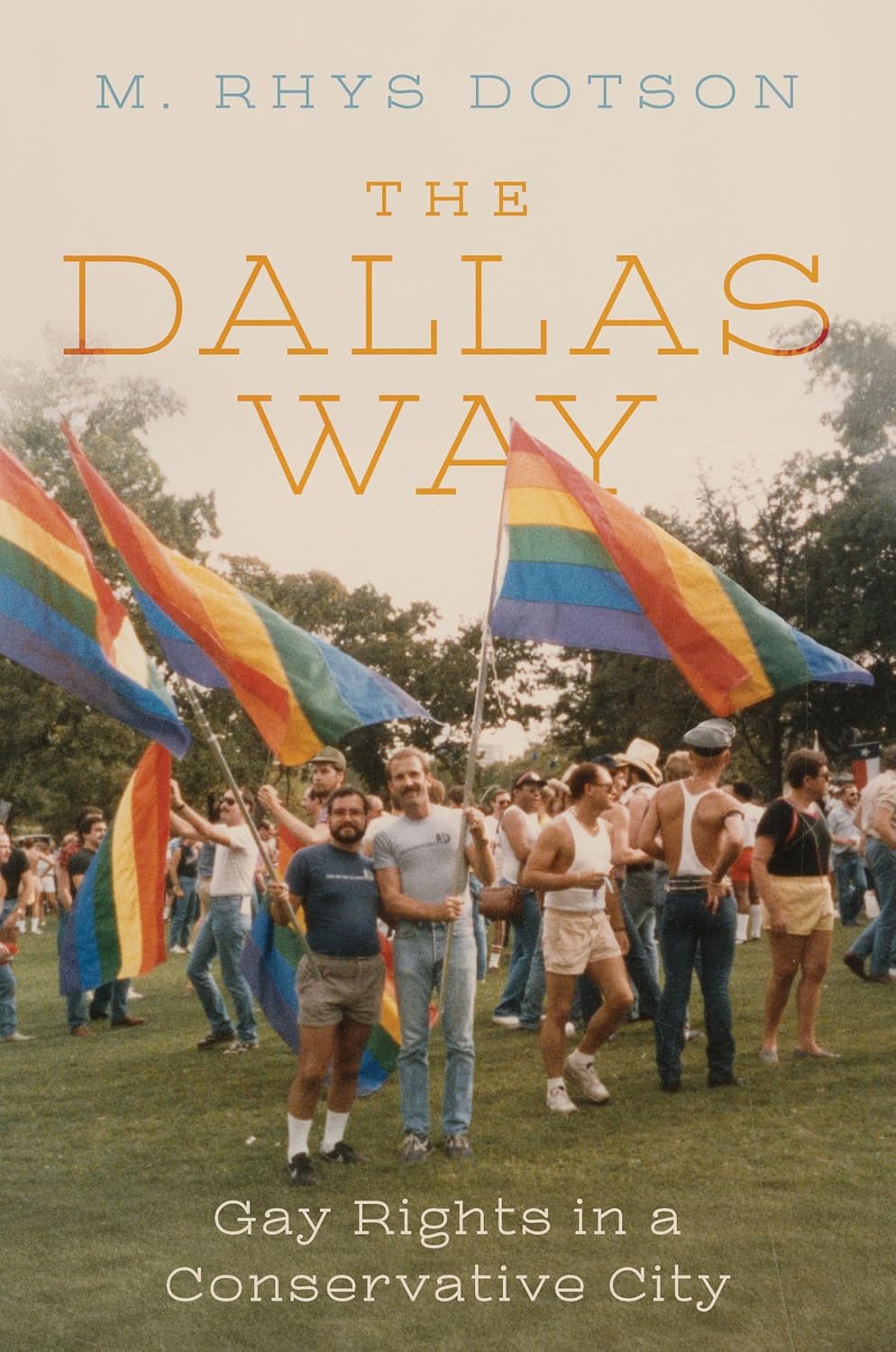
It’s also the title of a new book, “The Dallas Way: Gay Rights in a Conservative City” by M. Rhys Dotson, associate professor in the Department of History at the University of Texas at Tyler.
Dotson joined Texas Standard to discuss the book. Listen to the interview in the player above or read the transcript below.
This transcript has been edited lightly for clarity:
 Texas Standard: These days, Dallas, like other large cities in Texas, leans more to the left than the state as a whole, but you identify it as conservative. I’d like to start there because I think it’s key to understanding your thesis.
Where does Dallas’s essential conservatism come from and how is it unique?
M. Rhys Dotson: Well, I think that overall, Dallas, in the past, it was pretty conservative. Especially if you look back at the history of Dallas in the late 19th century, you see that it’s very business-oriented.
And then as I was writing my book and trying to figure out the feel of the city, I did a lot of research. Some of that research centered on the religiosity of those folks who lived there in Dallas in the mid-20th century, and I discovered that Dallas is one of the most highly attended regions of the country where people are members of a congregation.
So I think that there is a element of maybe social conservatism, not necessarily political conservatism, that was built into Dallas based on the level of people attending churches — mostly Protestant churches, but there are people of other faiths as well.
Your book tracks LGBTQ history in Dallas to the mid-20th century, and it includes the intentional ways gay people created a community and advocated for their civil rights. Explain that strategic choice a little bit and what you, and others, call “the Dallas Way.”
Well, I think that what we really see is that gay people or LGBT people are members of faith, just like non-gay people.
Now, before the Stonewall Rebellion in 1969, we do see that there is movement, especially by a gentleman named Phil Johnson, to try to organize a gay community. And of course, in this time period across the country, not just in Dallas, it was not uncommon for police departments to raid known locations where gay folks would hang out.
And so Phil Johnson decided to organize with local ministers in Dallas to hold their meetings. Their group was called the Circle of Friends, and they held their meetings within church property. It shows, again, that level of religious faith that people had in Dallas at the time, because they outwardly expressed, the Circle Of Friends, that they wanted to hold their meetings on church property for two reasons:
One, Johnson wanted a place for homosexual men, predominantly, to meet outside of the bar scene. But two, he believed, and I think very correctly, that by organizing a meeting on church property, that that was a place in which local police officers would never think about to raid a gay organization and try to capture or expose homosexuality.
AIDS became a major focus for Dallas activists in the ’80s, as it was across the country. Talk about how the Dallas Way influenced the community’s response to AIDS.
Well, so the Dallas Way, which is actually not something that the gay community came up with — it’s been a longtime approach from members of the Dallas community since, again, back to the late 19th century… Essentially that approach were businessmen who were kind of making decisions for the community and for themselves as well — like what would benefit them, but also benefit the community.
We’ve seen different organizations kind of co-opt that phrase, “the Dallas Way,” right? In the gay community, in the late ’70s and early ’80s, Bill Nelson, one of the presidents of the Dallas Gay Political Caucus — or later it was the Dallas Gay Alliance — when he was president, famously said, “when we go to city hall, we put on a shirt and tie.”
I think that speaks to that politics of respectability, right? Like we belong here, we’re like you. But when it comes to the AIDS crisis, we start to see that, yes, they are trying to be respectable. I guess they put on a shirt and tie, but also when they hold a parade, they go get a permit. When they’re going to protest something, they get a permit.
But with the AIDS crisis, and especially as so many members of the leadership organizations there in Dallas are getting sick and dying… And of course, I always have to remind people that AIDS is before HIPAA, so essentially your medical information is not secure and private.
And so being gay was already a tough road to walk. But then being gay and having AIDS was even harder. And without any kind of anti-discrimination ordinances, we see that you can get fired from your job. You can lose your medical insurance. You could lose your life insurance. You could be kicked out of a house if you were renting.
So the Dallas community bands together and they continue to push for more support from the state government, from the federal government, in addressing this crisis.
A couple of organizations open up food pantries. There’s an organization called People with AIDS who look into and try to buy apartment complexes so that people with AIDS who have the disease and have lost housing have a place to go.
So they’re supporting themselves essentially in the Dallas Way, but they’re also pushing and putting pressure on local government.
Now you acknowledge that this book features mostly gay men, many of whom were white and relatively affluent. Why do we know so little about activism from gay women and people of color in Dallas?
Right, so I think a lot of that has to do with the archival material that we have access to at this point.
Phil Johnson, as I mentioned earlier, considered himself to be the Dallas gay historian. And so he kept a lot of documents and those documents were donated to the resource center there in Dallas, which were later donated to UNT’s archival material, which is predominantly where I got most of my stuff.
There are some women who were active in the Dallas Gay Political Caucus — Vivienne Armstrong and Louise Young specifically. They donated their papers to the resource center and then later ended up at UNT.
But I think that one, it’s a limitation in the archives. But we know that these other folks did exist in Dallas. Unfortunately, for the archival material, most of the stuff that has been archived is stuff that was created by, as you mentioned, prominent white men. And I think that that speaks to a couple of things:
One, as I mentioned earlier, there aren’t any anti-discrimination ordinances. So typically, the people who are who are going to be able to be — quote, unquote — “out” in public, they’re going to be the folks who are going to have more financial stability. And unfortunately, in this time, that tends to be men and it tends to be white men.
The other reason is that we see, or that I know, that there are people of color in Dallas who obviously are a part of this community. In the Dallas Gay Alliance, they created or attempted to create sub organizations. And one that sticks out to me immediately is like a Hispanic caucus.
But the problem is that the Dallas Gay Alliance wanted to kind of micromanage these folks. The Hispanic caucus specifically did not appreciate being micromanaged and they only existed for a very short time. And those individuals ended up like separating from the Dallas Gay Alliance.
And I’ve yet to find where their archival material is at. I would love to find that because I think that would give us even a more full and rich understanding of Dallas’s gay community during this time period.