This week in Texas music history: Love Street Light Circus opens

Houston turns on the Love Street Light Circus Feelgood Machine.

By Jason Mellard & Alan Schaefer, The Center for Texas Music History at Texas State UniversityJune 1, 2026 10:25 am, , ,

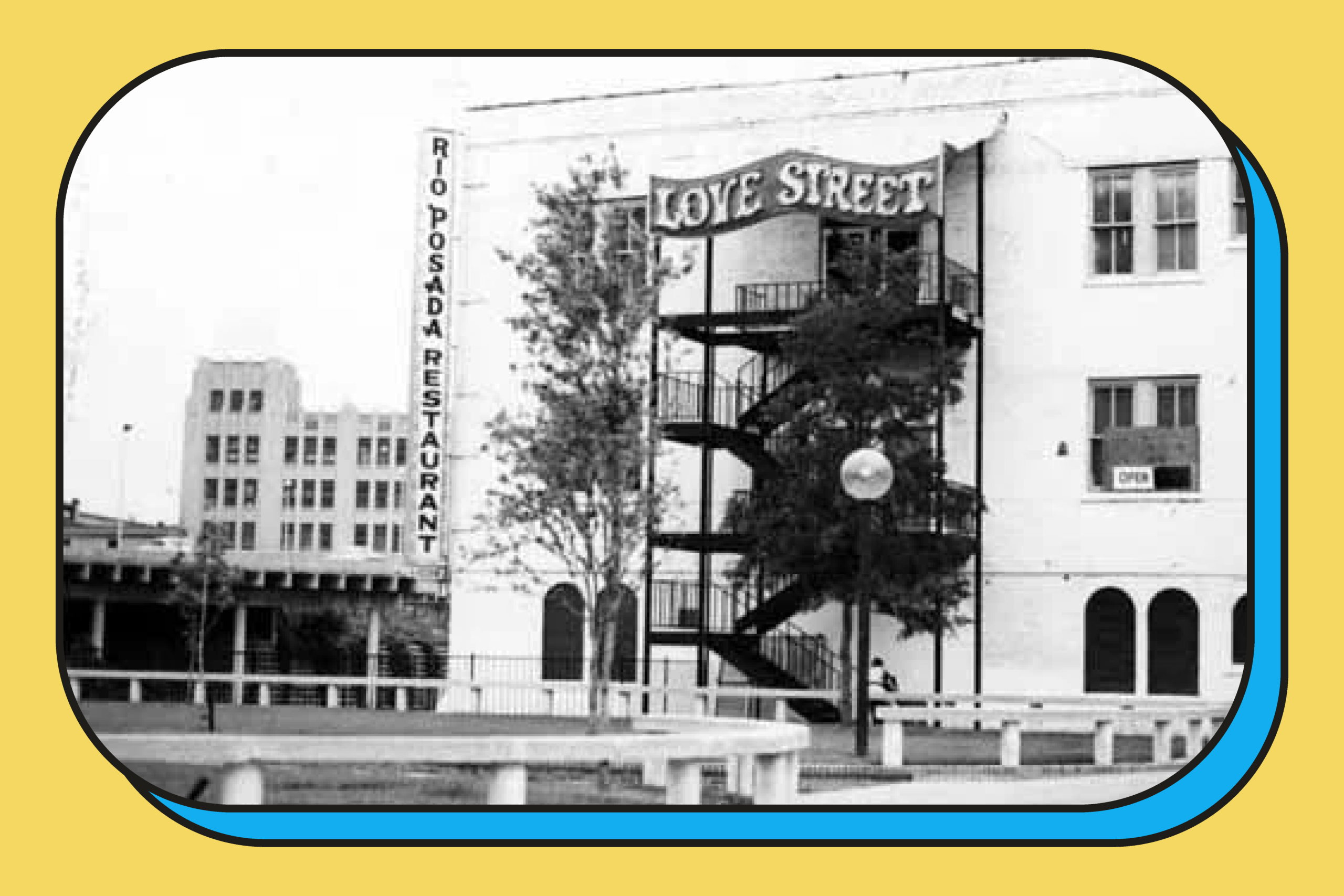
The psychedelic music scene of 1960s Houston was accelerated by the opening of Love Street Light Circus Feelgood Machine, more commonly known as Love Street, on June 3, 1967.

The music venue took over the old Sunset Coffee building at Allen’s Landing on Buffalo Bayou. Artist David Adickes envisioned Love Street after a trip to San Francisco, where Texans like Chet Helms and Bob Simmons were key to the psychedelic ballroom scene then in full swing.

Love Street quickly became ground zero for Houston’s counterculture. Adickes originally thought of the club as a “summer project,” but new ownership partners from Houston’s International Artists record label extended Love Street’s run until 1970, also making that label’s psychedelic artists house bands for the record company’s very own venue.

The club had tables and chairs but also a space called “Zonk Out” that contained cushions and backrests for more horizontally inclined patrons to enjoy the psychedelic light shows.

While the patrons could “zonk out,” the performers endured the additional labor of carrying their equipment all the way up an exterior staircase to the stage on the third floor. Bands that did so included a who’s who of Texas psychedelia: the 13th Floor Elevators, the Red Krayola, the Lost and Found, Shiva’s Headband, and Fever Tree, blues musicians Johnny Winter and Lightnin’ Hopkins, and even a late-night cameo from San Francisco’s Jefferson Airplane.


Houston band the Moving Sidewalks performed at the venue often — their hit single “99th Floor” is heard as a tribute to the 13th Floor Elevators, but it’s possible that Love Street’s onerous stairs might also have been on their minds. When the Sidewalks broke up, guitarist Billy Gibbons formed a new group that made their live debut at Love Street: A little ol’ band called ZZ Top.

Plans to open new iterations of Love Street in Corpus Christi and San Antonio were not quite realized, and the Houston club closed in 1970, the same year as its Austin counterpart the Vulcan Gas Company. But, the heyday of psychedelia was wholly celebrated in Houston at this radical venue.

Sources

Vicki Welch Ayo. Boys from Houston: The Spirit and Image of Our Music. CreateSpace Independent Publishing, 2013.

Ben Graham. A Gathering of Promises: The Battle for Texas’s Psychedelic Music, from the 13th Floor Elevators to the Black Angels and Beyond. Washington, D.C.: Zero Books, 2015.

Sara Gredler in Laurie E. Jasinski, Gary Hartman, Casey Monahan, and Ann T. Smith, eds. The Handbook of Texas Music. Second Edition. Denton, TX: Texas State Historical Association, 2012.

Media: Love Street Poster Explained More from the same YouTube account on Love Street

If you found the reporting above valuable, please consider making a donation to support it here. Your gift helps pay for everything you find on texasstandard.org and KUTX.org. Thanks for donating today.