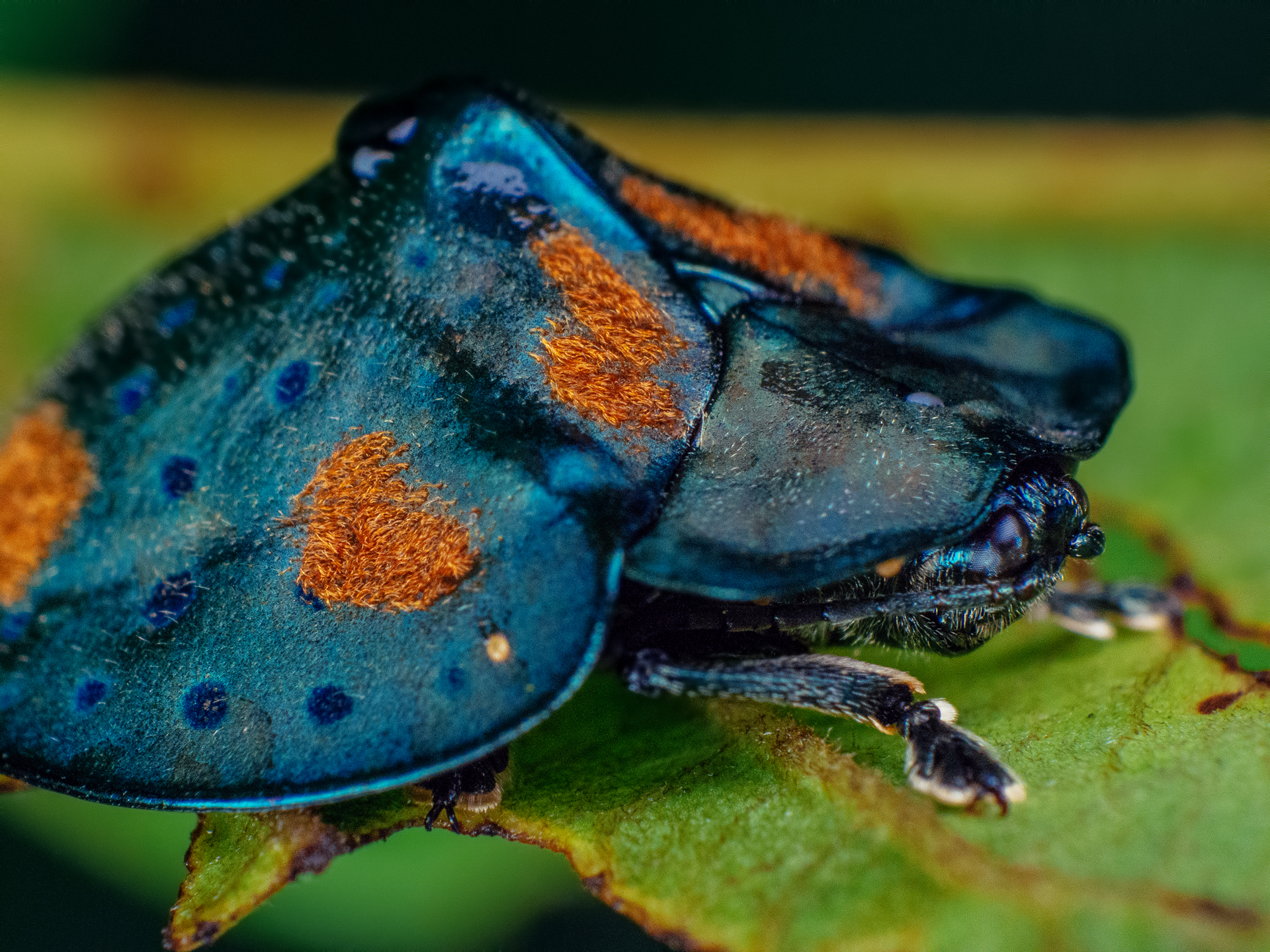
This beautiful beetle has some unique habits worth trying to spot

There are many varieties of tortoise beetles. Some are beautiful, some carry around their old exoskeletons and poop on their backs.

By Laura RiceAugust 13, 2026 4:04 pm, , ,

Texas A&M AgriLife Extension Service specialist Wizzie Brown loves many insects but she says tortoise beetles are among the most beautiful.

The top surface of their body is called a carapace, like a turtle, but she thinks the similarities end there.

“It kinda looks like a tortoise shell, I guess, if you use your imagination maybe,” Brown said.

Identifying a tortoise beetle

Their domed carapace is made up of two parts: their front wings, which are called elytra on beetles, and a shield-like structure that covers the thorax that is called the pronotum.

From there, the beetles can look very different depending on which species you’re looking at.

“They may be smooth, they may have spines or weird projections coming off of them. There’s a lot of variability,” Brown said. “The ones that I like personally, because there are some that are just brightly colored or they have spots or stripes or whatever, the ones that like are the ones that have a translucent carapace. And then underneath that they have metallic colorations and they’re just absolutely beautiful. I mean, like bright gold.”
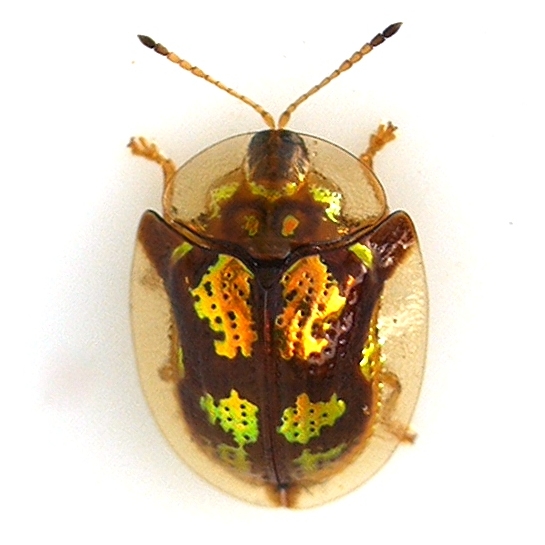
By Ilona Loser - Own work, CC BY-SA 3.0, https://commons.wikimedia.org/w/index.php?curid=9614715

A tortoise beetle with a translucent shell and some gold coloration.

Brown remembers making an insect collection during graduate school and being so excited to pin one of those gold tortoise beetles.

“That color doesn’t stay there when they die,” Brown said. “And I was very, very sad. Take a picture, because it’s not gonna last.”

Unique traits

Some tortoise beetles have the ability to change color while they are still living. They can shift pigments in their exoskeleton and can also change their bodies from being a shiny surface to a matte surface.

Brown says this movement within the cuticle of the exoskeleton helps them camouflage themselves.

Tortoise beetle larvae also have a strange habit involving their urogomphi — little projections that come off the tip of their abdomen.

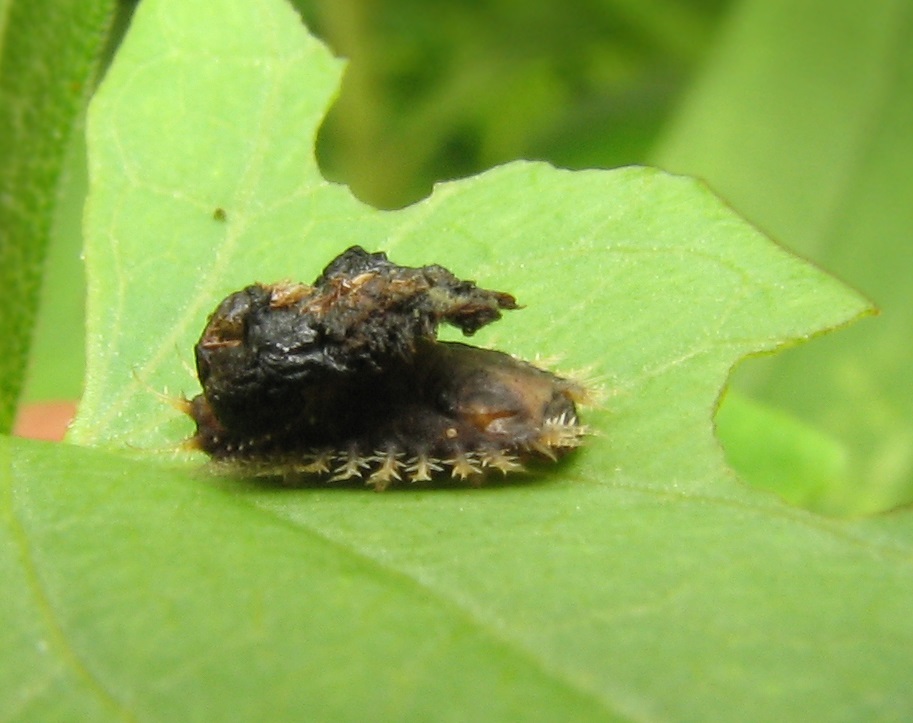
“They are going to use those to form this kind of ladder-like structure with debris,” Brown said. “They will stack frass, that is insect poop, and then the exoskeletons from when they molted, they’ll stack those on the urogomphi and it kind of extends out from their body the more that they put stuff on there. And they will then bend the tip of their abdomen up over their body and it almost looks like they’ve got like a little parasol or umbrella that they’re holding over their bodies. It’s absolutely adorable.”

Brown says nobody really knows why tortoise beetle larvae do this, but reserachers think it is to help protect themselves from predators.

By Beatriz Moisset - Own work, CC BY-SA 4.0, https://commons.wikimedia.org/w/index.php?curid=76390103

A tortoise beetle larvae holds up a "parasol" of frass.

“It’s some sort of a camouflage and since there’s the frass, it is stinky so that can also repel things, but it’s very cute,” Brown said.

By looking at the number of exoskeletons stacked on a tortoise beetle larvae, you could also determine its age.

“Which is pretty cool,” Brown said.

Do you have a bug question for Wizzie Brown? Drop us a line, and we’ll pass it along.

If you found the reporting above valuable, please consider making a donation to support it here. Your gift helps pay for everything you find on texasstandard.org and KUT.org. Thanks for donating today.