There’s a brand-new T. rex in town — and he’s rocking a beach bod just in time for summer.
For decades, fossils from a species of Tylosaurus — a type of extinct predatory marine reptile — were believed to be from a smaller species called Tylosaurus proriger.
Then a trio of researchers realized they had found something else: An apex predator about the size of a school bus with a mouth full of serrated teeth.
Amelia Zietlow is a museum specialist at the Museum at the Castle in Appleton, Wis., and recent Ph.D. student at the American Museum of Natural History. She’s the lead author of a paper published in the Bulletin of the American Museum of Natural Science.
She, along with her coauthors Michael J. Polcyn and Ronald S. Tykoski, reviewed specimens from around the globe. They’re calling it Tylosaurus rex: “T. rex” for short.
Zietlow says she first suspected she had a new species on her hands in late 2020, just as she began working at the American Museum of Natural History.
“I found a fossil in the collections at the American Museum of Natural History that just looked kind of different. I couldn’t quite put my finger on why, and it was from Texas, which was unusual for this kind of animal,” Zietlow says.
She had noticed something strange about the teeth.
“The teeth are serrated. So just like a steak knife, they have these little ridges along the blade of the tooth. And that’s not very typical for mosasaurs,” Zietlow says.
Zietlow worked alongside Polcyn and Tykoski, who are both based in Dallas. They told her that there were many specimens like the one she’d found at the American Museum in Dallas collections, such as Southern Methodist University and the Perot Museum.
Zietlow says avocational and hobbyist paleontologists in the Dallas area were instrumental to her discovery.
“A lot of those mosasaurs were found by avocational paleontologists, so people who were just going out in their backyards in some cases and finding these guys on their land. They then dug them up, sometimes with the museums, and chose to then donate them to those museums so that they could be studied by researchers like me. And a lot of those people also donated their time and volunteered to help prepare the fossils or clean all the extra dirt off,” Zietlow says.
Zietlow visited 22 museums across North America and Europe to compare the fossils found in Texas to those of the smaller Tylosaurus, T. proriger.
The combined efforts of the hobbyists and the team paid off. They had found a new species.
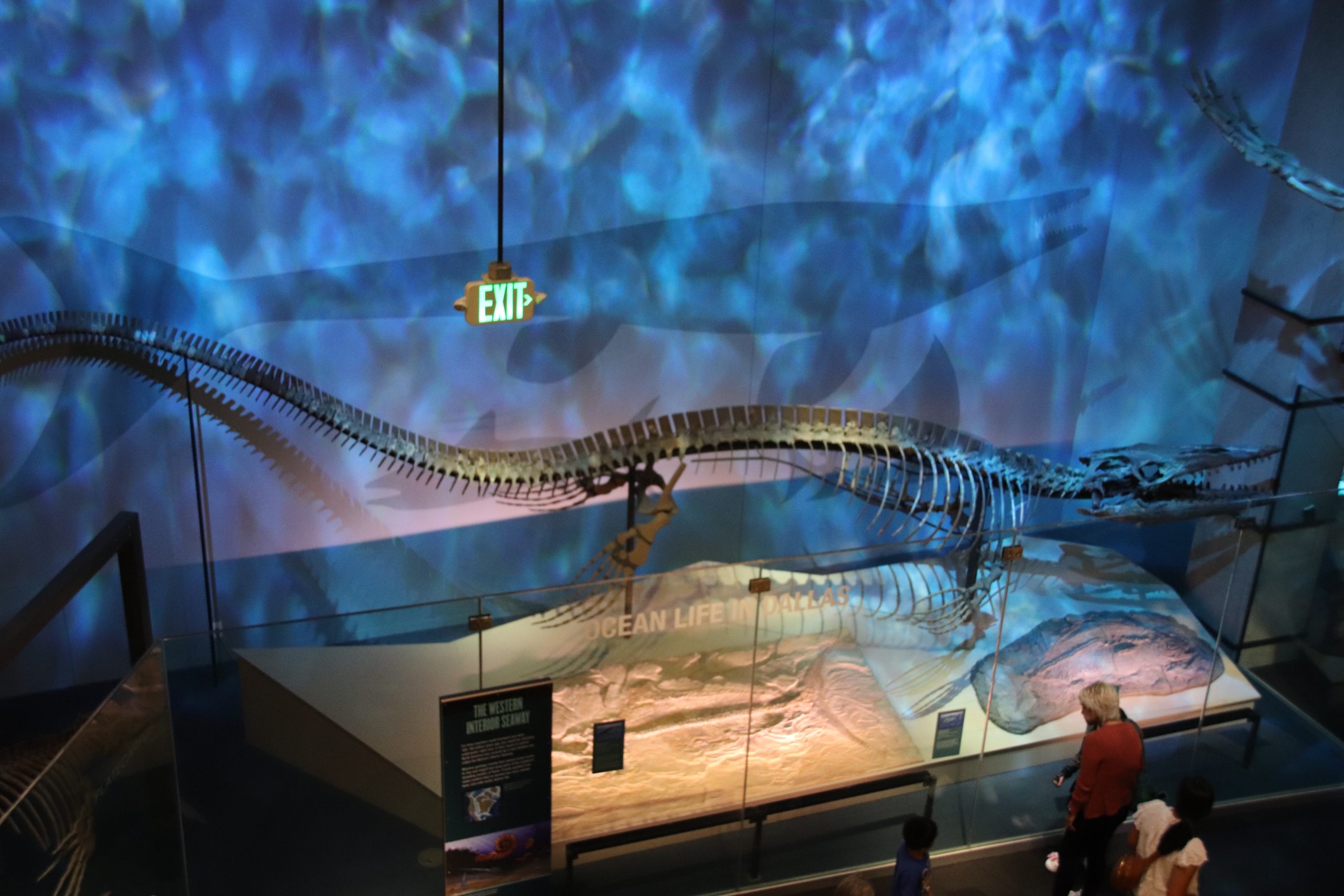
Tylosaurus rex is the largest known Tylosaurus, a genus of mosasaur. It averaged in the 30- to 35-foot range, with the largest specimen measuring at 43 feet. It ruled the shallow, tropical inland sea that covered most of Texas about 80 million years ago, during the Cretaceous Period.
Make no mistake, unlike Tyrannosaurus rex, this T. rex is no dinosaur. Instead, Zietlow wants you to picture a giant, swimming lizard.
“Mosasaurs would have looked a lot like a monitor lizard, something like a Komodo dragon, except take that and scale it up to be about the size of a school bus. Give it flippers, a shark’s tail, and an extra row of teeth on the top of its mouth,” Zietlow says.
As a generalist, it attacked just about anything that swam past. It would have used its knife-like teeth on ancient fish and other marine reptiles, like the long-necked plesiosaur.
These prowling kings of the sea would have lived a brutal life.
“There’s a fossil at the Perot Museum of one of these animals that’s just loaded with bite marks and some of them are pretty severe to the point where the Perrot Museum nicknamed it the ‘Black Knight’ after the Monty Python character who just gets hacked to pieces and keeps living,” Zietlow says.
Now, she says she and fellow researchers are looking into other mosasaurs from across Texas, which she says has a rich history of the species.
“This discovery has helped to shed light on the overall diversity and patterns of evolution of this group,” Zietlow says.