Who is Aaron Reitz? The federal ‘MAGA attorney’ overseeing prosecution of the Houston ICE shooting

Reitz has worked with Ken Paxton at the Texas Attorney General’s Office, with Sen. Ted Cruz as his chief of staff, and with Pam Bondi as the assistant attorney general for the United States. He’s now leading one of the most crucial legal offices in Texas and the nation.

By Michael Adkison, Houston Public MediaAugust 26, 2026 10:15 am, , ,

From Houston Public Media:

On more than one occasion in his life, Aaron Reitz has sworn an oath to defend the Constitution of the United States against all enemies, foreign and domestic. Most recently, it was on July 9, to serve as the lead federal prosecutor for the Southern District of Texas, one of the most significant U.S. attorney postings in the country.

By its own writing, this U.S. attorney’s office, which encompasses Houston and Galveston down to the southern border, prosecutes more federal criminal cases than most other districts across the country.

“For forever, Texas has been underwater in terms of resources for the federal bench; all four districts, but especially Southern,” Carl Tobias, a University of Richmond law professor, told Houston Public Media. “And that could be explained pretty clearly by the border, I think a lot of it.”

Reitz, a firebrand conservative who has drawn scrutiny for challenging the results of the 2020 presidential election and arguing that court orders can justifiably be disobeyed, was not tapped for the role by the usual route. Bloomberg Law reports he was not appointed by President Donald Trump to serve as the U.S. attorney, though he had worked for the Trump administration previously. Instead, the district’s judges selected him to serve in the office, allowing Reitz to circumvent a Senate confirmation hearing.

That process, though permissible under federal law, is not the traditional route, by which a nominee is appointed by the executive branch of government and then confirmed by the Senate.

“I’m honored to serve as the chief federal law enforcement officer and lawyer for this mission-critical district,” Reitz said in a news release when he was sworn in. “Our office will relentlessly combat violent crime, illegal immigration, drug and human trafficking, corruption, and fraud. We will faithfully uphold the rule of law and protect the public. Things are about to get very bad for criminals in the Southern District of Texas.”

Two days before that, on July 7, a van carrying four immigrants without legal status in Houston was pursued by federal immigration agents. When U.S. Immigration and Customs Enforcement (ICE) agents approached the van, the federal government alleged the driver, Lorenzo Salgado Araujo, attempted to use his car as a weapon, a claim the other three men in the van dispute. An ICE officer fired his gun and shot Salgado Araujo, a 52-year-old father of three who had lived in the U.S. for more than 30 years, according to his family.
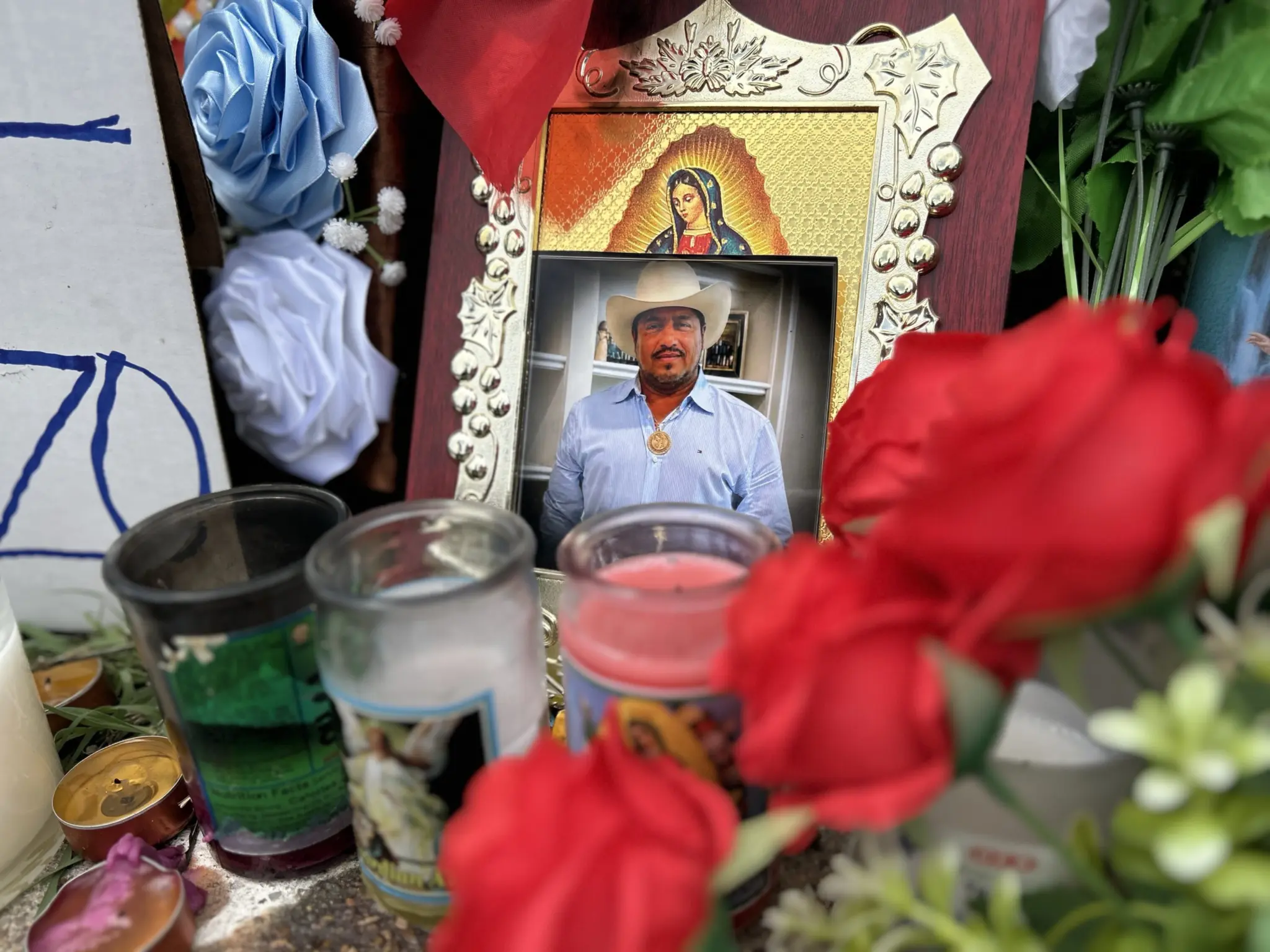
Bianca Seward / Houston Public Media

A photo of Lorenzo Salgado Araujo is displayed July 9, 2026, at the location where he was fatally shot by an ICE agent two days before in Houston’s East End.

“They’re killing me,” Salgado Araujo said, clutching his stomach, according to an attorney for one of the witnesses. He died thereafter. His killing has spurred the community into action, prompting multiple investigations at the local, state and federal levels. Protests have called for transparency from the federal government.

Now a month into the role, Reitz, whose office did not make him available for an interview, has helmed the federal government’s legal representation related to the shooting. Following the FBI and U.S. Department of Homeland Security’s investigation, they will present their findings to the U.S. attorney’s office for the Southern District. It would then be up to Reitz and his affiliates to decide whether or not to press any federal charges against the agents involved.

Out of the arena — and back in

The first time Reitz swore an oath to defend the U.S. Constitution was just after he graduated from Texas A&M University, when he entered the U.S. military.

He had just married his wife, Meredith, whom he had met on the school bus to his first day of classes at Barbara Bush Middle School in San Antonio. The two began dating when they attended Ronald Reagan High School, and they both went to Texas A&M. Eventually, though, Meredith decided to transfer to the University of Texas at Austin — as Aaron has said, Meredith, who wanted to be a veterinarian, had taken the rectal temperatures of too many cows. They broke up in the process but soon rekindled and were married in October 2009.

Less than a year later, the Reitzes moved to Quantico, Virginia, before he was deployed to Afghanistan with the U.S. Marine Corps in early 2011. After returning to the United States, Reitz applied to the UT Law School.

His de-facto resume, which he touted during his first run for office in 2020, touts his conservative record: he was a fellow at the Texas Public Policy Foundation, a conservative thinktank; he was chosen by his peers as the Lino Graglia Conservative Student of the Year at UT; he was a fellow at the Alliance Defending Freedom, a conservative nonprofit; he was president of UT’s chapter of the Federalist Society; and served as editor-in-chief of the Texas Review of Law and Politics. After graduating, Reitz went into private practice at Bracewell LLP, a Houston-based law firm.

“Wonderful law firm, but really felt that I had been taken out of the arena,” Reitz told The Texan in a 2019 interview.

At that time around 2017, Don Willett, a justice on the Texas Supreme Court, was appointed by Trump to the 5th U.S. Circuit Court of Appeals. That left a vacancy on the state’s highest civil court. After Willett was confirmed to the bench, Texas Gov. Greg Abbott appointed his general counsel, Jimmy Blacklock, to the Texas Supreme Court.

As luck had it, Reitz knew Blacklock. In Austin, he would recount, conservative circles ran small. He reached out to Blacklock and asked to serve as chief clerk to the new justice. Blacklock accepted.

In Reitz’s own telling, he took a 70% pay cut to join Blacklock’s team. But it was the jump into public policy that Reitz wanted to take advantage of. In the spring of 2019, Reitz decided to run for Texas House of Representatives in a district representing southwest Austin, which had flipped for Democrat Vikki Goodwin in 2018. He resigned from Blacklock’s office in May 2019.

In the interview with The Texan, Reitz said that, while he would be voting for Trump’s reelection in November 2020, his district’s voting trend was “proto-typical suburbia, that was a little bit squeamish about Trump. Not his policies, but you know, you had a lot of families that were saying, ‘Gosh, I’m for Trump, but I’m not super in favor of his Tweets… the persona, I don’t want my young boy to grow up to be like Donald Trump.”

On primary election day, March 3, 2020, days before much of the country shut down for the COVID-19 pandemic, Reitz placed fourth in the Republican primary for the Texas House seat. By that December, Reitz was working on the team with the Texas Attorney General’s Office seeking to suspend certifying the results of the 2020 election won by Democrat Joe Biden.

The day before Reitz was set to begin working in the office of Texas AG Ken Paxton, Reitz told The Texas Tribune, several OAG officials reported Paxton to the FBI over concerns of abuses of office, the same allegations that would result in Paxton’s impeachment in the Texas House of Representatives three years later.

But he opted to stick by Paxton through the scandal as the AG, who now is running for U.S. Senate, was acquitted by the Texas Senate. Through his time at the OAG, Reitz said he worked on border security matters, religious issues, and led the election integrity divisions in 2020 and 2022. That included working on Texas v. Pennsylvania, a lawsuit brought by Paxton’s office to suspend the certification of election results in key states that were for Biden in the 2020 election.

In April 2021, Reitz led a lawsuit against the Biden administration that accused the federal government of lapsing in border security, allowing COVID-19 to spread via migrants traveling to the U.S. By October 2022, after the case had worked through the courts, both the OAG and the Biden administration agreed to dismiss the case.

Reitz led a similar effort a year later, in April 2022, which was also dismissed later that year. In the initial complaint, Reitz called the standard process of an immigration hearing to argue for or against removal “slow” and said it requires either paying for a migrant without legal status in detention or running the risk of their fleeing.

Years later, Reitz would compare his relationship with Paxton to a football game: Paxton was the head coach, and Reitz was the offensive coordinator. In total, he would tell Austin’s ABC affiliate, KVUE, he led 46 lawsuits against the Biden administration, a significant portion of which were dedicated to immigration policy.

Eventually, Reitz left Paxton’s office to work as a chief of staff to U.S. Sen. Ted Cruz, R-Texas. He resigned from the OAG on May 12, 2023, two weeks before Paxton would be impeached.

“We’ll keep fighting this war together,” Reitz said in his resignation letter to Paxton. “But now it’s my time to fight it on a different front.”

Just and unjust laws

Every Martin Luther King Jr. Day, Reitz said in an Instagram post in 2022, he rereads King’s “Letter from Birmingham Jail,” an open letter the civil rights leader wrote in April 1963 while imprisoned for leading demonstrations in Alabama. In it, King writes that, just as people have a duty to follow just laws, they have a duty to break unjust laws as well.

It was that theory — that someone could justifiably break laws that they found morally wrong — that had rankled the U.S. Senate judiciary committee.

On a Wednesday morning in February 2025, the committee convened with the goal of establishing the backbone of the Department of Justice. Three nominees sat before them, making up three of the most crucial law enforcement roles in the federal government.

There was D. John Sauer, nominated to be Solicitor General, on the left and Harmeet Dhillon, Assistant Attorney General for Civil Rights nominee, on the right. In between them sat Reitz, then 37 years old, in a blue pinstripe suit, awaiting his hearing to eventually become the Assistant Attorney General for the Office of Legal Policy at the Department of Justice.

Sauer and Dhillon remain in their roles today. Reitz would hold his role for 72 days before resigning to run for an elected office.

X / Attorney General Pam Bondi

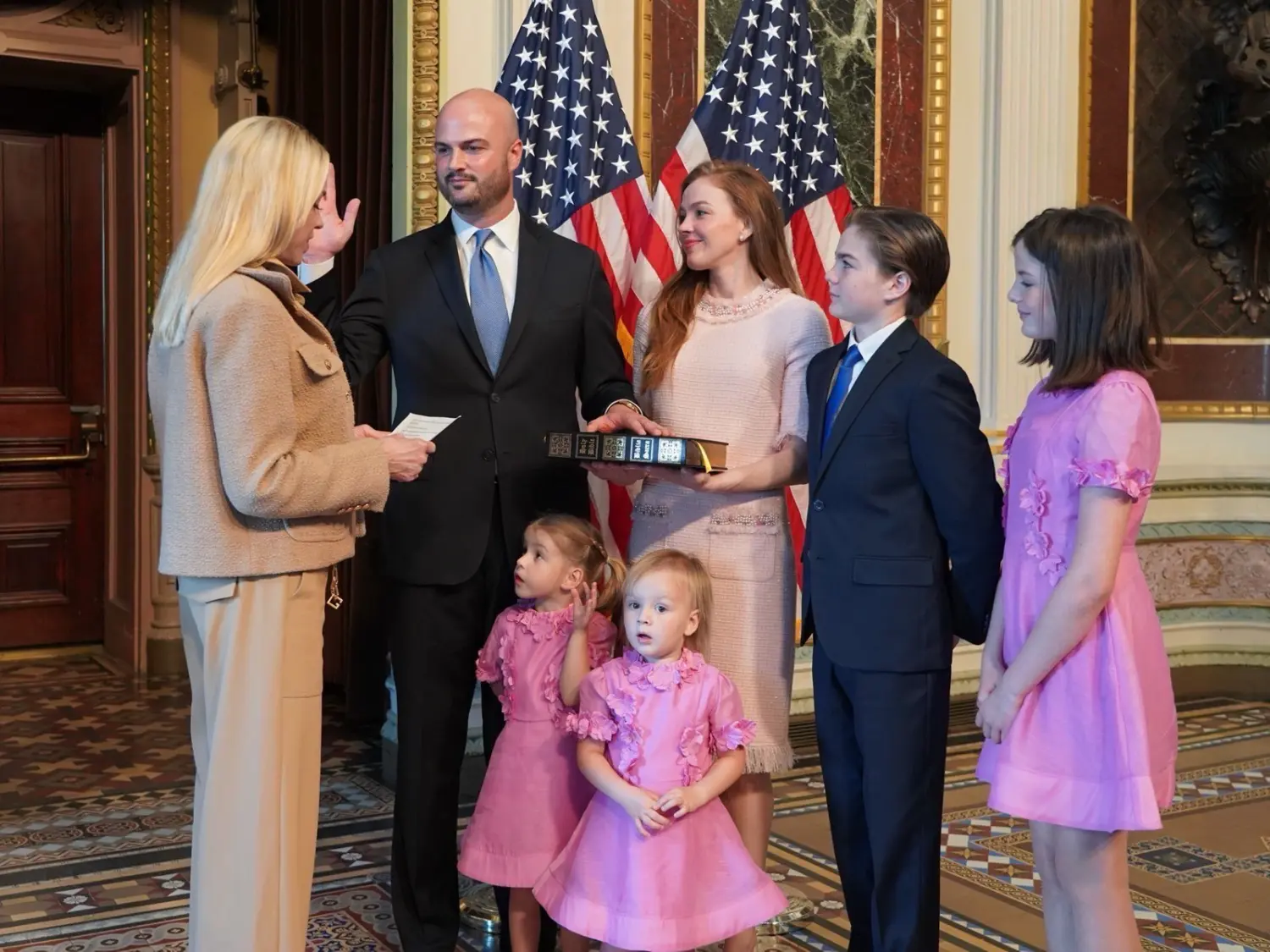
Aaron Reitz was sworn in as Assistant Attorney General by then-AG Pam Bondi, standing alongside his wife and family.

When Trump stated on Truth Social he would appoint Reitz to the office, he called the Texan “a true MAGA attorney, a warrior for our Constitution, and will do an outstanding job at DOJ.”

“He is currently my chief of staff and has the virtually impossible job of keeping me out of trouble,” Cruz, a member of the committee, said with a laugh. “In that regard, he has failed spectacularly.”

Reitz, in turn, called Cruz a mentor.

Democrats on the committee, though, had some concerns, mostly surrounding Reitz’s digital footprint on X, the social media platform formerly known as Twitter. One post Sen. Dick Durbin of Illinois took issue with was from March 30, 2020, when U.S. Judge Lee Yeakel blocked Texas from closing abortion clinics during the COVID-19 pandemic.

“Looking for some Andrew Jackson-level leadership on this one,” Reitz wrote at the time. “‘Judge Yeakel has made this decision. Now let him enforce it.'”

“So you’re saying that a legal court order from a federal court should not be followed under some circumstances,” Durbin said. “What would those circumstances be?”

“What I’m saying is that there are some instances in which a public official is lawfully bound by the holding of a particular court, in which case that official would in fact be lawfully required to be bound by it,” Reitz said. “I can’t speak, though, ranking member Durbin, for all instances in which that dynamic may or may not be in play given a certain lawsuit.”

Durbin called his response “an incredible statement by someone who wants to be a part of the Department of Justice.” It was also prescient: during Reitz’s time in the Trump administration, it began defying court orders on immigration policy.

Aside from his political theory on ignoring court orders, it was Reitz’s social media presence that garnered the most attention from his confirmation hearing. He had deleted the vast majority of posts from his X account, which he had created in 2014.

“I have oftentimes observed a practice of regularly deleting old tweets,” Reitz said in his written testimony. “I recall, though am not certain, clearing out my X account shortly before joining the Senate as a Chief of Staff in 2023, since most of my social media activity was related to my prior service in Texas and not related to my role as a Senate staffer.”

U.S. Senate Committee on the Judiciary

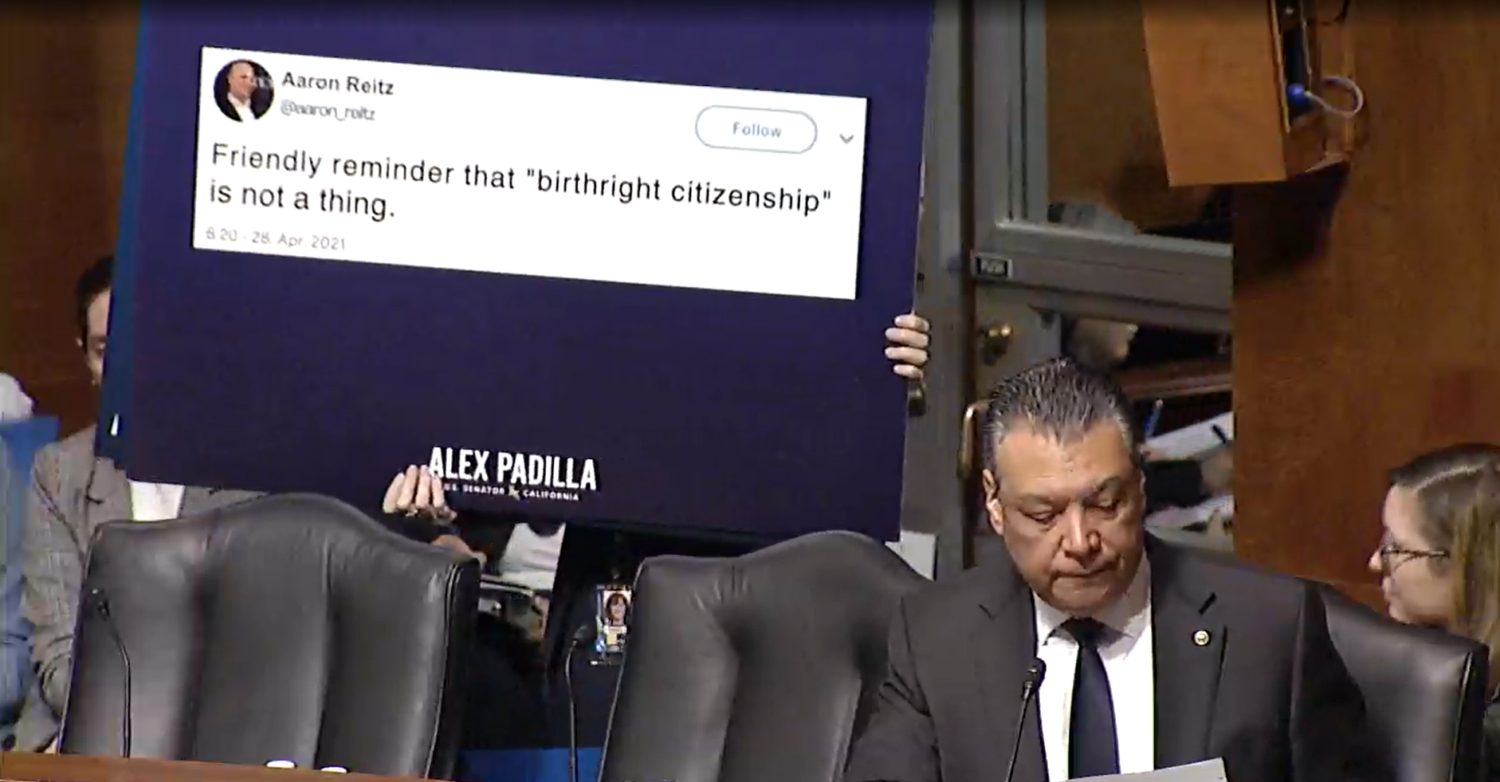
U.S. Sen. Alex Padilla (D-California) displays a tweet purportedly from Aaron Reitz reading, “Friendly reminder that ‘birthright citizenship’ is not a thing.”

“Friendly reminder that ‘birthright citizenship’ is not a thing,” Reitz had tweeted in 2021, according to a screenshot shared during the hearing.

Another tweet from February 2021 called the U.S. Supreme Court’s Bostock decision, which codified protections from workplace discrimination on the basis of sexual orientation or gender identity, “the worst SCOTUS decision since Obergefell,” which permitted same-sex marriage.

In September 2020, Reitz shared a photo of late Sen. Joe McCarthy, who spread fears of communism during the Red Scare of the 1950s, with the caption, “Bring back the good ol’ days.”

The posts, ultimately, were not enough to halt his confirmation. A month later, on March 26, 2025, Reitz became one of the senior most law enforcement officials in the nation, and he once again swore an oath to defend the U.S. Constitution.

By June 11, however, Reitz was resigning. As he put it in his resignation letter to Trump, “you charged me with developing and implementing the battle plans to advance your Law and Order Agenda and to restore integrity to our Justice System. … Duty now calls me to continue that fight on a new front.”

The next day, Reitz announced a bid to become the next attorney general of Texas, succeeding Paxton.

Battle tested

A month out from this year’s Republican primaries in Texas — when GOP voters would select their pick to run for Texas attorney general, among other seats — Reitz was thinking about the oaths he had sworn in the past to protect the U.S. Constitution from all enemies, foreign and domestic. Those domestic enemies, he postulated, include the modern day Democratic Party.

“What I have come to believe from long-fought personal experience is that there are — the leadership class of the Democratic Party today can rightfully be construed as enemies of the Constitution,” Reitz told KVUE. “This isn’t me being hyperbolic. This isn’t me exaggerating with political rhetoric. We have seen what the left is capable of doing. We have seen what the Democratic Party is willing to push when they have the power. And I believe that what they want for this state and our nation is antithetical to our closest values, to American values, to western civilization, and to the United States Constitution.”

That included, Reitz would write, the head of the Texas House of Representatives’ Democratic Caucus, state Rep. Gene Wu of Houston. Responding to a post that depicted Wu stating that several marginalized groups, including Latino, Black, Asian and other communities, “share the same oppressor,” Reitz said he wanted Wu’s citizenship revoked.

“As AG, I want to see [Wu] de-naturalized,” Reitz wrote on social media on Feb. 9. “On what basis? He likely concealed his anti-American sentiment throughout his citizenship app process — the details of which are conspicuously absent from public record.”

Wu, whose office did not return a request for an interview, was born in China before moving to Texas with his family at a young age. He became a U.S. citizen around the age of 14, through his parents.

Reitz’ former bosses, Cruz and Paxton, both criticized Wu for his “bigotry” and “racist” comments. Reitz was also not the only candidate in the race for Texas attorney general to raise concerns over Wu’s comments. U.S. Rep. Chip Roy said Wu should resign from the state legislature. State Sen. Mayes Middleton of Galveston, who would go on to secure the Republican nomination, wrote that Wu was “showing us why only those born in America should be eligible to run for office.”

It was Reitz, however, who drew the most attention for his comments. He had been the hand-picked successor to the attorney general’s office — Paxton, who was leaving the role after three terms to run for U.S. Senate, endorsed him. As part of his campaign, Reitz labeled himself as the only candidate who was “battle tested” in a law enforcement office.

In the six years since Reitz last ran for public office, his platform had shifted further to the right. By his own submissions on Ballotpedia, his three key messages of his 2020 campaign for the state legislature were to “preserve Texas’s vibrant economic climate through low taxes and light regulations,” “Make our schools and communities safer,” and, “Give our children a first-class education.” By his 2026 campaign, his three key messages were “advancing an America First Law & Order agenda,” “Securing our southern border,” and, “root[ing] out corruption and stop[ping] far-left local governments from undermining Texas values.”

Just as in his 2020 campaign, however, Reitz finished in fourth place. As Middleton and Roy headed to a runoff, Reitz threw his endorsement to Middleton. Since then, Reitz had stayed relatively quiet, campaigning for Paxton and Middleton and sharing the occasional social media post from Trump administration officials.

Then, on July 9, Reitz made his next career move known — he was sworn in as the new U.S. Attorney for the Southern District of Texas.

His appointment prompted congratulations from Cruz, Paxton and Abbott, the Texas governor, who wrote on social media, “You’ll do great. Huge win for Texas.”

Added Paxton: “I know Aaron will be an outstanding U.S. Attorney and will serve the Southern District of Texas with integrity and a strong commitment to the rule of law that will undoubtedly advance the cause of justice in our state.”

‘Let the justice system work’

On July 15, a week after Lorenzo Salgado Araujo was shot and killed by an ICE agent, the FBI executed a search warrant on the van involved in the shooting, which Salgado Araujo was driving. In the search warrant, signed by FBI Special Agent David McNeilly and approved by federal magistrate judge Richard Bennett, a new allegation came forward: law enforcement officers had seen “plastic bags with what appeared to be a white crystal-like substance packaged in small plastic bags.” The substance, McNeilly wrote, was “consistent with methamphetamine.”

The search warrant was unsealed and made public soon after. Aside from the allegation itself, some officials questioned the decision to share the indictment publicly so soon into the investigation.

“I’ve been doing this 20 years. I’ve never seen a federal search warrant, at least before a grand jury presentation, let alone the probable cause statement behind it,” Sean Teare, the Harris County District Attorney, said on Houston Matters on July 17. “And there was no evidentiary value to be gained from it anyway. It’s puzzling. It’s concerning.”

It was the first time drugs had been mentioned at all in the investigation of the shooting, which was being investigated by the FBI, Harris County DA and the Texas Rangers, concurrently and independently. It was also an allegation that Salgado Araujo’s family did not believe.

Michael Adkison / Houston Public Media

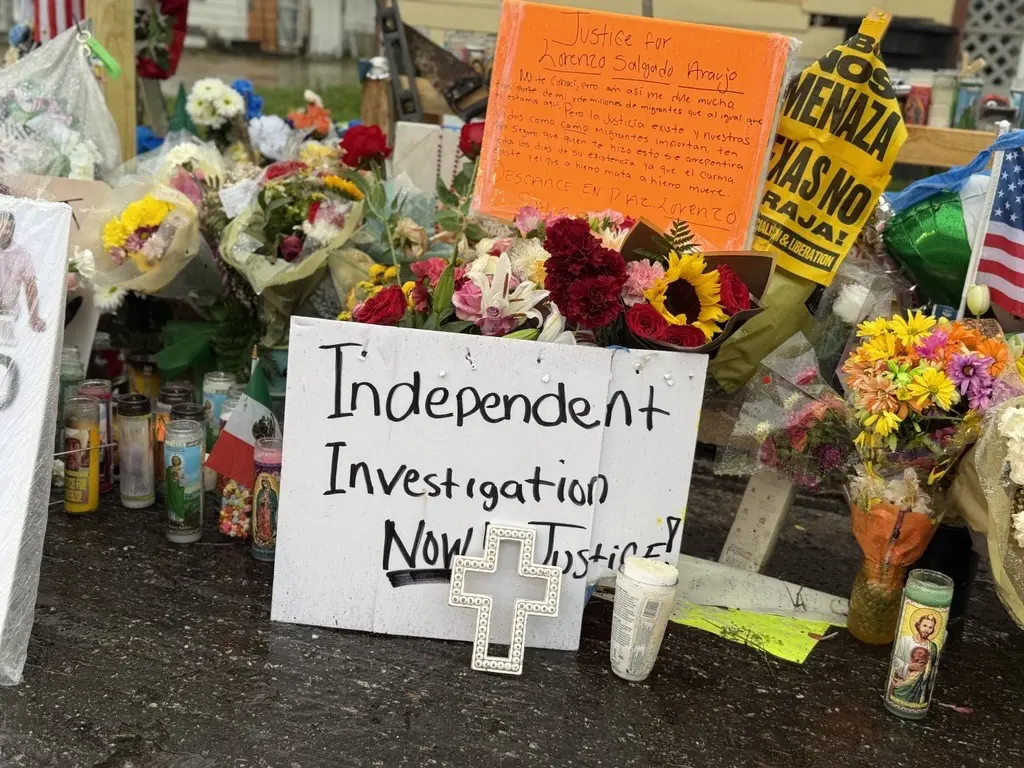
A memorial to Lorenzo Salgado Araujo, who was shot and killed by an immigration officer, pictured on July 14, 2026.

“After consulting with my client and his family, our understanding is that this was granulated salt, which is paired with lemon and water as a homemade electrolyte mix used by outdoor workers in extreme Texas heat, not methamphetamine or any other illicit substance,” said Ruby Powers, an attorney for Salgado Araujo’s brother, Victor, who was also in the van the day of the shooting.

Reitz confirmed to The Texas Tribune, in an Aug. 13 report, that the substance tested by the FBI was not meth.

It’s not immediately clear what led up to the search warrant being unsealed, or who decided to unseal it. As federal attorneys who would oversee the prosecution of the shooting, if there were to be any, U.S. attorneys likely played a role in the decision, according to Jay Coons, a criminal justice professor at Sam Houston State University.

“There is a lot of controversy rising up out of this shooting, and there is not too much being said by federal authorities,” Coons said in an interview with Houston Public Media. “In my experience, what I would believe is this is why the affidavit was unsealed as quickly as it was and made public: because this kind of takes away from the narrative that the deceased individual was this great guy. … Well, this information would argue against that. And it also gives a reason why he would be attempting to escape.”

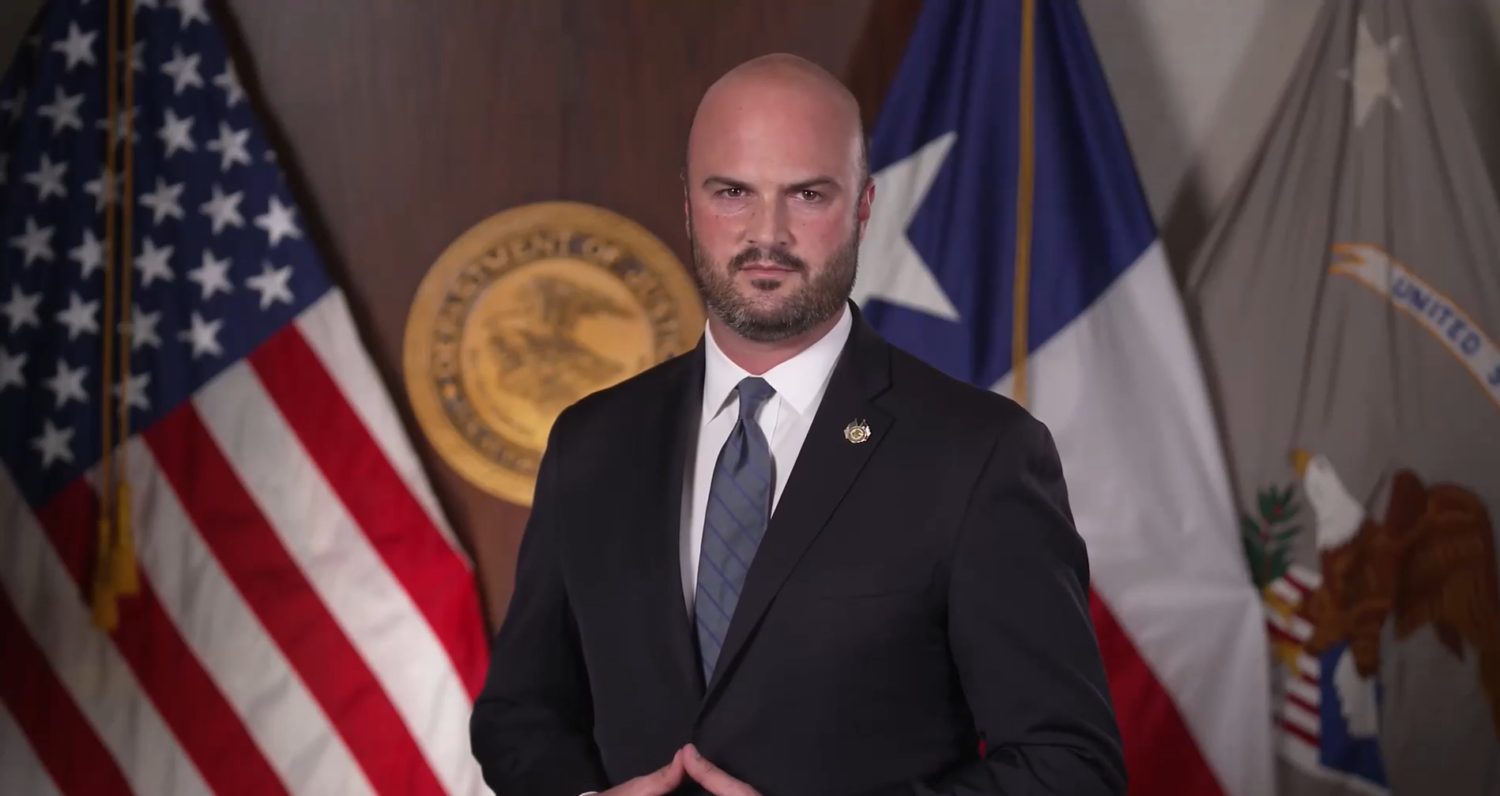
Regardless of the decision to unseal the search warrant, Reitz made his preliminary stance on the shooting known by the end of the week. In a video statement shared by the U.S. attorney’s office, Reitz stated that evidence indicated federal agents were searching for two Guatemalan men “known to be driving a white van” who were subject to deportation. While looking for that van, they allegedly found “a similar van” being driven by Salgado Araujo on July 7 and attempted to pull the van over, but the “aliens then fled, conducting a rapid U-turn and hopping a median to get away. The agents chose not to pursue.”

X / U.S. Attorney Aaron Reitz

U.S. Attorney Aaron Reitz speaks in a video message on July 16, providing a preliminary description of the shooting of Lorenzo Salgado Araujo nine days prior.

Shortly before 7 a.m. that morning, the federal agents saw the van again, Reitz said.

“And again,” Reitz said, “the illegal aliens attempted to flee, but this time the agents successfully surrounded the vehicle. At some point, two of the four officers got out of their vehicles and instructed the non-compliant aliens to put the van in park. Preliminary information indicates the driver shifted the van into reverse, then forward again, while an officer was partially inside the van or immediately next to it. During this confrontation between federal agents and a group of illegal aliens attempting to flee, one of the officers fired a single shot.”

Reitz also raised the allegation of “possible narcotics trafficking and drug offenses,” given the bags of powderlike substance in the van.

“I want to reiterate: This assessment is based on preliminary information given to my office,” Reitz said. “We draw no decisive conclusions and believe federal law enforcement will conduct a thorough investigation.”

As part of the investigation, the substance was tested for narcotics. Though the official results of the test have not been made public, U.S. Rep. Sylvia Garcia, D-Houston, who has worked alongside the family and championed the independent investigation, said last month on social media that testing showed the substance was in fact an electrolyte powder.

Coons, who worked in the Harris County Sheriff’s Office for more than three decades, said the decision to file a search warrant over the substances was proper police work. By contrast, he said, the decision to unseal the search warrant without knowing what the substances were could be perceived as hasty.

“If we release that document and not allege but insinuate that there was narcotics in there,” Coons hypothesized, “what do we say when a test result comes back and it was whatever it was? That’s going to do more harm than good. … So, my thoughts there would have been, great idea to release it, but let’s hold off until we know what we have.”

Reitz’s office has also pushed to keep at least one of the key witnesses to the shooting, Jose Trinidad Rojas Pliego, in federal custody, even after a federal judge ordered his release. On July 29, Reitz submitted a motion to reverse the decision permitting Pliego’s release, which was denied days later. The U.S. attorney’s office is appealing the decision to the 5th U.S. Circuit Court of Appeals, which had not made a ruling on Pliego’s release as of Monday.

“We are doing everything we can to seek the truth and do the right thing,” Reitz said in the July 16 video statement. “In the meantime, I encourage the public to give the FBI and DHS the opportunity to investigate. Let the justice system work. And pray for safer communities in which law, order, and justice prevail.”

Houston Public Media’s Bianca Seward contributed to this report.

If you found the reporting above valuable, please consider making a donation to support it here. Your gift helps pay for everything you find on texasstandard.org and houstonpublicmedia.org. Thanks for donating today.