African diaspora in Houston revels in continent’s World Cup success

A record 10 countries from Africa qualified soccer teams for the expanded field in this year’s FIFA World Cup, with nine advancing to the knockout stage.

By Sonia Kinyua, Houston Public MediaJuly 6, 2026 10:16 am, , ,

From Houston Public Media:

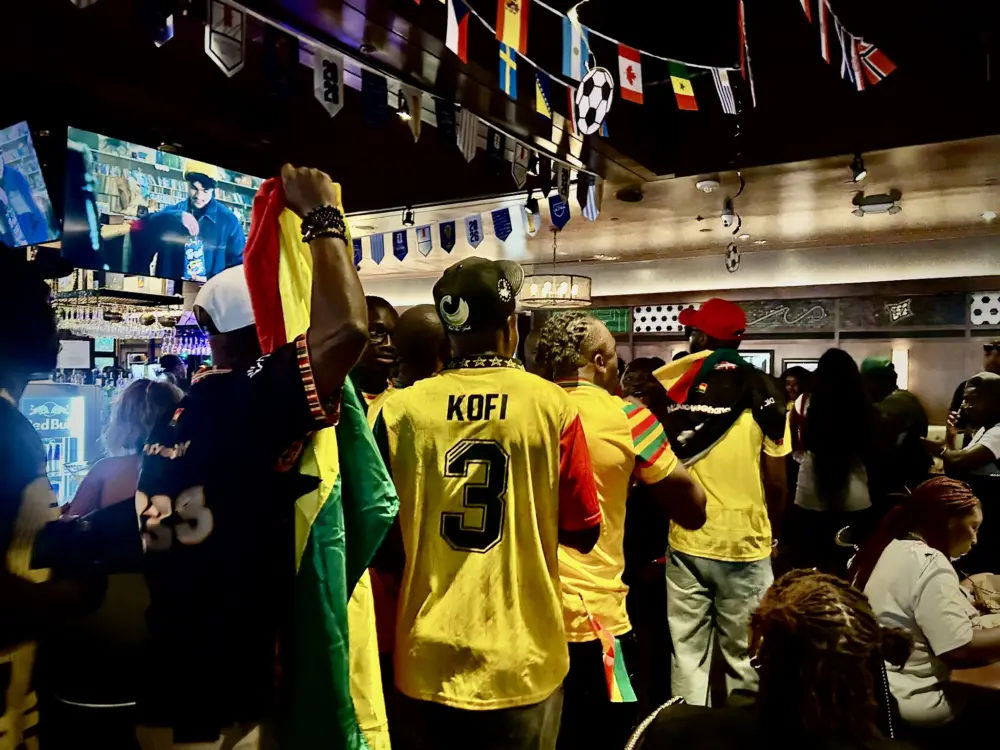
More than 50 Ghanaian soccer fans flooded Bar Louie in Sugar Land, buzzing with anticipation for the African country’s World Cup match against Panama. The team had struggled to break through for 90 minutes — a draw seemingly predetermined.

It wasn’t until the 95th minute when midfielder Caleb Yirenkyi scored a goal. When the referee blew the final whistle in Toronto — sealing a 1-0 victory for Ghana on June 17 — the sea of yellow jerseys in the Houston-area bar erupted into cheers.

The Houston area is home to one of the largest West African populations in the United States. And for many members of the African diaspora, the 2026 FIFA World Cup is more than a sporting event.

“Soccer is everything; it’s a religion,” said Moses Abotsi, a Ghana native now living in Houston. “It doesn’t matter whether Ghana is playing, if Nigeria is playing, if Senegal is playing, you see other African countries supporting each other. It makes the diaspora very unique. We look out for each other, we support each other.”

That sentiment goes far beyond the African diaspora in Houston.

Nana Osei-Opare, a professor of history and faculty member for the Center of African and African-American Studies at Rice University, said it’s a shared identity.

“When an African team is playing, the African continent supports the African team against any non-African side,” he said. “So there’s a very strong sense of unity and basically pan-African ideas when it comes to football continent-wide.”

African unity is taking center stage this year. Africa made World Cup history with 10 of its nations qualifying for the tournament — the largest contingent the continent has ever seen.

Nine of those national teams qualified for the World Cup’s knockout stage. Ghana, Cape Verde and Egypt play round-of-32 matches on Friday, and the final match in Houston is Saturday’s round-of-16 game between Morocco and Canada.
AP Photo/Ashley Landis

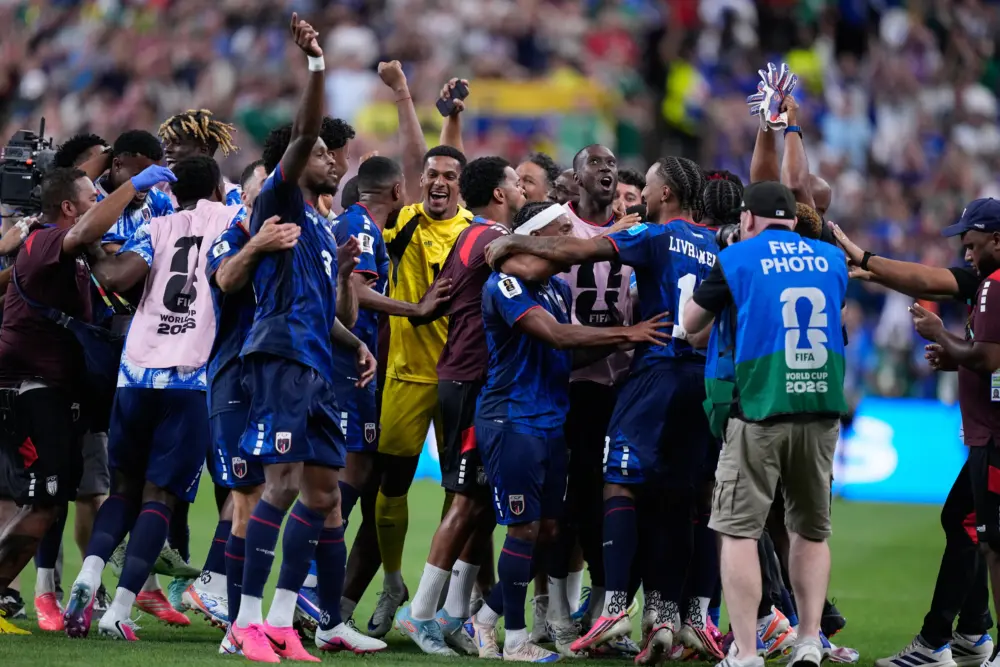
Cape Verde team members celebrate after the World Cup Group H soccer match between Cape Verde and Saudi Arabia in Houston, Friday, June 26, 2026.

Cape Verde made a stunning World Cup debut by tying with Spain — one of the more highly regarded teams in the tournament. Then, when it played Saudi Arabia to a scoreless draw on June 26 in Houston, Cape Verde became the smallest country to qualify for the knockout stage.

“It’s amazing just to know that a small country can definitely have big dreams, and we can make it no matter what,” said Nadine White, a Cape Verdean living in Houston. “It’s amazing that this is our first time and, like, we’ve gone so far.”

For the last seven editions of the World Cup, which is played every four years, the Confederation of African Football (CAF) had only five allocated spots. This year FIFA expanded the total field from 32 to 48 teams, giving Africa a historic number of nine guaranteed spots.

The increase in representation was decades in the making.

During the World Cup in 1966, FIFA guaranteed one spot to be shared between Asia and Oceania. African contenders were required to enter a playoff round against winners from Asia or Oceania in order to qualify for the tournament.

African nations boycotted the 1966 World Cup in protest. They demanded that Africa be given a guaranteed spot of its own. In response, FIFA changed the rules for the 1970 World Cup, and granted Africa a guaranteed spot.

The boycott secured Africa more seats at the table. But when you watch the tournament today, African talent isn’t isolated to those teams. It’s everywhere.

Osei-Opare said their participation goes beyond citizenship. For fans, heritage is the thread that connects them to the players.

“When they see somebody who was born in Spain or England, but their grandparents can be traced to the continent, people in the continent say, ‘Oh, that’s a Moroccan, that’s a Ghanaian, that’s a Malawian,'” he said. “We believe no matter how far removed you might be physically from that place of home, that you are still one of us and part of us.”

That sense of belonging hits close to home for many first-generation children growing up in the U.S. However, life between two countries – or two continents – can leave a gap in their identities.

The game changes that.

Manasse Kwete, a Democratic Republic of Congo native from Dallas, said soccer bridges that divide.

“You have a lot of Africans that are born in Europe and the U.S., and sometimes it’s hard to develop pride or identification with Africa,” he said. “It allows a lot of Africans that have never been to Africa to see all these African countries to cheer for, to laugh, and to see all types of cultural things to build more pride on the cultural heritage of Africa.”

Michael Adkison/Houston Public Media

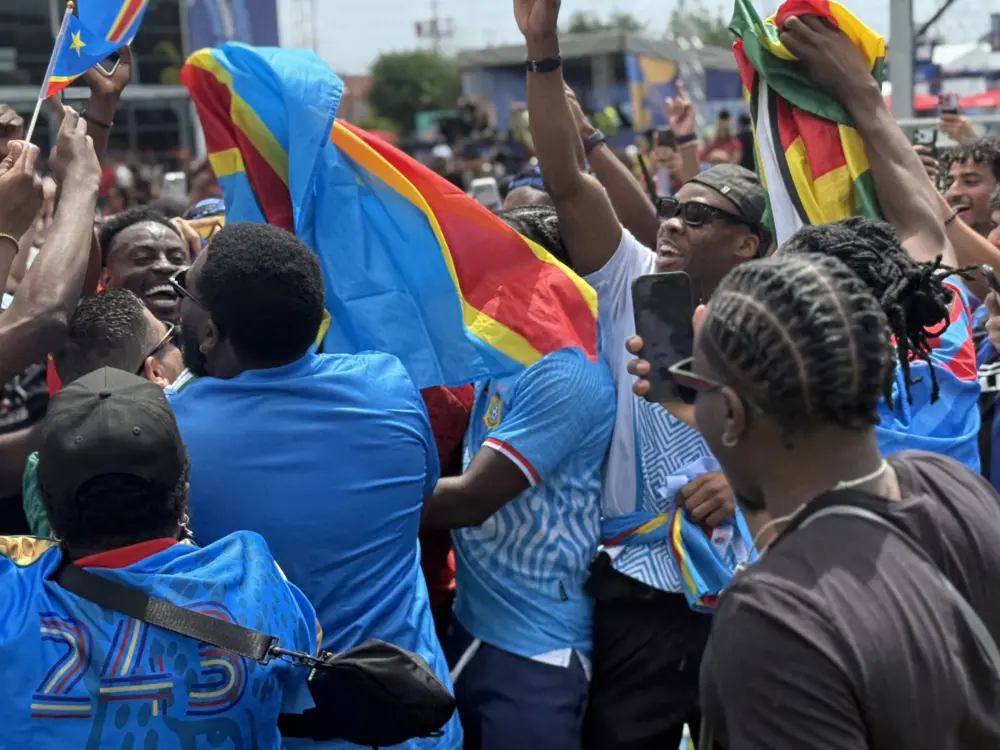
Congolese fans celebrate the team’s opening World Cup match in Houston from the FIFA Fan Fest on June 17, 2026.

That pride goes beyond the pitch. For many Africans, the World Cup is a chance to change how Africa is often portrayed in the media, Osei-Opare said.

“Oftentimes Africa is portrayed as a place of squalor, disease, and where everyone’s trying to leave because everything is so terrible,” he said.

“I think you look at soccer when they cover national teams, and they show the cities, that people are happy, celebrating goals together, they show where players are from, the town and the community,” Osei-Opare added. “It is a great way in which African history, society and cultures can be unpacked for the West.”

The World Cup can be a global microphone that sheds a new light on the continent.

Medard Mikobi, a Democratic Republic of Congo native who lives in Indiana and traveled to Houston to watch games, echoed this sentiment and emphasized the impact of the world stage.

“It’s bigger than the game,” Mikobi said. “The game gives us a chance to have a voice where we don’t have in politics and opens up doors for the rest of us.”

It’s a voice, he said, that doesn’t need translation.

“Everybody speaks a different language,” he said, “and I think soccer is the language that connects all of us.”

If you found the reporting above valuable, please consider making a donation to support it here. Your gift helps pay for everything you find on texasstandard.org and houstonpublicmedia.org. Thanks for donating today.