Winn Morton is not the type of designer you’ll find in your closet. He once told his friend Myra Walker designing regular clothes would “bore him to tears.”
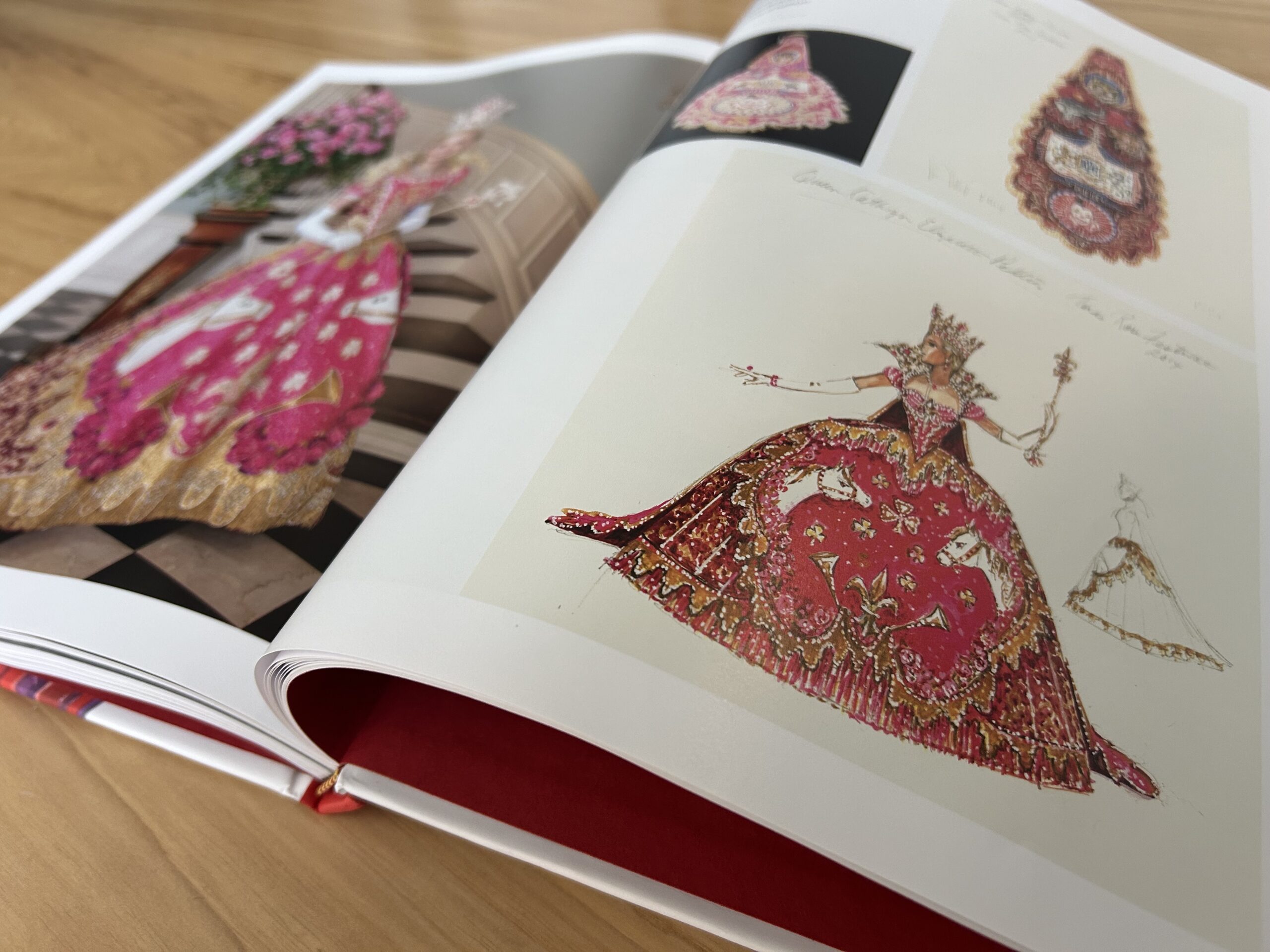
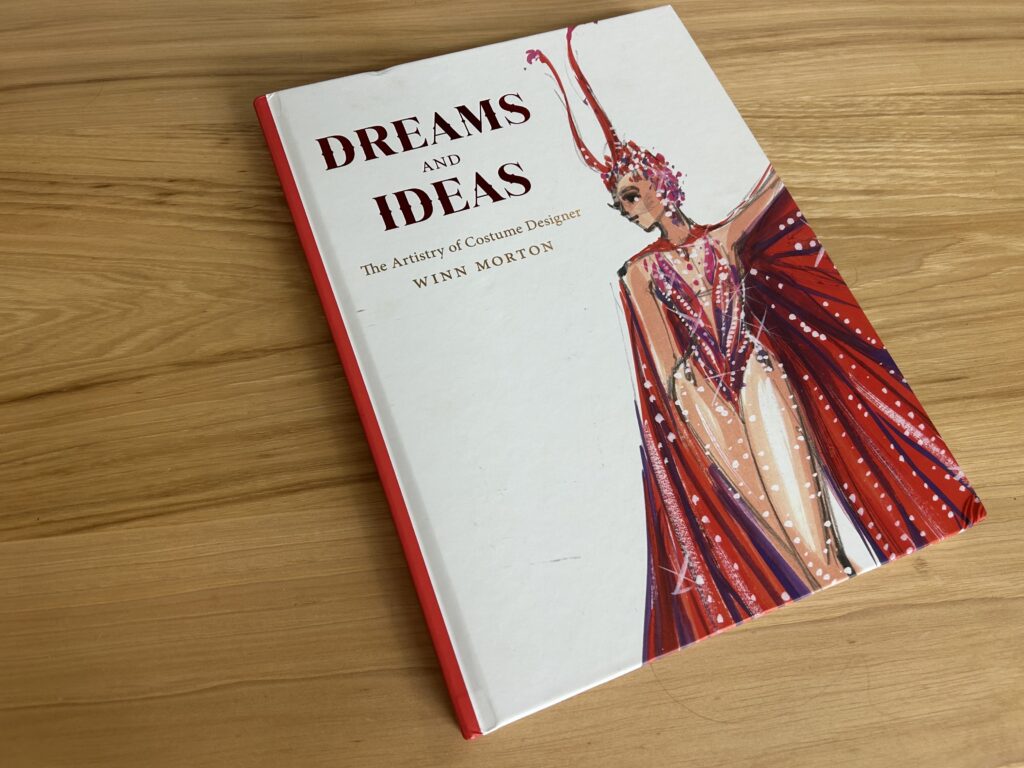
Instead, he designed over-the-top and intricate costumes for Broadway plays, for circuses, for parades and for theme parks. Many of them are on display in colorful, full-page sketches and photos in a new book, “Dreams and Ideas: The Artistry of Costume Designer Winn Morton.”
Walker, a professor emerita of the College of Visual Arts and Design at the University of North Texas, put together the book. But she emphasizes that it has Morton’s stamp on it as well.
“We had a 25-year conversation about this book,” Walker said. “I knew what he wanted… ‘Dreams and Ideas’ is also a title Winn chose.”
Walker met Morton in 1985 when she was looking for a job.
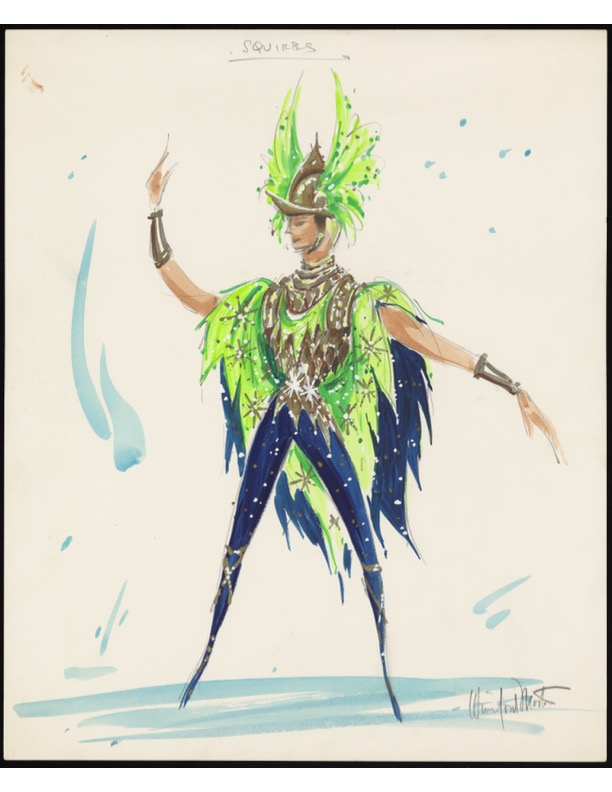
Skating Squires, Roxy Theatre, New York, c. 1956-1958.
“And he says, ‘Well, I am the designer. I don’t do assistants,’ but he said it in a very nice way,” Walker said. “And then he started showing me all these fabulous color photographs of the Texas Rose Festival costumes that he was working on. And he took me to where one of the backdrops was being painted and so I was just, you know, mesmerized – I’d never met anyone like him.”
Morton’s career began in Dallas in the early 1950s. Working for designer Peter Wolf, Morton designed San Antonio Fiesta gowns — which Walker says was a precursor for his later work with the Texas Rose Festival in Tyler.
“And then big job was the State Fair of Texas in 1953,” Walker said. “And there were like 17 huge, like 10-foot by 20-foot dioramas set up. The theme was the storybook of Texas agriculture.”
After that, Morton moved to New York. He was immediately hired by CBS television and designed costumes and dresses for television, including “The Ed Sullivan Show” and “Arthur Godfrey and His Friends.”
“It was a golden age of television,” Walker said. “And yet, if we think about the stage with the bulky cameras and all those cords and, you know, it was all about getting close up to the performers. But Winn, I think, was really longing for a bigger stage. And he got it when he got the job at the Roxy Theatre.”
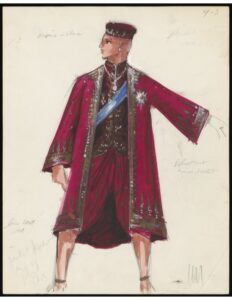
The King of Siam, The King and I, Jones Beach Theater, 1972.
There, Walker said, he was really in his element.
He designed for Roxy Theatre’s showgirls and ice skaters before moving on to do costume work for Broadway and off-Broadway productions.
But by the late 1970s, it was time to make a change. His mother had died and Walker said Morton was ready to return to Texas. He did so in a big way as he was invited to become the designer for Six Flags.
“Throughout the ’80s, it was all about Six Flags, because there were multiple theme parks, and there had to be hundreds of designs for these musical revues,” Walker said.
At the same time, she said, Morton was designing sets and lighting for charity ball parties.
“He’s one of the few artists that did scenic-design sets and costumes and always supervised how the lighting was going to work with all of that. And people don’t really do that – you kind of specialize in the one area,” Walker said. “But he could do it all.”
In the mid-1980s, Morton got the job he’d always wanted, designing for the Ringling Brothers Circus.
“That was a lifelong dream of his, since he was a young boy and seeing them unload the circus train in Dallas, and he was fascinated with the circus,” Walker said.
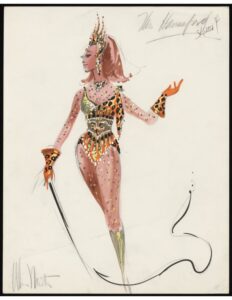
Mrs. Hanneford, sketch 4 (Struppi), Hanneford Circus, c. 1973, Circus World-Wisconsin Historical Society.
The job didn’t last long, however, as the owner who hired him died before Morton’s costumes debuted and his son had different ideas.
“Winn did not like to be constricted by a budget,” Walker said.
Morton’s longest-running commission was the Rose Festival.
“All of the young women are presented in these very elaborate, exciting costumes and Winn always outdid himself every year,” Walker said.
But when it comes to how people remember Winn Morton, Walker said it goes beyond his work.
“Winn loved knowing and working with all of the performers. He liked talking to them,” Walker said. “It could be clowns outside the tent. It could be musical performers for Six Flags — the dancers, the singers. It really made a difference to him to get to know the performers that he was designing for.”
“Dreams and Ideas” is just a small portion of Morton’s work. His archives are housed in the University of North Texas library’s special collection. Walker said her goal with the book was just to introduce people to what Morton did.
“They just don’t make them like him anymore,” Walker said.