Everything’s bigger in Texas, or so the saying goes. What happens when you take that literally?
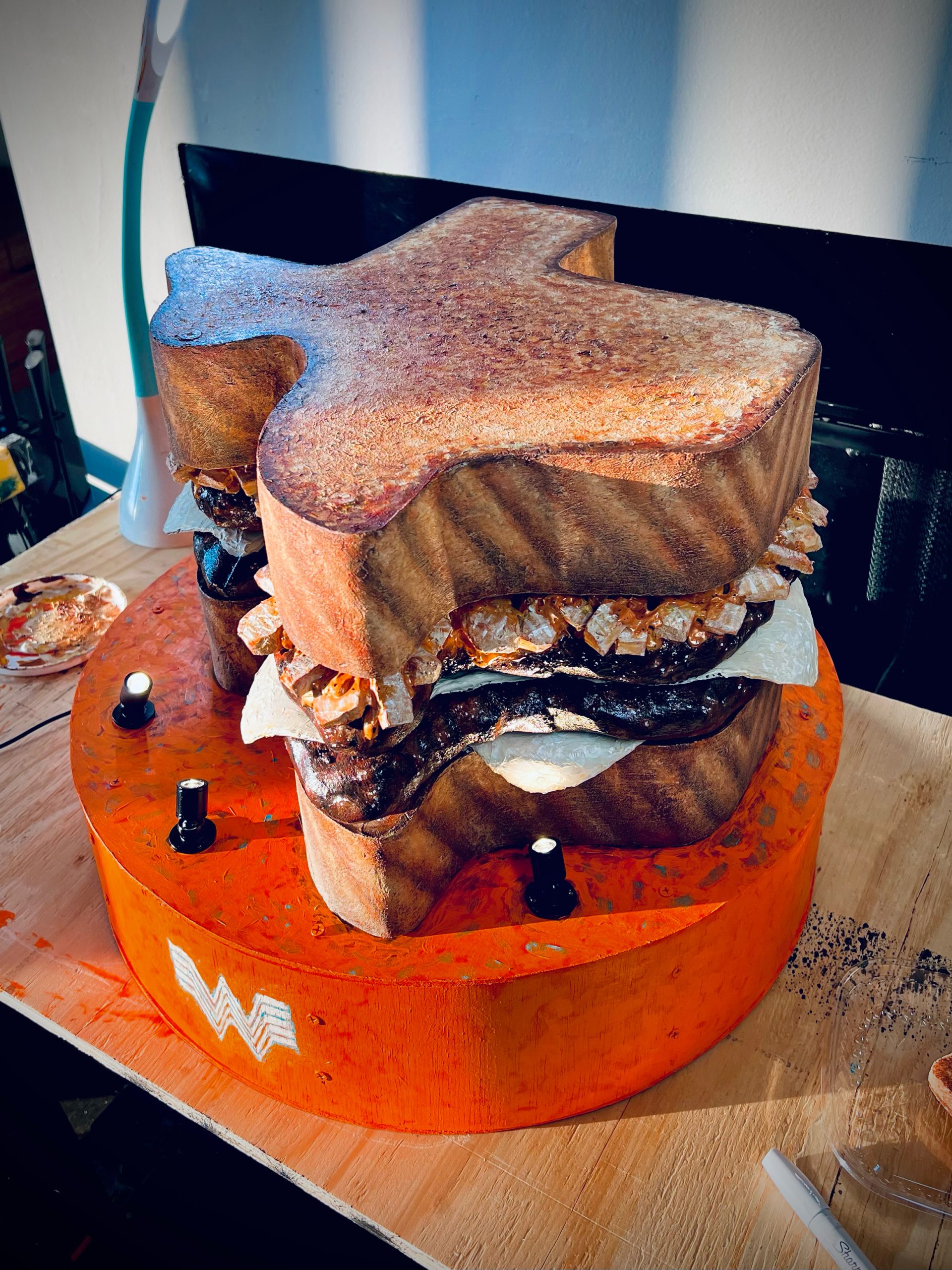
Take piece of Texas toast the size of a road sign, or a vanity license plate that feels less like a piece of metal and more like a monument.
Somewhere between roadside attraction, pop art and social commentary, you’ll find Ken Womack. He has built a career turning familiar objects into objects that are strange, funny, and maybe even a little revealing — and certainly thought-provoking.
GIANT, a new exhibit from Womack, has just opened at the Museum of the Southwest in Midland. Womack joined the Standard to talk about the exhibit. Listen to the interview in the player above or read the transcript below.
This transcript has been edited lightly for clarity:
Texas Standard: We were talking a little bit earlier and you were telling me that you actually got your start not so much in art, but you got into advertising. How much of an influence was advertising on the sort of art that you do today?
Courtesy of Ken Womack
Ken Womack: Out of college, I went to the University of Texas at Austin, graduating in the mid-80s, kind of went directly into advertising because my degree plan was more about being an art director and a designer.
So it was a natural fit, and it allowed me to flex all of the strengths — so design strengths, conceptual, the ability to write… And I love working on TV spots and campaigns and branding and all of that.
So, if you’re looking at my work and you understand my background, I think it’ll be a pretty immediate connection. A lot of the work that we’re doing, or a lot the work that I’m doing, is about big branding and sort of the obsessions that we have with brands and how we sell to one another — which is a direct connection to everything that I’ve been doing for the last 35 years in the advertising industry.
You know, when I first saw some photographs of your work, I immediately thought the age of Warhol and Roy Lichtenstein and all of that. I mean, did you grow up on that stuff?
Oh sure, those are huge influences of mine and I’m proud to steal from all of the greats.
Yeah, I think, you know, we all borrow from everyone. There’s a whole lot of Jasper Johns in the way that I execute some of my painting styles. The larger pieces are very much in the pop art realm. I think they call it post-pop now after Warhol and everything from the ’60s.
Most people who are maybe casual fans of art, when they see my stuff, will consider it to be pop art. That’s okay, that’s cool with me, as long as they like the work and it speaks to them and they’re entertained by it or maybe it causes them to think.
Let me ask you about that strand of this because I know that you have no problem being playful and funny with the art that you do, but you’ve said that there are statements behind many of the pieces.
I’m wondering what the people are missing if they stop at the joke. How do you try to send a bigger message, and is there a sort of through line to these pieces in GIANT?
You know, it’s really interesting because a lot of people look at my stuff and it is very playful on its face. If that’s the way they want to evaluate it and look at it, I’m totally fine with that. Almost all of these pieces have some kind of deeper meaning.
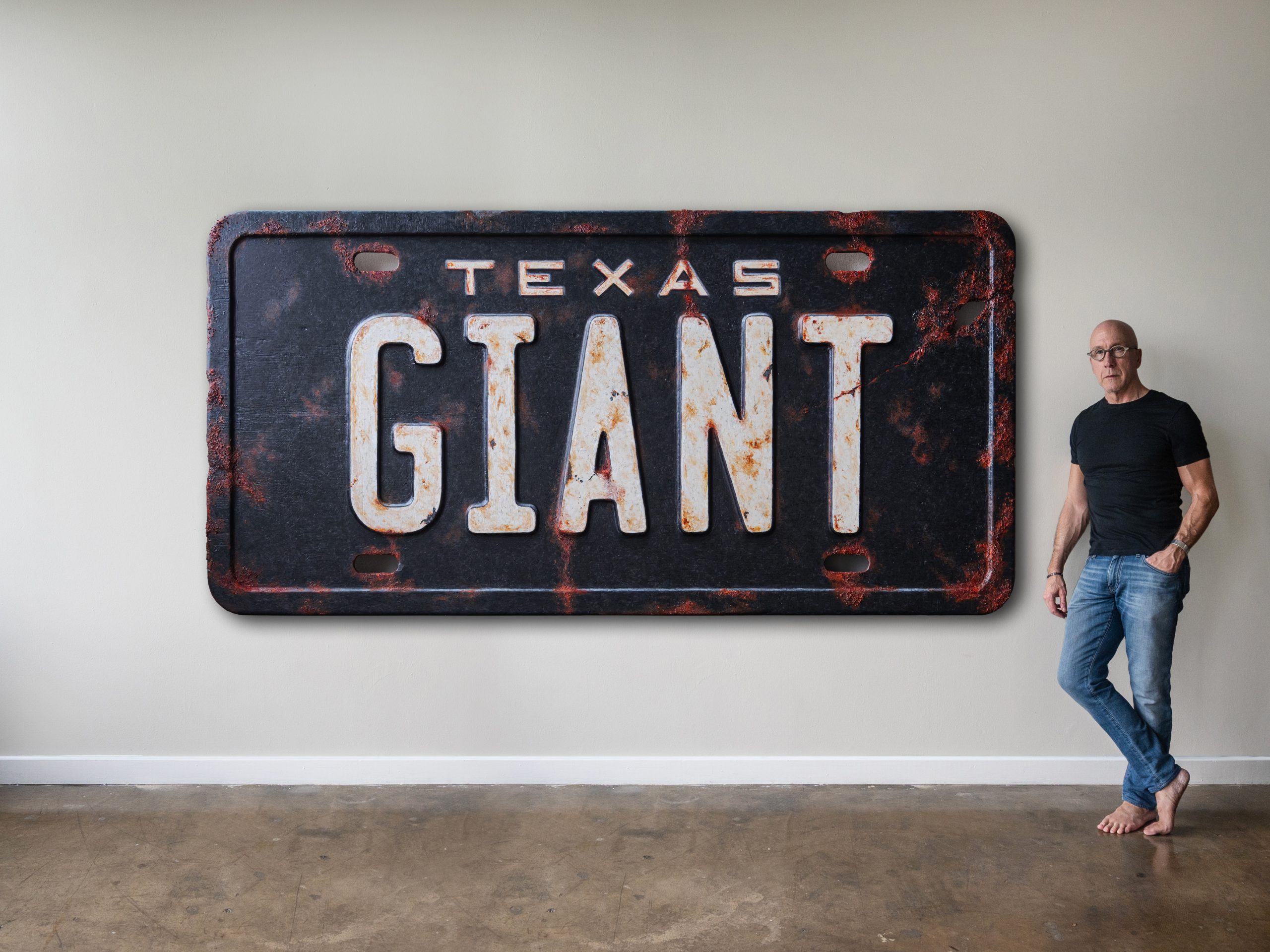
For example, the title piece — which is “GIANT,” the name of the show. The title piece is an eight-foot, rusted-out Texas vanity plate that says “GIANT.” Most people will look at it, and they will just equate it with the state and the big colorful nature of the state. You know, “everything’s bigger in Texas.”
There’s a whole lot of things that go into all of the work and all of different stories, I think, add a richness to the texture of the art statement.
Courtesy of Ken Womack
Tell me a little bit about “Brolaroid.” It’s hard to describe except to say that it’s the biggest Polaroid camera anyone has ever seen, but it also sort of turns the audience into part of the artwork. It must be fun to watch people interact with it.
Yeah, it certainly is. So that piece, if you haven’t seen it, the one that we’re displaying here at the GIANT show is actually the Brolaroid 2. It’s different than a Polaroid camera, which would spit a print out of the front.
It looks like that, but it has a hidden video camera. So when you stand in front of it where the print would normally come out on a Polaroid, that’s a TV, so you see yourself in live action there where the print would be.
So we saw, at Spectrum Art Fair, people are lined up 30 deep to sort of stand there and star in their own movie. If you’ve ever been to a basketball game where they do the kiss cam and lpeople are going to get on TV, they lose their mind. That’s what happens in front of the Brolariod.
It’s just a fun sociological experiment, because you’re watching people star in their own movie. Even though you’re one foot away from them, watching them, they get lost in it and it’s just kind of a cool thing.
Texas is all over this exhibit when you get right down to it — not just geographically, but culturally. And on the one hand, I think, well, some these pieces could only have come from Texas, but I wonder if you’re saying something broader about American culture, because you’re sort of saying something larger about some of that stuff that’s part of everyday life.
We’re always selling everything is kind of at the heart of what a lot of these pieces do and it’s holding a mirror up to society and saying, “are we obsessing over things too much?” Are we placing too much value in things that are consumables or things that are just about the money?
It calls into question what our value structure is.
This is your first solo museum exhibition I understand. You could also say that this is a kind of retrospective of, what, your last five years you’ve been doing this, am I right?
Well, it actually goes back a little bit further than that.
So the oldest piece that I have in this show was from 2018. So it’s a little deeper than that, and it’s my first museum show, and it is my first museum solo show. I’m really excited about that because of it. It’s a big step up for me.
So this will be the first time that the work has really been seen the way it should be, which is a lot of space around it, the ability to light it properly so you don’t have the pieces on top of one another like you might have at an art fair in a gallery where the space is more tax.
What do you plan to do after this? How long does this run, and what’s next for you?
This is a nice long run. So it’s three months long, which I think will give everybody in West Texas an opportunity to come out and see the show. We’re gonna add a piece in July and we’re gonna add “Texas Toast 7” in August. So we’re giving even more reason for people to come in and see this show, which is exciting.
We’re also talking with some different museums about potentially taking some of the pieces and adding those in. And so I think that’s the future, is high-end galleries, different museums and that type of thing. I think that’s the intent there.