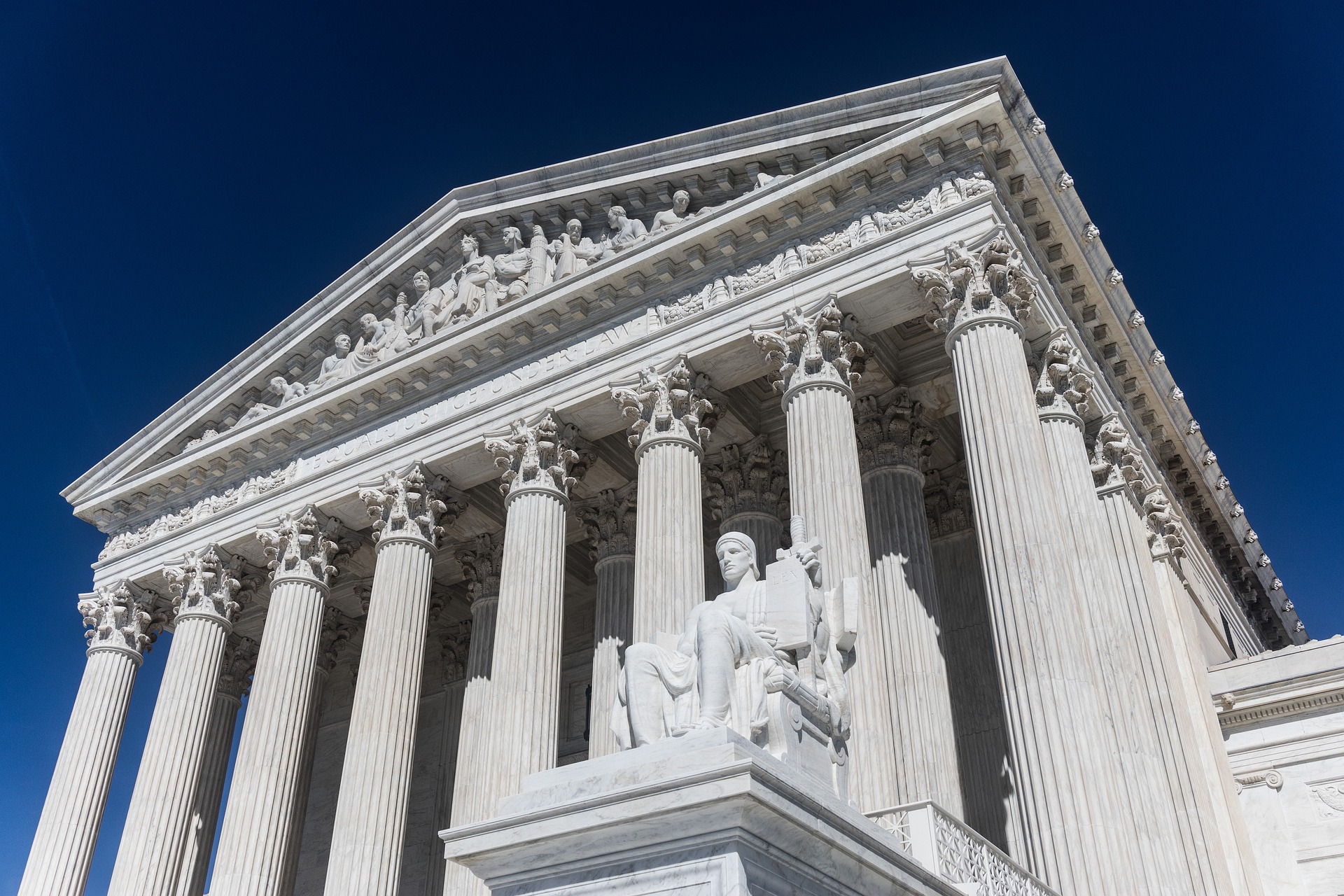
The next few weeks are expected to bring another wave of major decisions from the U.S. Supreme Court as the justices race toward the end of their term.
The court has already delivered a few blockbusters, including a decision rejecting President Trump’s tariffs and another in a Louisiana voting rights case that could make it significantly harder to challenge congressional maps with the argument that they dilute minority voting power.
The court has yet to drop decisions on cases related to birthright citizenship, a gun rights case, and one about executive power.
Seth Chandler, a Constitutional Law Professor at the University of Houston Law Center, said that during oral arguments for Trump v. Barbara, the birthright citizenship case, the justices seemed like they were leaning towards maintaining the status quo.
“The betting line is that the court is going to rule either that the constitution holds that all persons born in the United States are citizens of the United States and that there is no exception in the case of persons whose parents are unlawfully present,” he said.
However, Chandler said the court might take another tact by avoiding the constitutional question and instead focusing on previous congressional statutes related to citizenship.
“The virtue of that ruling is that it would leave it open for Congress to redefine matters,” he said.
However, Chandler said he thinks the biggest case in front of the court this term involves the president’s ability to remove agency heads, as well as the head of the Federal Reserve.
“(This case) really challenges the structure of the government that’s grown up since the Great Depression in which you’ve had independent agencies that are structured to rely on expertise and an ability to escape the political process — which was seen as a feature but it’s now seen by some as a bug,” he said. “(The argument goes that) Article II of the Constitution says that all executive power is in the hands of the president, and if you prevent the president from removing people that he doesn’t like, well, how is he supposed to run the government?”
Chandler said he wouldn’t be surprised by a split decision on this case, where the Court does allow the president to remove agency heads but protects the Federal Reserve.
“I think that would have the virtue of reassuring foreign markets that the money supply in the United States is not going to be entirely politicized,” he said.
The Court is also weighing several second amendment cases.
One is a challenge to Hawaii’s law that prohibits licensed gun owners from bringing their guns on to private property without explicit permission from the property owner. And there’s another case that was brought by a Texas man who’s challenging a federal law that makes it a crime for users of illegal drugs to have a gun.
“The Texas case is interesting in that the guy occasionally used marijuana, which made it a crime for him to own a gun. The question’s going to be, where does the court draw the line? Maybe it would say that people who are addicted to meth or more serious drugs, that the Constitution doesn’t give them the right to own a gun,” he said. “But what about the person who every once in a while takes a hit of marijuana? Are we really going to say that the government can come in and disarm you because of that?”
The Hawaii case does not have that much effect on Texas directly, Chandler said.
“It’s about the default rule,” he said. “In general, a property owner can exclude people from carrying guns onto their property, a sort of a property right that they have. The issue is what do you do when the store is silent, when it doesn’t bother to say anything? Hawaii says the default rule should be that you can’t bring guns onto the property, whereas the Texas default rule tends to be that you can, unless the store owner says that you can’t.”
The Court is also expected to issue decisions on two state bans in Idaho and West Virginia involving the participation of transgender women and girls on women and girl sports teams.
“Again, the betting line is that the court will uphold these statutes and say that they don’t violate the Constitution… or Title IX,” he said. “If they were to strike down either of the statutes, it would potentially have an effect in Texas because Texas has laws that are actually quite similar to those in West Virginia and Idaho.”
The Court is also expected to rule on the constitutionality of the Trump administration’s effort to remove protected immigration status from Syrian and Haitian nationals.
The Temporary Protected Status, or TPS, program was established in 1990. As of last year, there were nearly 1.3 million people from 17 countries living and working in the U.S. with TPS protections, according to Congress.