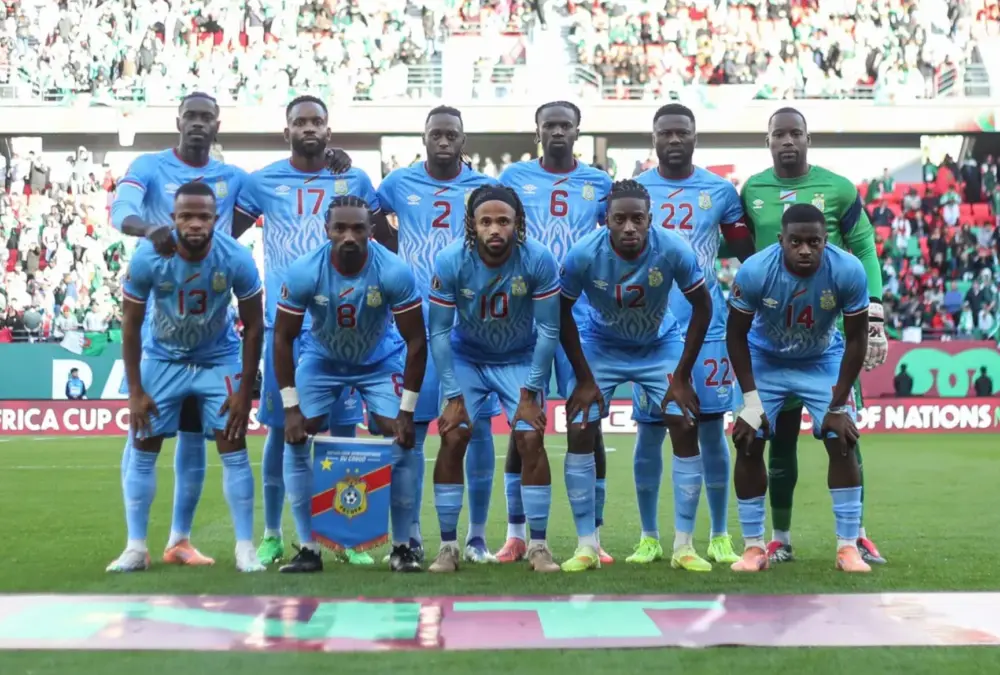
It wasn’t until 99 minutes into the Democratic Republic of Congo’s soccer match against Jamaica in March that the African team scored its first and only goal of the game. But that goal qualified them for the 2026 FIFA World Cup.
To hear him tell it, it only took a minute for Tshiunza Kalubi to buy tickets to Congo’s World Cup debut in Houston on June 17.
“The minute — and I’m not even kidding you, the minute — that they qualified, my wife and I went online and secured tickets,” Kalubi, a Congolese Houston resident, told Houston Public Media. “For a lot of people, just seeing that Congolese flag and knowing that it’s going to be represented on the world’s biggest stage, I have never experienced anything like this.”
For Kalubi, and many other fans of Congo’s national soccer team, this was a moment to be witnessed in the nation’s sports history. In its current entity, the country has never before qualified for the FIFA World Cup.
“It means everything,” Marcus Mpwo, a Houstonian born and raised in Congo, told Houston Public Media. “Me seeing them live here at home will probably never happen again in my whole lifetime. Maybe not even in my kid’s lifetime. It’s really a once-in-a-lifetime chance.”
That dream, though, may be upended for many fans. An outbreak of Ebola in Congo — with more than 1,000 suspected cases and 250 suspected deaths — has resulted in travel restrictions by the U.S. government. On May 18, the Centers for Disease Control and Prevention (CDC) and the Department of Homeland Security (DHS) temporarily suspended travel for non-U.S.-citizens coming from Congo and other countries affected by the epidemic.
The team itself has been cleared to enter the United States, according to Congo’s ambassador. But those restrictions, which are in place for 30 days, mean Congolese soccer fans may not be able to come to the match in Houston on June 17.
“We’ve got our happiest moment in the World Cup,” Kalubi said. “And unfortunately, it’s going to be counterbalanced by this outbreak of Ebola.”
A nation of many names
“During the 20th century,” the soccer team’s website reads, in the nation’s official language of French, “the country had several names.”
For much of the 1900s, Congo had been colonized by Belgium, before gaining independence in 1960. At one point it was the Republic of Congo; then, it was the Democratic Republic of Congo; in 1971 it became the Republic of Zaire. Finally, in 1997, the nation returned to its name today, the Democratic Republic of Congo. That’s not to be confused with its neighbor to the west, the Republic of Congo.
Since the ‘90s, several conflicts have shaped the country and brought it to international attention. Last year, Congo and Rwanda entered a peace agreement, mediated by the United States. In December, Congo and the U.S. entered a “strategic partnership“; last month, 15 people were deported by the U.S. government into the DRC.
In 1974, Congo became the center of the world of sports for one night. In a major upset, Muhammad Ali defeated the then-undefeated and undisputed heavyweight boxing champion George Foreman in Kinshasa. That match, billed as “The Rumble in the Jungle,” was one of the most-watched live broadcasts in history and has been called one of the most important sporting events of the 20th century.
“It just brought so much pride to the country,” Kalubi said. “I would say that for this generation of Congolese … this [2026 World Cup] is that generation’s equivalent.”
What is the Congolese Association Football Federation?
Though this will be the first time the Democratic Republic of Congo will compete in the FIFA World Cup, it’s technically true in name only.
In 1974, when Congo was called Zaire, the national soccer team became the first sub-Saharan African nation to compete in the World Cup, where it was eliminated in the group stage.
But this will be the national team’s first appearance since then, and the first as the DRC national football team, which goes by the nickname “the Leopards.”
Its governing body, the Congolese Association Football Federation (FECOFA), was founded in 1919 when the nation was still colonized by Belgium. FECOFA became affiliated with FIFA in 1962, and it became a member of the Confederation of African Football (CAF) in 1963.
Currently, the Democratic Republic of Congo is ranked 46th in FIFA’s ranking of men’s soccer teams across the globe. It’s a long shot bid for the international title, but one Congo fans are still excited about.
Their match on June 17 will be against Portugal, one of the top teams in the world. They’ll also face Colombia on June 23 in Guadalajara, and Uzbekistan on June 27 in Atlanta.
“They’re super excited to come to Houston,” Houston host committee president Chris Canetti told reporters on Wednesday. “And we’re ready to welcome them with open arms and give them a great Houston experience.”
Living and practicing in Houston
In June, the Congo team will make a journey across the Atlantic Ocean to H-Town, where it will be based throughout the tournament.
Though the exact date of arrival has not been finalized, officials with the Houston World Cup host committee predict their arrival will come around June 10 or 11, just as the World Cup kicks off in Mexico City.