From Inside Climate News:
At least six small cities and towns in the Coastal Bend region of Texas issued disaster declarations in the last two weeks, begging not to be forgotten amid a spiraling water crisis.
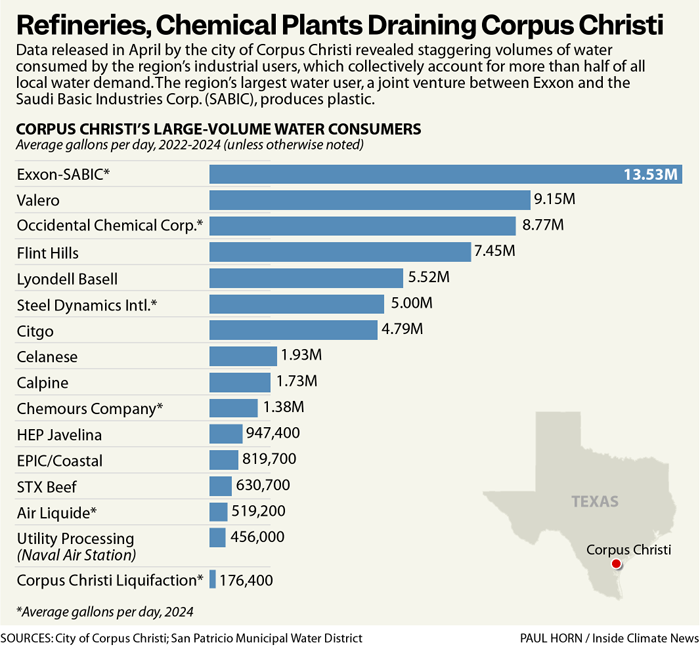
All attention lies on the city of Corpus Christi as it grapples with the growing likelihood of an unprecedented disaster. But Corpus Christi, the eighth-largest city in Texas, doesn’t just provide water to its own industries and residents. It supplies the entire seven-county region, including 20 other municipalities.
“Everyone is like, ‘What the heck is going on and what do we do?” said Elida Castillo, mayor of the small town of Taft, which issued a disaster declaration on April 21. “I’m just trying to figure out what we could do.”
Castillo recently organized a town hall meeting on the water crisis for the 3,000 residents of Taft, but officials from Corpus Christi didn’t show up. She hasn’t heard much from county or state officials either. She is getting a sense that nobody knows what to do, and she isn’t alone.
Amy Hardberger, director of the Center for Water Law and Policy at the Texas Tech School of Law in Lubbock, said most Americans can’t wrap their minds around the grave implications of empty reservoirs. Those who can feel deeply unsettled by what is happening in Corpus Christi.
“It’s not my goal for other people to be panicked,” she said. “But many of us are very scared.”
If Corpus Christi becomes the first modern American city to run out of water, it would take most surrounding communities with it. Up the coast of Corpus Christi Bay, the cities of Ingleside and Aransas Pass, with a combined 19,000 residents, issued disaster declarations on April 22.
“There should be some type of legislation that will assist us now, rather than in the future,” said Ingleside City Manager Brenton Lewis. “All these small cities that have declared disasters are looking at alternate water supplies.”
The towns of Three Rivers, Orange Grove and Alice also issued disaster declarations in the week prior.
“Regional water demand is exceeding available supply,” said an April 14 declaration from the City of Alice, population 17,000. “Continued drought conditions threaten public health, safety and welfare, as well as essential public services.”
Alice, however, expects to fare better than other communities. Last July it cut ribbons on a groundwater desalination plant, a decade in the making, owned and operated by an investor-backed water treatment company called Seven Seas.
“They have a profit margin,” said Alice City Manager Michael Esparza. “We are paying a private company to do something for us. It’s no different than we do with a lot of things. Although, this one is pretty big because it’s our water.”