From KERA News:
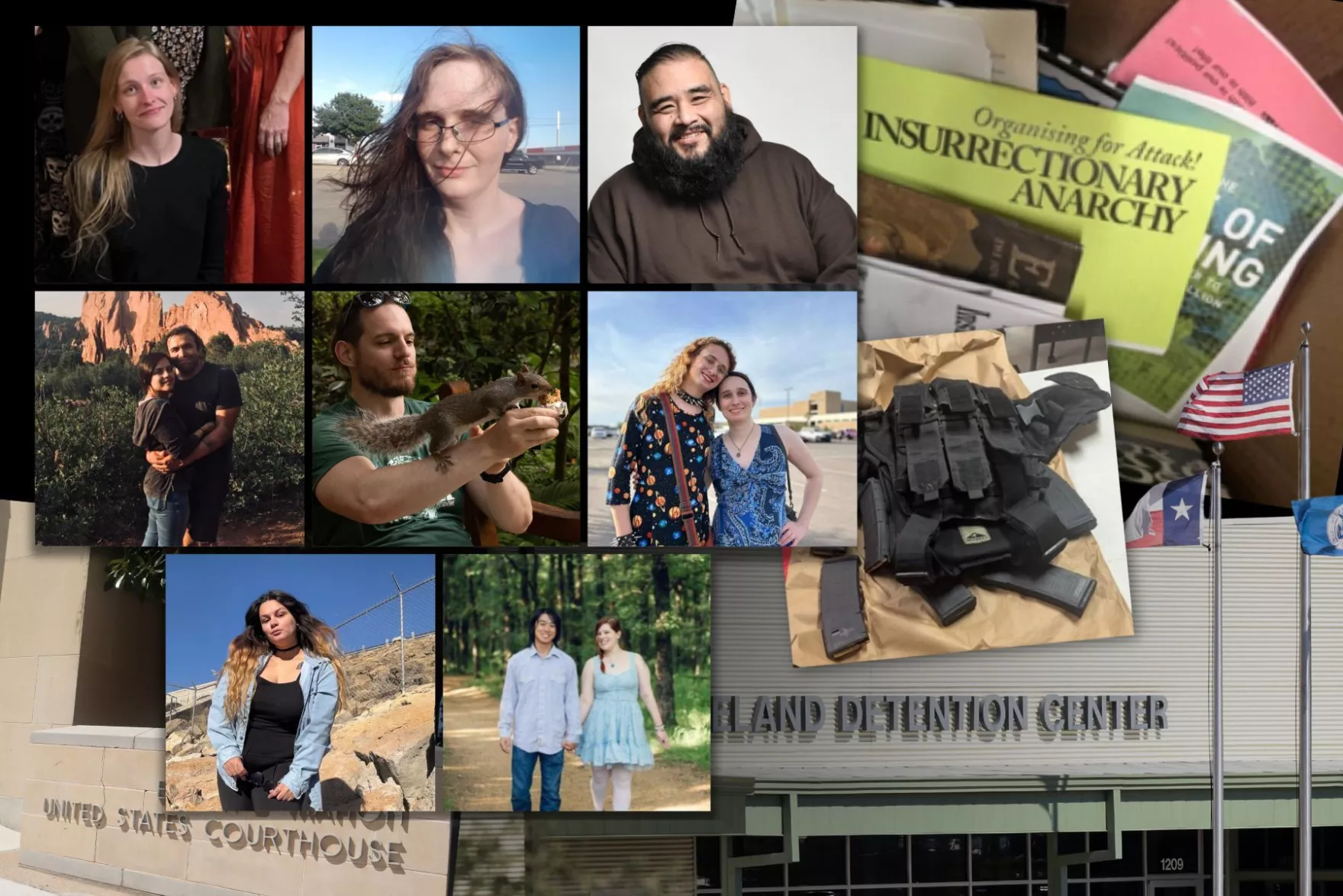
Prairieland ICE detention center shooter Benjamin Song was sentenced to 100 years in prison Tuesday, with others getting 30 years or more for their role in a July 4, 2025 immigration protest turned violent.
Song was convicted of attempted murder for shooting and injuring an Alvarado police officer outside the Prairieland Detention Center during the demonstration.
U.S. District Judges Mark Pittman and Reed O’Connor also sentenced seven others, who were convicted in March of playing a role in the nonfatal shooting of Alvarado Police Lt. Thomas Gross outside the ICE facility as part of an “antifa” cell.
Maricela Rueda was sentenced to 70 years for her role that night nearly one year ago. Autumn Hill, Zachary Evetts, Meagan Morris, Savanna Batten, and Elizabeth Soto were all sentenced to 50 years. Daniel Sanchez Estrada was sentenced to 30 years.
All defendants who were present at Prairieland the night of July 4, including guilty plea defendants Nathan Baumann and Seth Sikes, will have to “jointly and separately” pay $4,408.95 to the Prairieland Detention Center.
Before Pittman read his sentence, Song — sitting in the jury box with an orange striped jumpsuit and cuffs — told the court he doesn’t hate cops, Trump or Nazis.
Song called the idea that he intended an ambush the night of July 4 “impossible.” Rather, when he saw Gross exit his car and point his gun at another defendant, Song said he saw his “worst nightmare” and feared an instance of police brutality.
Song was glad, he said, that the people at Prairieland didn’t end up like Renee Good, Alex Pretti, Botham Jean, Atatiana Jefferson and other people killed by law enforcement.
Song also denied antifa — short for anti-fascist — had anything to do with terrorism, or that it was a group of which he was a member of. He defended anti-fascism as an ideal.
“What kind of people are not against fascism?” Song said.
Pittman warned Song multiple times not to make a political statement and instead testify about his own character. The judge said Song had “obviously” not accepted responsibility and showed no remorse.
Pittman also struck down Song’s attorney Phillip Hayes’ attempt to mention evidence he said proves Song fired his gun at the ground as suppressive fire. Pittman said it’s “by the grace of God” that Song and others are not dead.
“If we’re in a day and age that we use suppressive fire at an officer trying to stop a riot, we are in a really, really bad point in our history,” Pittman said.
Sanchez Estrada also denied ties to antifa as a domestic terrorist group.
“I’m many things, your honor, but I’m not a terrorist,” Estrada told O’Connor.
Song, Hill, Evetts, Batten, Morris, Rueda, Elizabeth Soto and Ines Soto were convicted of rioting, providing material support to terrorists, conspiracy to use and carry an explosive, and use and carry of an explosive — the explosive being fireworks.
Song was also convicted on three counts of discharging a firearm.
Sanchez Estrada was convicted of corruptly concealing a document or record. He and Rueda, his wife, were convicted of conspiracy to conceal documents.
Seven more people — defendants Nathan Baumann, Joy Gibson, Susan Kent, Rebecca Morgan, Lynette Sharp, John Thomas and Seth Sikes — pleaded guilty last year to providing material support to terrorists in connection with the shooting. They face up to 15 years in prison.
Those defendants and Ines Soto, who was convicted during trial, will be sentenced July 1.
The sentencing comes three months after a three-week-long trial in Pittman’s court, during which prosecutors argued the group was part of a broader cell that shared anti-ICE and anti-government beliefs. Jurors heard directly from the injured lieutenant, the government’s expert witness on antifa, and the defendants who cooperated with prosecutors.
The jury did not hear witnesses or see evidence from the defense. Instead, defense attorneys chose to rest immediately after the government rested its case.
The defendants and their attorneys argued the protest was supposed to be a peaceful noise demonstration in support of the immigrants inside the detention center, and they never intended for things to get violent.
Twenty-two people have now been accused in state courts, federal courts or both of playing a role in what happened the night of July 4.
Federal officials have called this the first domestic terrorism case targeting antifa since President Trump declared the ideology a domestic terrorist threat last year. Experts told KERA News the outcome could determine the playbook for how the Trump administration targets alleged left-wing violence, even though the charge of providing material support to terrorism was not necessarily related to antifa or any set of beliefs.
Similar cases are being tried across the country. Most recently, Minnesota prosecutors alleged 15 people charged in a conspiracy to injure federal officers earlier this month are tied to antifa groups.
“The Trump Administration has made it clear: Antifa terrorists and their networks will be investigated, disrupted, prosecuted, and neutralized with the full force of federal law,” the White House wrote in a press release earlier this month about what it said were arrests of antifa “militants” and “thugs.”
Defendants and their supporters accuse the administration of politically persecuting them for their beliefs.