A house fire in the middle of the night at the fictional home of April and Leo Taurus — it’s the kind of moment that resets everything. What do you take? What do you leave behind? And what lingers after the flames are put out?
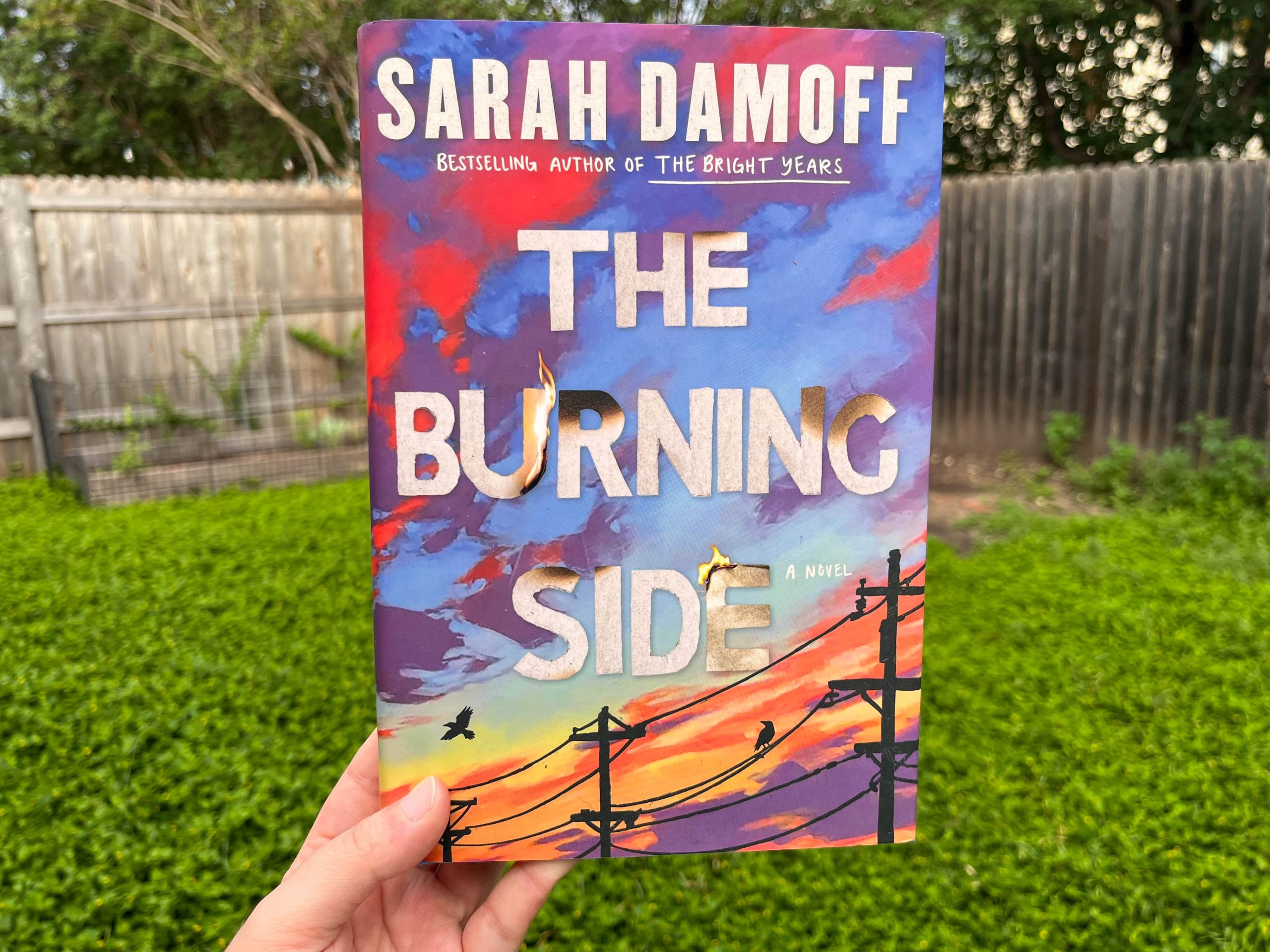
In “The Burning Side,” author Sarah Damoff places a family in that very crisis and follows the fallout as they retreat and regroup at April’s childhood home in Dallas and confront the things that were smoldering long before the flames.
It’s a story about a marriage under pressure, issues surrounding aging parents and having young kids, and what can for many be a very uneasy question about what home really means.
Damoff joined the Standard to talk about the novel. Listen to the interview in the player above or read the transcript below.
This transcript has been edited lightly for clarity:
Texas Standard: I suppose I’ve always thought that people who are writing fiction are drawing from their own experience, and I raise that because I wonder why you chose this setting, these particular characters for your sophomore novel?
Sarah Damoff: Yes, I agree. The connection between fiction and reality is often inseparable. Even if most of what’s on the page is imagined, it comes from something that we have experienced, witnessed.
And for me, with “The Burning Side,” I spent a year and a half when I was newlywed, expecting my first baby, living with my husband’s grandparents. His grandmother was sick and his grandfather was healthy and so he just needed help taking care of her so he would be able to leave the house and not be alone in the house with her, essentially as she was in her last months of life.
And so I had this experience that was very formative for me as a young, married person who was at the beginning of the story of my family. Every night I got to sit down at the table and have dinner with this couple who had been married for 56 years and they were in their final chapter.
And I knew, even then in my early 20s, that this was giving me a unique perspective that not a lot of my peers or people in the same life stage might be able to have. I just felt like there was enough material there to feed my imagination, to tell the story of two very different marriages under the same roof.
How did the writing process itself compare to your first book now that you’ve had that experience under your belt?
That’s a great question. It was very similar in that I kind of got in this tunnel with my characters. It was a little bit harder to do with the second book because now I have readers. And I have to not think about them when I’m there with the characters. I have to save the readers to think about them later.
Now I will say that because of the timing of publication, I got to draft most of “The Burning Side” before my first book, “The Bright Years,” had even come out. And so it was kind of quiet before the storm.
And one other thing I’ll say about this process is I had sold “The Burning Side” on proposal, which means my publisher was expecting it. I was on a deadline. That was different from my first experience.
And I think now that I’ve done both, I prefer, even if it’s a bit of a risk, to kind of write all in secret on my own before I show anyone. And hopefully once the whole book is written, then they’ll want it and they’ll enjoy it.
But those were some of the differences between the two processes.
Did you feel like there was a little bit of pressure there to deliver and to meet other expectations, that sort of thing?
A little bit. And honestly, for the drafting process, I put this on myself. My publisher, I think, would have been flexible either way. But because I had pitched them a certain story with a certain arc and ending, I thought, what will happen?
Because of the way I write, I really discover as I write on the page. And so I wondered what would happen if the story leads me in a completely different direction, which it really didn’t. There was one surprise and the publisher was great with that.
But it was different than being completely on my own with a story that was only in my head and heart — to have people that were waiting for it and expecting it. So there was a little bit, even though my publisher was wonderful, really this kind of self-imposed pressure to do what I was supposed to do.
I want to shift into the characters of the book, especially April, because she’s experiencing what I think a lot of mothers experience when it comes to shouldering so much of the emotional work of family life.
Can you say a little bit more about her character and what you drew from to write her?
Absolutely, yes. So April is in an interesting position because she now has still two young kids as well as what we find out very quickly in the book is that her father has a diagnosis of early onset Alzheimer’s.
And so she’s in the sandwich generation, where she’s a caretaker on both sides — all while her own marriage is crumbling and having to figure that out.
We also get flashbacks over the past 10 years to find out some secret histories they have, how they got to the point where they are. And in those flashbacks, we see that she has also, very recently, really struggled with postpartum depression. And so there’s a lot of pressure on her. And she doesn’t always handle the pressure in the best way.
But it was, as I discovered her and wrote about her — and I am a mother and I have friends who are mothers — it was, to me, what felt the most honest way for this character in these circumstances.
Now, let’s talk about Leo now. How did you try to get across with that character?
So Leo and April are married and come from very different backgrounds. And as that happens, oftentimes in a relationship, you know, it becomes this kind of pressure position, this kind of mirror. It can be very beautiful or it can be difficult.
April comes from a warm family with wealth and resources. Leo comes from a very broken home and severe poverty. And they come from different cultures. Leo is Mexican-American and so his story is the one that really surprised me because I knew we were going to live with the in-laws for the summer and he’s very close with April’s entire family.
As often happens in a marriage, it’s not just the two people that are part of the partnership. It’s the whole family and those interwoven relationships. And so he’s close with her family especially because he came from this very broken family.
He’s really not in touch in the present day. But as I was writing to him, I realized how much his past and his family had formed him and had shaped him and how many unanswered questions he had about his own upbringing that were really important, even if he had married into this wonderful family.
And he’s now asking those questions as his marriage crumbles: Just what are his roots, what happened in his own family of origin, and how that’s still really important to anyone, even if they kind of find this found family later on.
You know, when you have a relationship that’s falling apart, quite often, there’s a lot of blame that becomes sort of in the spotlight, but there’s also this sense of guilt. And especially for April, you write about it in a very intimate way.
I’m wondering if you could say more about how universal you think that feeling is in family life. It’s not just in, you know, the end of a relationship, but in families more generally?
Yes, that’s a great question. I think it’s pretty natural, as we were kind of discussing earlier about, will readers assign blame? I think that is just part of human nature. And I think we want to find fault whether a person is more inclined to always blame themselves and kind of carry that shame and guilt, or whether they’re more inclined to always blame the other person.
It really comes down to this very human question of why? Why is this thing happening? Typically, if you’re talking about fault and blame, we’re asking the heart of the question, the core of it, is why is this pain happening? What caused this pain? How could we have prevented it or how could we prevent this pain in the future?
Even if we might not know, that’s really what we want to know and what we’re asking. We might not be able to articulate it when we’re quick to put blame on ourselves or other people.
But really that is the question, and that’s a shared universal experience because obviously, we don’t want pain. We want to avoid pain and conflict. And so what is the cause of that pain is kind of the root. And I think the difference in a healthy relationship or an unhealthy family might be, how are we able to look at this a little more objectively and oftentimes there is blame.
It’s not to say that there’s no blame or that people don’t do things wrong, but how can we look at it? Usually, there are wrong actions by more than one person. And so how can we look at that very honestly and address those?
You know, working here at the Texas Standard, I’m often thinking about, is there something here that was especially Texan to you about the way that this story unfolds? Obviously, there’s the component of Leo and his background, but is this a story that could be told anywhere, do you think, or does Texas become a kind of background player, if you will?
I think it’s somewhere in between the two — a lot of the relational dynamics and the multigenerational-under-one-roof family dynamics, relationships that really could be set anywhere.
But Texas is important and I would say it’s specifically interesting to look at it in the context of Leo’s character and his background, because he is Mexican American. Both of his parents came over from Mexico, did not have a network or community or easy time of it. And that is a big part of how he grew up and what shaped him.
I had a reader ask, why make Leo a minority? And I said, well, actually, maybe not everyone is aware of this, but in Texas, the largest ethnic group is the Hispanic demographic. I’m a Texas native. And so, to me, I really feel like writing is like transcribing what I observe around me.
And I wasn’t intentionally like, “I’m going to write about this thing.” I just was like, okay, what is the common experience of marriage here in the place where we’re setting this, which is Texas?
And so I think that I think Billy and Deb are very kind of typical Dallas people, and that’s all there. And there are some fun certain settings that are familiar for us as Texans.
But really, this experience of Leo’s arc with his parents and his experience being Mexican American and then in a marriage where he didn’t marry into that same culture, that can happen anywhere, but it’s more prevalent here in Texas.
This idea of what home really means… You know, I know that in the process of thinking about other people’s situations, the answer to that question — what home means — sort of is revealed in the details.
And I’m curious if that happened for you as these characters were sort of developing in the flow of this. And I’m thinking, too, for the reader, whether home is really as much a part of the story as the relationship itself?
You know, I’m always learning alongside my characters and I’m always exploring through the process of putting words on the page. And it is something that I personally have thought about a lot, just what is the meaning of home.
And in the writing of “The Burning Side,” there was a complimentary experience. On the one hand, I wrote about a house that burned down and a couple that, you know, this is a metaphor, but it also is a physical reality for them. They’re losing things on multiple levels, multiple layers.
And in the process of drafting this book was when the L.A. wildfires happened, I had already written the scene. I had already been halfway into the book. And I remember just really getting sucked into watching interviews of people who had lost their homes in those wildfires, and just the reality of our material possessions are a gateway to memory.
You know, anything we might touch or feel sensorially is evoking something in us — memory, identity. So material things mean more than just what they are, and a home is maybe the epitome of that.
And so it is actually important, the place where we find ourselves. So not to diminish the importance of that at all, but then it is so interconnected with who we share that place with.
Our identity and the importance at home is always going to be connected to the people that are there and the relationships that fill it and the memories that it makes up. And we really go deeply into exploring memory through Alzheimer’s, but even through April and Leo and how their memories differ from each other and how the losing of their physical place evokes memories in them.
So it was a very two-fold experience of like, this is an important thing, our physical place, but it is made important by the people we share it with. And so when we lose that, what we hold on to is those relationships and what we’ve taken from that place.