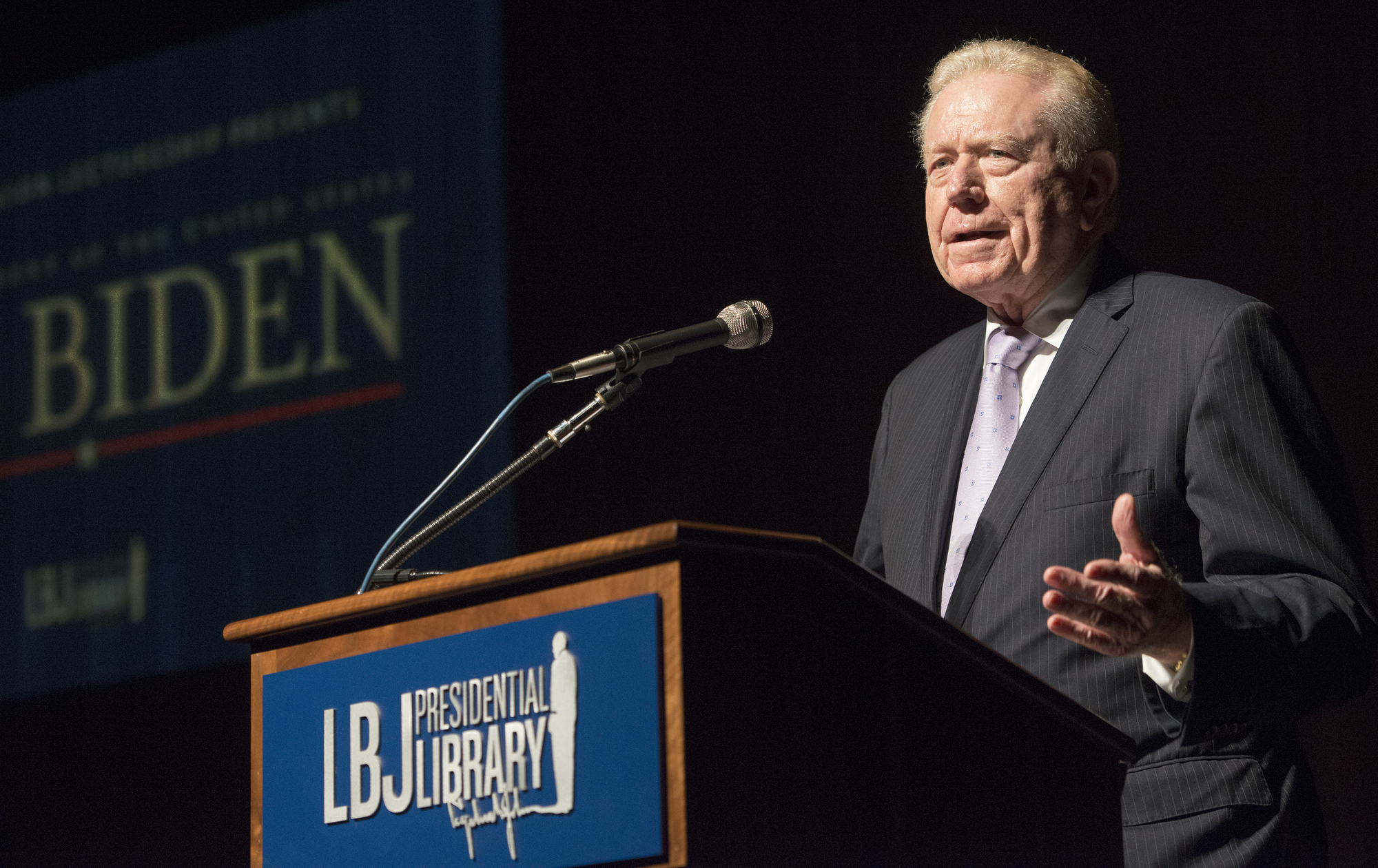
Ben Barnes was first elected to the Texas Legislature at age 22. By 26 he was Speaker of the Texas House — and Lyndon B. Johnson was predicting he’d be president one day.
Today, Barnes, who went on to serve as Texas’ lieutenant governor, is still something of a political kingmaker at age 88. His new book, “Get It Done: Seven Decades of Lessons from a Political Legend,” reflects on his time in politics.
Barnes grew up on a small peanut farm and didn’t have much exposure to politics in his young life beyond his father’s support for Franklin Roosevelt.
“Of course, we didn’t have television then. As a matter of fact, we didn’t have electricity at my house until we were in the eighth grade,” he sa id. “But we would listen to FDR’s fireside chats on a radio.”
Barnes did not think about running for public office as a young person. By the time he was in his early 20s ,he was more focused on his coursework at the University of Texas at Austin.
“It was beyond my wildest dreams that I would run for office so young and really, quite frankly, run for office without any money. And that was the most difficult thing,” he said. “I literally knocked on every door in the three counties in Central Texas. And if I had not knocked on the doors, I don’t think I would have had a chance to win.”
Barnes said the work ethic he picked up from farm life was key in his early political career.
“We had to work or we weren’t going to be able to hang on to the farm — we weren’t going to survive or make a crop,” he said. “So hard work was something I was used to, but I really felt like that this was a chance for me to do something.”
He was also influenced by a high school English class in which he read Les Misérables, which introduced him to ideas of justice and revolution.
“It was the fact that I realized that you could have a real impact, no matter how old you are,” he said. “Those young teenage children in the streets of Paris made me think that I was maybe 21 and wasn’t too young to run.”
He said he hopes the lessons imparted in his book will inspire young people today who may have an interest in politics. Barnes said he has a lot of lessons learned.
“Always be the most prepared person in the room. Do your homework, understand more about the subject. Don’t talk too much and don’t try to brag about how much more you know than anybody else in the room,” he said. “People will listen to you if they think you really understand and have really done some research and have got some judgment.”
Barnes developed relationships with some of the biggest names in Texas politics: Not just Lyndon Johnson, but also Gov. John Connally, who Barnes served under when he was lieutenant governor.
“John Connally was one of the most persuasive individuals that I have ever known,” he said. “Certainly, we did have disagreements. But I always felt like that John Connally still respected me and still was willing to work with me. And as we worked together more and more, I became more comfortable disagreeing with him.”
Connally was governor during a big shift in the Texas higher education system as the state became more urban and less rural.
“If he hadn’t recognized that we need to spend the money on research and development and be willing to spend the political capital to pass the tax bills to pay for that education, that’s what’s helped make the University of Texas and Texas A&M (what they are today),” Barnes said. “It’s been very, very beneficial for the past 50 years.”
Barnes also served alongside political titan Barbara Jordan, who represented Houston in the 1970s.
“She was, a very young person coming to the Texas Senate, the first Black woman to serve in the Texas Legislature. And I was a 26-year-old Speaker of the House. And we were both young. And we both had our doubts in some ways about how effective we were going to be,” he said. “But Barbara Jordan had the courage and had the charm and the veracity not to sit on the back row and be very quiet. She soon understood that she could be effective and that people would listen for her. And she had a tremendous voice.”
Barnes lost the race for governor in 1972, at which point he had been in public office for 12 years. Rather than worrying too much about the defeat, Barnes said he was ready to switch careers.
“I felt like that I had ample time to use the tools that I’d honed and being in public office in Texas,” he said. “And while I didn’t have any ambition to go run for public office again, I had ambition to keep serving the people of Texas and from the private sector rather than the public sector. And I knew I still had a good full life ahead of me. And I was going to be able to spend time with my children, my family, and I was going to have another chance to make good and accomplish some things.”
Barnes said looking back on his political career, he feels the thing that separates the politicians with staying power versus the ones without is a reputation for integrity. He said that is what sticks out to him about his time working with LBJ and the landmark legislation that was passed during LBJ’s time in office.
“You have to have a reputation of someone whose word is good and who’s going to always do their best to tell the truth,” he said. “You think about the sixties and the unrest in the background of Vietnam, the background of assassination of a president, of a president’s brother, and of the predominant Black leader in the United States, Dr. Martin Luther King. What a background of fear and destruction and animosity.
And quite frankly, we’ve got way too much hatred today. There was hatred in the air there, but Johnson took all those negatives ad combined them and created a policy to pass that very important legislation.”