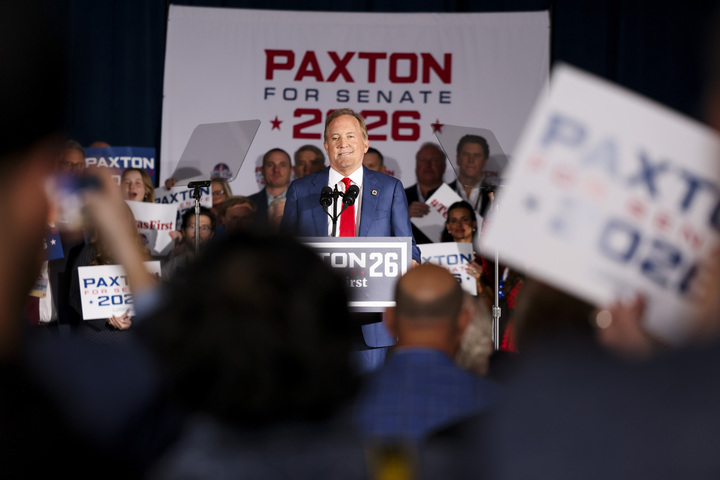
Some Texas Republicans are worried that Attorney General Ken Paxton’s nomination for the U.S. Senate could complicate races farther down the ballot during the upcoming November midterm elections.
Sen. John Cornyn, before losing the primary runoff in May, warned that down-ballot GOP seats could be at risk if his opponent, Paxton, was the nominee. Now, Paxton is set to face Democratic nominee Texas State Rep. James Talarcio this November.
Could Cornyn’s prediction become a reality?
Eleanor Dearman reports on state politics at the Fort Worth Star-Telegram. She joined Texas Standard to discuss. Listen to the interview in the player above or read the transcript below.
This transcript has been edited lightly for clarity:
Texas Standard: Let’s talk about something that seems like a contradiction, but maybe not.
So a political expert in one of your stories said that Paxton was the weaker candidate compared to Cornyn, and that could put down-ballot Republicans at risk, but he also won the primary runoff by a very healthy margin. Explain that discrepancy.
Eleanor Dearman: So I think the idea is that some saw Sen. Cornyn as the stronger candidate over Attorney General Paxton when facing Rep. James Talarico, the Democratic nominee for U.S. Senate, in a general election — I think that’s kind of the key distinction there.
Generally speaking, runoffs in general elections, like what we have in November, are different beasts. Runoffs often favor candidates that are perceived as being on the more extreme end of the political spectrum, and that arguably helped Paxton on May 26.
Are there specific down-ballot races that the Texas GOP is worried about, or that Democrats might be targeting because they have a higher likelihood of flipping those than others?
I haven’t heard from the Texas GOP specifically for this article, but there’s a Republican consultant that I quote in the article who said he thinks the party should be fine down-ballot.
That said, there are certainly races that Democrats are targeting. Ones that come to mind offhand are 15 state legislative races that are being watched by the Democratic Legislative Campaign Committee. 12 of those seats are currently held by Republicans.
There’s also several congressional races and statewide seats, such as the railroad commission race, that also maybe they’re tuning in to.
Given the number of seats Democrats are targeting at the state Legislature, would winning some or all of them get them anywhere close to gaining some amount of power in the Texas House?
Well, I’m going to throw some numbers and a little bit of math here, so bear with me.
So basically, for the latest legislative session, there were 62 Democrats and 88 Republicans in the House. And then there were 11 Democrats and 20 Republicans in the Senate.
So looking at the House specifically, there are 150 members. A simple majority to pass bills generally is 76 votes. So that means Democrats would need to pick up 14 seats. So that’s obviously two more than the 12 Republican-held seats being targeted by the Democratic Legislative Campaign Committee that I mentioned just a bit ago.
So can they do that? That’s the big question. It obviously remains to be seen. But I do think one important thing to keep in mind is that even a closer margin could be significant for Democrats because that’s fewer Republican House lawmakers that they need to attract onto their side to get their support for specific votes on close bills.
So there’s a lot of talk about Democrat James Talarico’s chances of breaking that long streak with no Democrats in statewide office. What about other races?
That’s a great question. I think it is important to have that historical context that in Texas, it’s been decades since a Democrat has won an office statewide, so doing so is obviously an uphill feat for any Democrat.
I think some of the seats specifically that I’m keeping my eyes on are open seats, which is kind of interesting this election cycle. We have an open attorney general seat with Paxton running for U.S. Senate. We have an open comptroller seat as well, and an agriculture commission race where incumbent Republican Sid Miller lost his runoff — that’s effectively an open seat as well without an incumbent. Same with the Railroad Commission.
So I think the volume of generally open seats that we have does pose interesting opportunities for Democrats and is something that I think voters should keep a watch on.
Has the state GOP put out any messaging about this concern? Or what about the Paxton campaign?
So I think really what we’re seeing right now is a message of unity coming from prominent Republicans in Texas and nationally as it relates to the U.S. Senate race, but also that message kind of going down-ballot as they look ahead to November.
The big takeaway is that runoffs can be bruising, so Republicans are going to want their party to make up and join together to win in November against Democrats. That’s going to be the message that I would expect to see.
That said, how effective that message is, is still up in the air. I’m speaking to this U.S. Senate race here specifically, but I’ve spoken to Republican Cornyn supporters who are still figuring out what to do in November when they head to the ballot box.
I think that’s going to be a storyline that we continue to follow as we get closer to November, just watching that messaging from the different camps.
Some recent polls have put Democrat James Talarico ahead of Paxton in November. How seriously should we take those projections?
Five months is a long time in Texas politics and a lot can happen between now and November, so I think we’re still in a bit of a waiting game to see how things develop and what happens between now and then — both in Texas and nationally.
What role does the new redistricted Texas Congressional Act play in all of this, if anything?
I think that’s a really interesting question, and I think it’s one that we’ll be watching.
I think what we’ll be looking at is to see if the seats that Republicans wanted to flip into the red column do flip, but then also if there are any unintended consequences in seats that are currently held by Republicans in the U.S. House.
One political science professor described to me as posing the question: Might Republicans have drawn their margins too thin? I think Election Day will have our answer.
Anything else you’re keeping an eye on, in terms of the campaigns and Paxton’s influence on these down-ballot races?
I think the key thing that I’m watching is first the behavior of moderate Republicans or independents, trying to see where they go down-ballot, but also in the U.S. Senate race — I think that’s one thing that I’ll be tracking closely.
And then also I’m watching the state of affairs between now and November. Like I said, five months is a very long time, especially in Texas and Texas politics. So I’ll be curious just like everyone else to see what the conversations are that we’re having five months from now.